Photography Basics
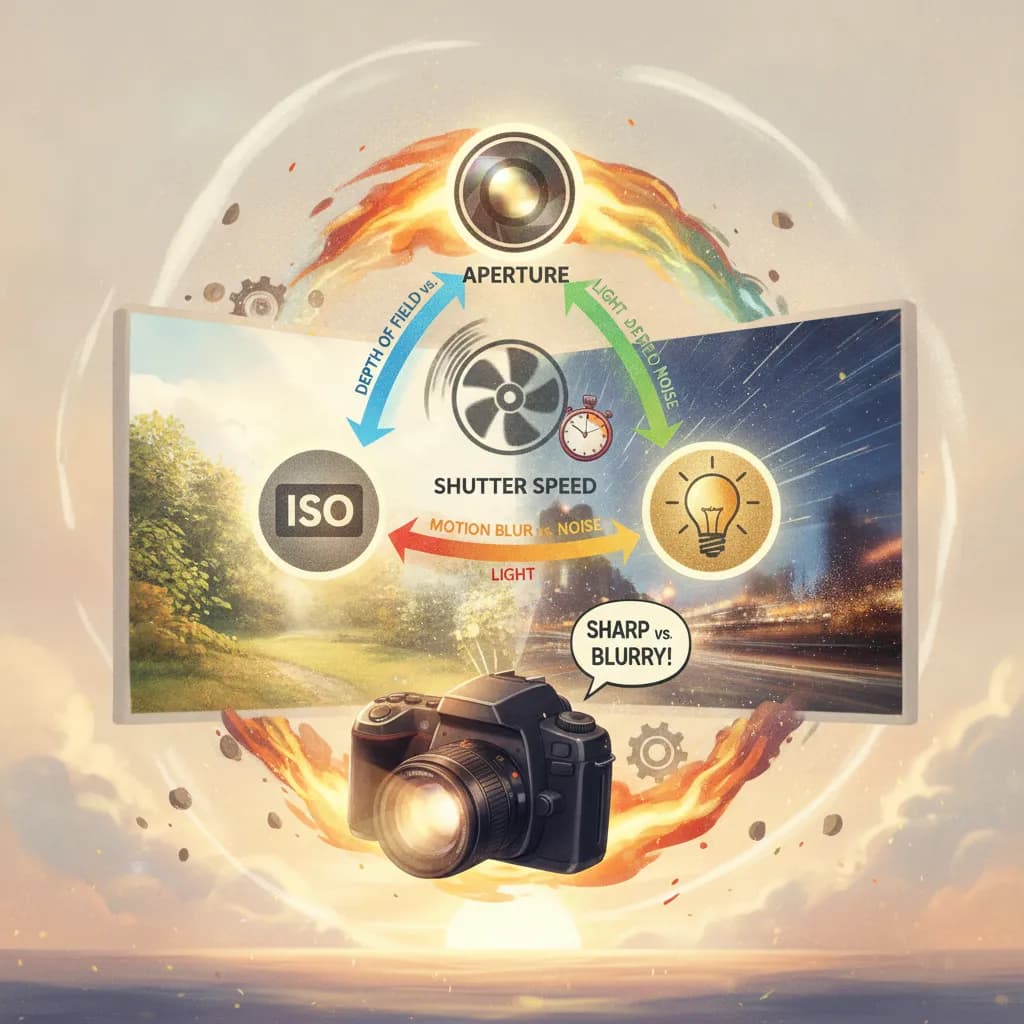
Three simple camera settings — and understanding how they trade off against each other — explain nearly everything about why one photo looks sharp and another doesn't.
Cheat Sheet
- The exposure triangle — aperture, shutter speed, and ISO — is the core set of controls that together determine how bright or dark a photo turns out.
- Aperture (how wide the lens opening is) also controls depth of field, meaning how much of the image stays in sharp focus versus blurred background.
- Shutter speed (how long the camera's sensor is exposed to light) determines whether motion appears frozen sharply or blurred.
- ISO controls the camera sensor's sensitivity to light, with higher ISO brightening dark scenes at the cost of more visual grain or noise.
- Composition techniques like the rule of thirds — placing key subjects along imaginary gridlines rather than dead center — are widely used guidelines for more visually engaging photos.
- Modern smartphone cameras use computational photography, combining multiple exposures and AI processing, to approximate effects that once required specialized equipment and manual technique.
The 60-Second Version
The exposure triangle — aperture, shutter speed, and ISO — is the core set of controls that together determine how bright or dark a photo turns out. Aperture, how wide the lens opening is, also controls depth of field, meaning how much of the image stays in sharp focus versus blurred background. Shutter speed, how long the camera's sensor is exposed to light, determines whether motion appears frozen sharply or blurred. ISO controls the camera sensor's sensitivity to light, with higher ISO brightening dark scenes at the cost of more visual grain or noise. Composition techniques like the rule of thirds, placing key subjects along imaginary gridlines rather than dead center, are widely used guidelines for more visually engaging photos. Modern smartphone cameras use computational photography, combining multiple exposures and AI processing, to approximate effects that once required specialized equipment and manual technique.
The Long Version
The Exposure Triangle
Every photograph's brightness is governed by three interacting settings: aperture, shutter speed, and ISO, collectively known as the exposure triangle. Adjusting any one of the three requires compensating with the others to maintain the same overall exposure, which is why photographers describe getting a well-exposed shot as balancing a genuine trade-off between these three settings rather than simply maximizing any one of them.
Aperture and Depth of Field
Aperture describes how wide a camera lens's opening is, measured in f-stops, controlling how much light reaches the sensor. Beyond brightness, aperture directly affects depth of field, the range of distance within an image that appears in sharp focus: a wide aperture (a low f-stop number) produces a shallow depth of field with a blurred background, commonly used for portraits, while a narrow aperture (a high f-stop number) keeps much more of the scene in focus, often used for landscapes.
Shutter Speed and Motion
Shutter speed determines how long the camera's sensor remains exposed to light for a given shot. A fast shutter speed freezes motion sharply, useful for capturing fast-moving subjects like sports, while a slow shutter speed allows motion blur to appear in the image, sometimes used deliberately for creative effects like smooth-flowing water or light trails from moving vehicles at night.
Composition Basics Worth Keeping in Mind
Beyond the technical exposure settings, composition, meaning how elements are arranged within the frame, plays a major role in how engaging a photo feels. The rule of thirds, a guideline suggesting key subjects be placed along imaginary lines dividing the frame into thirds rather than dead center, is one of the most widely taught composition principles, though experienced photographers frequently break it deliberately once they understand why it generally works.
Ad slot (placeholder — set NEXT_PUBLIC_ADSENSE_SLOT_ID once an ad unit is created)
Glossary
- Aperture
- The size of a camera lens's opening, controlling both light intake and depth of field.
- Shutter speed
- The length of time a camera's sensor is exposed to light, affecting motion blur or sharpness.
- ISO
- A camera setting controlling sensor sensitivity to light, trading brightness for added visual noise at higher settings.
- Depth of field
- The range of distance within a photo that appears in sharp focus.
- Rule of thirds
- A composition guideline suggesting key subjects be placed along a grid dividing the frame into thirds, rather than centered.
Go Deeper
- "Understanding Exposure" by Bryan Peterson
- National Geographic — Photography Tips