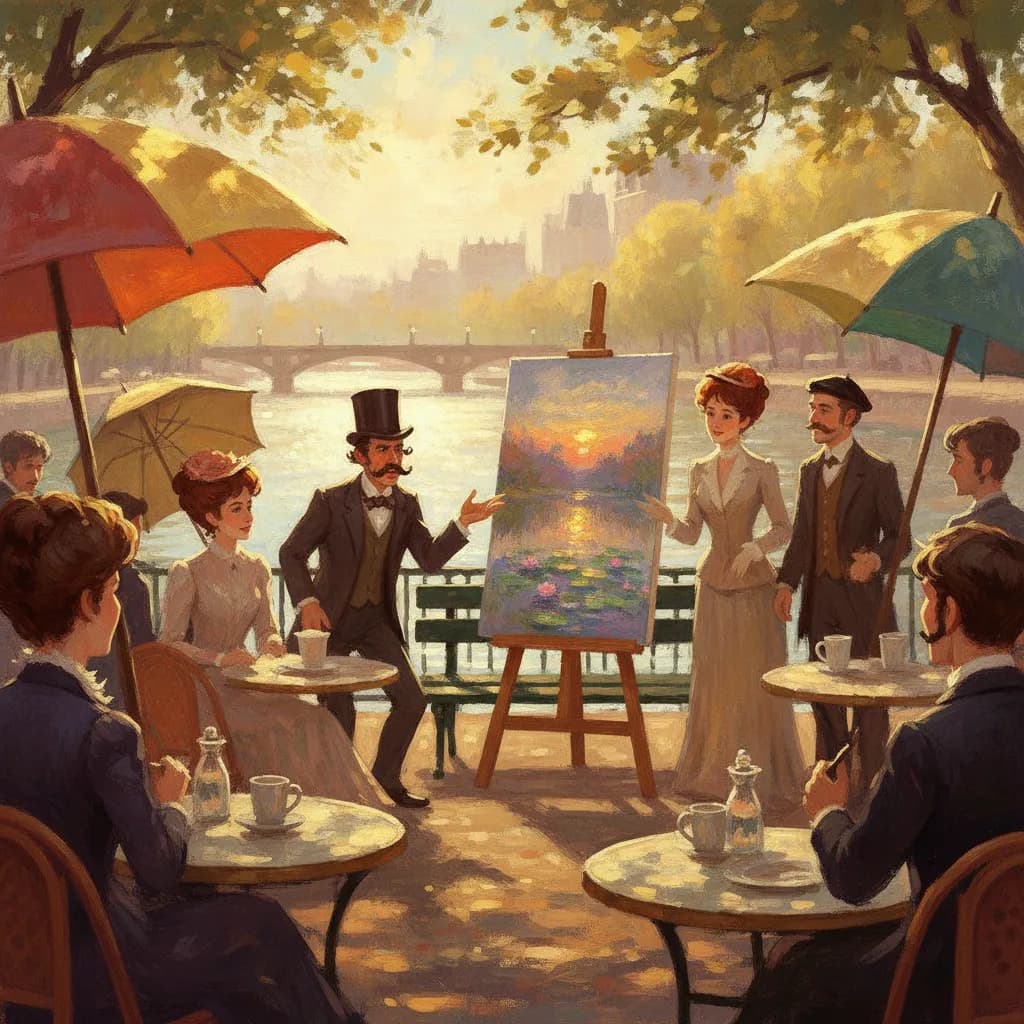
Impressionism
A style so disliked by critics at launch that its name started as an insult.
Cheat Sheet
- The name comes from a dismissive art critic mocking Monet's painting "Impression, Sunrise" — the artists adopted the insult as their label.
- Impressionists painted outdoors ("en plein air") to capture natural light directly, instead of composing idealized scenes in a studio.
- Brushwork is loose and visible rather than smoothed over — the goal was to capture a fleeting moment or feeling, not photographic precision.
- The movement was rejected by France's official art establishment (the Salon), which is exactly why the artists organized their own independent exhibitions.
- Key figures include Claude Monet, Pierre-Auguste Renoir, Edgar Degas, and Berthe Morisot.
- Impressionist paintings are now among the most reproduced and beloved artworks in the world — a complete reversal from their reception at the time.
The 60-Second Version
Impressionism emerged in France in the 1870s among a group of painters who broke from the polished, idealized style favored by the official art establishment. Instead, they painted outdoors, working quickly to capture the changing effects of natural light, using loose, visible brushstrokes rather than smooth, precise detail. The name itself comes from a critic mocking Claude Monet's painting "Impression, Sunrise" as unfinished-looking — the label stuck, and the artists eventually embraced it. Rejected by the official Salon exhibition, the group organized their own independent shows instead, a defiant move that's now seen as a turning point in modern art. Key figures include Monet, Renoir, Degas, and Morisot, and their work — once considered sloppy and unserious — is today some of the most recognized and reproduced art in the world.
The Long Version
A Technical Breakthrough
Part of what made Impressionism possible was a technical innovation as much as an artistic one: the invention of portable paint tubes in the mid-1800s, which let painters carry ready-mixed oil paint outdoors for the first time, rather than being tied to a studio grinding and mixing pigments by hand. New synthetic pigments developed around the same time also gave painters brighter, more varied, and more stable colors than earlier generations had ever had access to. Without that shift in materials, the entire practice of painting quickly outdoors, chasing changing light, wouldn't have been practically possible.
Breaking from the Salon
The group held their first independent exhibition in 1874, organized specifically because the official Salon — France's government-sanctioned art exhibition and the primary path to recognition at the time — kept rejecting their work as unfinished-looking and unserious. It was a defiant, self-funded alternative that's now seen as a founding moment of the entire modern art world, proving that artists could build an audience and a reputation by bypassing official gatekeepers entirely rather than waiting for their approval. That model — artists organizing and exhibiting independently — became a template later movements would follow again and again.
Beyond the Big Four
Beyond Monet, Renoir, Degas, and Morisot, the movement included other distinct voices worth knowing: Camille Pissarro, whose landscapes and mentorship influenced many younger painters directly, including several who would go on to define Post-Impressionism, and Mary Cassatt, one of the few Americans embraced by the largely French circle, known especially for intimate scenes of mothers and children. The group was never a tightly unified school with a fixed style — it was more a loose association of artists who exhibited together and shared a general interest in light, everyday subject matter, and looser brushwork than academic tradition allowed.
What Came After
By the late 1880s, a new generation — Van Gogh, Cézanne, and Seurat among them — pushed further past Impressionism's focus on capturing a fleeting visual impression, toward more structured, symbolic, or emotionally expressive styles, a shift art historians group under the umbrella term "Post-Impressionism." That lineage directly set up the more radical break of early 20th-century movements like Cubism and Expressionism, which is a large part of why Impressionism is so often taught as the true starting point of modern art, rather than simply one style among many in a long tradition.
Ad slot (placeholder — set NEXT_PUBLIC_ADSENSE_SLOT_ID once an ad unit is created)
Glossary
- En plein air
- Painting outdoors, directly from the observed scene, rather than in a studio.
- Salon
- The official, government-sanctioned French art exhibition that initially rejected Impressionist work.