Biomes
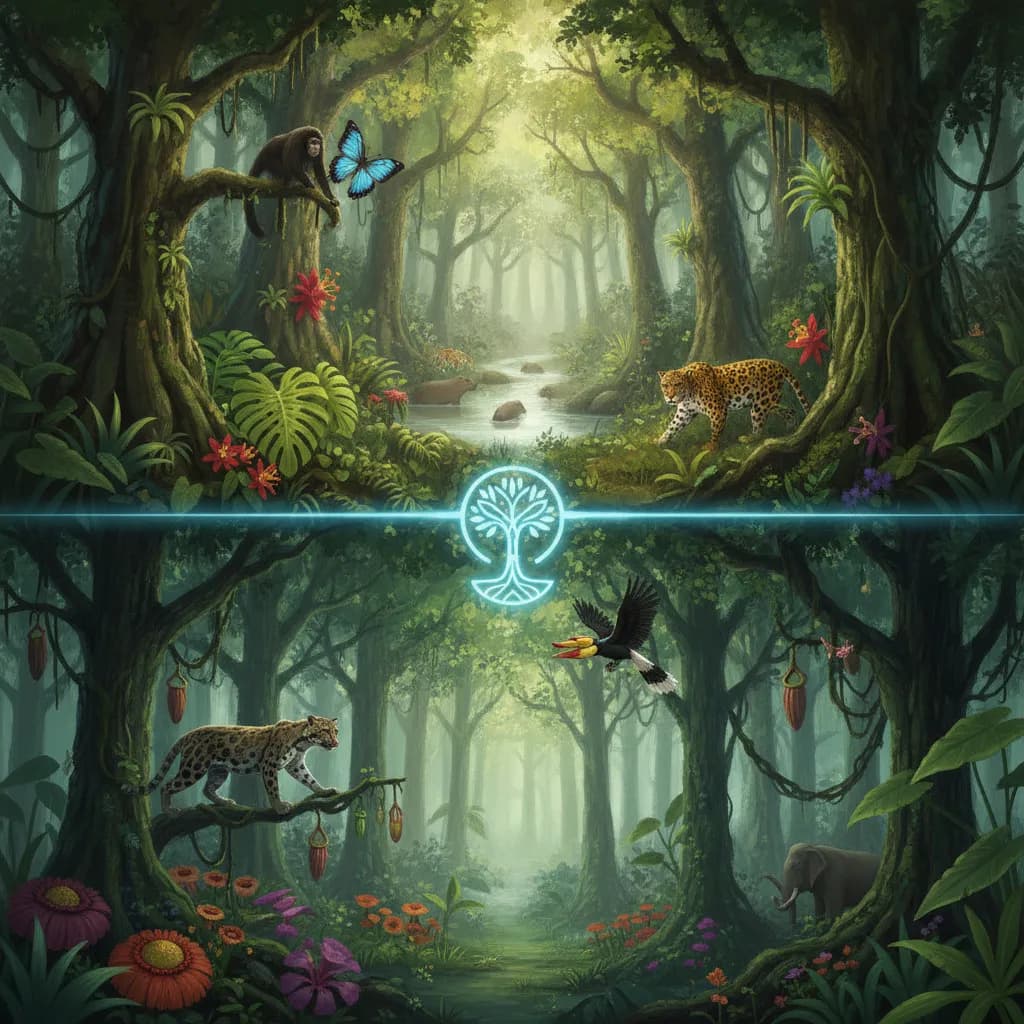
A rainforest in Brazil and a rainforest in Southeast Asia can share almost no species in common, yet ecologists still classify them as the same biome.
Cheat Sheet
- A biome is a large-scale ecological community defined primarily by climate, vegetation, and adapted animal life, spanning multiple countries or continents.
- Major terrestrial biomes include tropical rainforest, desert, grassland/savanna, temperate forest, taiga (boreal forest), and tundra.
- Biomes are distinct from ecosystems: a biome is a broad category (e.g. 'desert'), while an ecosystem is a specific local community of organisms and environment.
- Latitude and elevation both strongly influence biome type, which is why tropical rainforests cluster near the equator and tundra appears near the poles or at high altitude.
- Aquatic biomes, including freshwater and marine environments, are classified separately from terrestrial (land-based) biomes.
- Climate change is actively shifting some biome boundaries, with documented cases of forests transitioning toward grassland or desert conditions in vulnerable regions.
The 60-Second Version
A biome is a large-scale ecological classification defined primarily by climate, dominant vegetation, and the kinds of animal life adapted to survive there, spanning across multiple countries or even continents rather than describing any single specific location. Major terrestrial biomes include tropical rainforests, deserts, grasslands, temperate forests, cold-climate taiga, and treeless tundra, each shaped heavily by a combination of latitude and elevation, which is why comparable biomes tend to cluster in predictable bands around the globe. It's worth distinguishing a biome from the more specific concept of an ecosystem, since an ecosystem describes a particular local community of organisms and their immediate environment, while a biome is the much broader category that many individual ecosystems can fall under. Aquatic environments, including freshwater lakes and rivers as well as ocean systems, get classified as their own separate category of biomes entirely, distinct from land-based classifications. More recently, scientists have begun documenting actual biome shifts driven by climate change, with some historically forested regions showing measurable movement toward grassland or even desert-like conditions as temperature and rainfall patterns change.
The Long Version
Defining a Biome
A biome is a large-scale ecological classification defined by climate, dominant vegetation type, and the animal life adapted to survive within it, describing broad categories that recur across multiple, often widely separated regions of the globe rather than any single specific place.
The Major Land-Based Categories
The main terrestrial biomes include tropical rainforests, deserts, grasslands and savannas, temperate forests, cold-climate taiga (also called boreal forest), and treeless tundra, with latitude and elevation both playing a major role in determining which biome type appears where, which is why similar biomes tend to form recognizable, predictable bands circling the globe.
Biome vs. Ecosystem
It's worth keeping the concept distinct from an ecosystem, a much more localized term describing a specific community of interacting organisms and their immediate physical environment, since a single biome, like "desert," can actually contain many genuinely different specific ecosystems within it depending on local conditions.
Water Gets Its Own Category, and the Map Is Shifting
Aquatic environments, spanning both freshwater systems like lakes and rivers and full marine ocean systems, are classified as an entirely separate category of biomes distinct from land-based ones. More recently, scientists have begun documenting genuine biome shifts driven by climate change, with some historically forested regions showing measurable transitions toward grassland or even desert-like conditions as regional temperature and rainfall patterns continue changing.
Ad slot (placeholder — set NEXT_PUBLIC_ADSENSE_SLOT_ID once an ad unit is created)
Why People Care
Understanding biomes provides a useful large-scale framework for making sense of the planet's ecological diversity, and tracking how climate change is actively shifting biome boundaries offers one of the clearest, most visible signs of environmental change happening at a genuinely global scale.
Glossary
- Biome
- A large-scale ecological region defined by climate, vegetation, and adapted animal life, spanning across multiple geographic areas.
- Ecosystem
- A specific local community of interacting organisms and their physical environment, a smaller-scale concept than a biome.
- Taiga
- A cold-climate biome dominated by coniferous forest, also known as boreal forest, found across northern regions of North America, Europe, and Asia.
- Tundra
- A treeless biome with extremely cold temperatures and permanently frozen subsoil, found near the poles or at high elevation.
- Biome shift
- A change in a region's dominant biome type, increasingly documented as a consequence of climate change.
Go Deeper
More to Explore
- Climate Zones
Some regions have already measurably shifted from one officially classified climate zone into another — a tangible, trackable sign of how much the climate has actually moved.
- Time Zones
A single imaginary line in the middle of the Pacific Ocean is the only reason two neighboring places can be experiencing entirely different calendar days at the exact same moment.
- Map Projections
The world map hanging in most classrooms makes Greenland look roughly the same size as Africa — in reality, Africa is about 14 times larger.
- Continents & Oceans
A basic geography question, "how many oceans are there?", that doesn't actually have one single universally agreed-upon answer.
- India
More people vote in a single Indian general election than live in nearly every other country on Earth combined.