Continents & Oceans
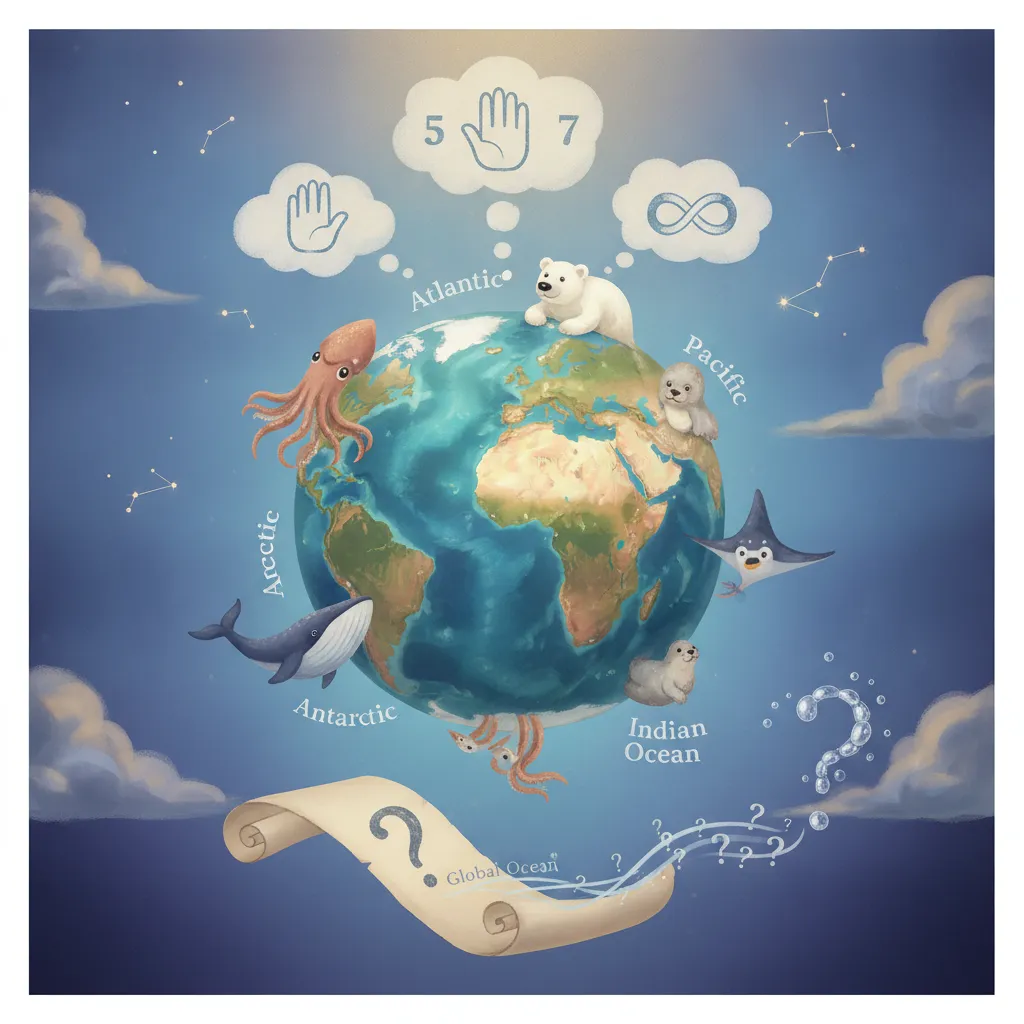
A basic geography question, "how many oceans are there?", that doesn't actually have one single universally agreed-upon answer.
Cheat Sheet
- Earth is typically divided into seven continents (Africa, Antarctica, Asia, Australia, Europe, North America, South America) and five oceans (Pacific, Atlantic, Indian, Southern, Arctic).
- The exact number of continents is actually a matter of convention rather than strict scientific definition — some models combine Europe and Asia into a single "Eurasia," for example.
- The Pacific Ocean is by far the largest of the five oceans, covering more surface area than all of Earth's land combined.
- The Southern Ocean, encircling Antarctica, was only formally recognized as a distinct fifth ocean by some major geographic authorities in relatively recent years, reflecting how ocean boundary definitions can still shift.
- Continents sit atop tectonic plates, and their current positions and shapes are the result of hundreds of millions of years of slow plate movement, not a fixed, unchanging arrangement.
- Ocean and continent boundaries aren't just abstract geography — they significantly shape global climate patterns, trade routes, and the historical spread of human populations and cultures.
The 60-Second Version
Earth is typically divided into seven continents, Africa, Antarctica, Asia, Australia, Europe, North America, and South America, and five oceans, Pacific, Atlantic, Indian, Southern, and Arctic. The exact number of continents is actually a matter of convention rather than strict scientific definition, some models combine Europe and Asia into a single "Eurasia," for example. The Pacific Ocean is by far the largest of the five oceans, covering more surface area than all of Earth's land combined. The Southern Ocean, encircling Antarctica, was only formally recognized as a distinct fifth ocean by some major geographic authorities in relatively recent years, reflecting how ocean boundary definitions can still shift. Continents sit atop tectonic plates, and their current positions and shapes are the result of hundreds of millions of years of slow plate movement, not a fixed, unchanging arrangement. Ocean and continent boundaries aren't just abstract geography — they significantly shape global climate patterns, trade routes, and the historical spread of human populations and cultures.
The Long Version
Seven Continents, By Convention Rather Than Strict Science
While most commonly taught as seven distinct continents, the actual number is really a matter of geographic and cultural convention rather than a strict, universally agreed scientific definition. Some classification systems combine Europe and Asia into a single landmass called Eurasia, since the two aren't separated by ocean the way other continents are, illustrating that "continent" is a somewhat flexible, human-defined category rather than a hard scientific boundary.
An Ocean So Big It Dwarfs All Land Combined
Among Earth's oceans, the Pacific stands out dramatically in scale, covering more total surface area than all of the planet's land combined, a scale that's genuinely difficult to fully appreciate on a standard flat map projection, which often distorts the relative size of oceans and continents.
A Fifth Ocean, Only Recently Widely Recognized
The Southern Ocean, encircling Antarctica, wasn't formally recognized as a distinct fifth ocean by some major geographic authorities until relatively recently, illustrating that even fundamental geographic categories like ocean boundaries can still shift somewhat as scientific and institutional consensus evolves.
Continents Aren't Fixed in Place
The continents' current positions and shapes reflect hundreds of millions of years of slow tectonic plate movement, meaning today's map is really just a single snapshot in an ongoing, extremely slow process of continental drift, with continents having occupied dramatically different configurations, including a single joined supercontinent, at earlier points in Earth's deep history.
Ad slot (placeholder — set NEXT_PUBLIC_ADSENSE_SLOT_ID once an ad unit is created)
Glossary
- Eurasia
- An alternative geographic model combining Europe and Asia into a single continent, used in some but not all classification systems.
- Pacific Ocean
- Earth's largest ocean, covering more surface area than all of the planet's land combined.
- Southern Ocean
- The ocean encircling Antarctica, formally recognized as a distinct fifth ocean by some major geographic authorities relatively recently.
- Tectonic plate
- A large section of Earth's outer shell whose slow movement over millions of years shapes the position of continents.
- Continental shelf
- The underwater edge of a continent, extending from the coastline before dropping off into deeper ocean.