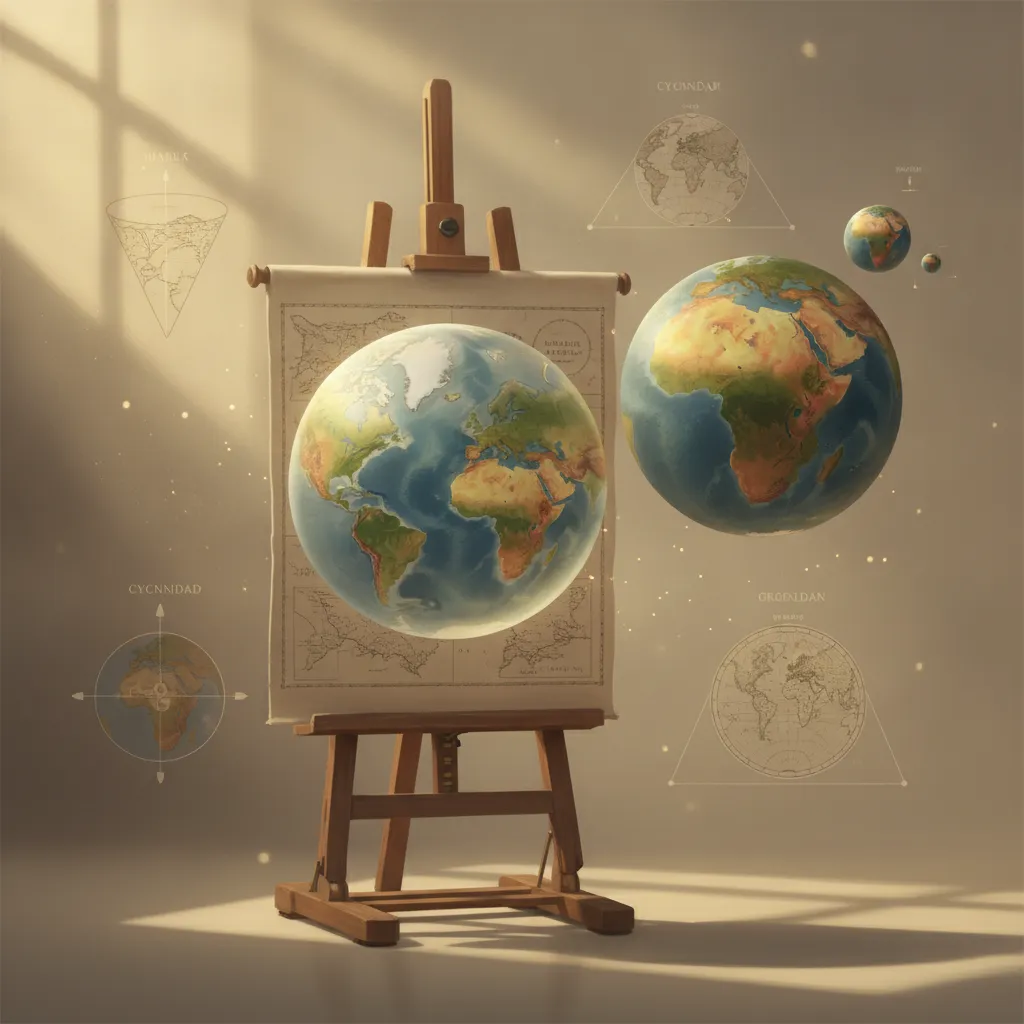
Map Projections
The world map hanging in most classrooms makes Greenland look roughly the same size as Africa — in reality, Africa is about 14 times larger.
Cheat Sheet
- A map projection is a mathematical method for representing the Earth's curved, three-dimensional surface on a flat, two-dimensional map, a process that unavoidably introduces some distortion.
- The Mercator projection, one of the most widely recognized world maps, significantly distorts the relative size of landmasses near the poles, making countries like Greenland appear far larger relative to Africa than they actually are.
- Different map projections prioritize preserving different properties — some preserve accurate shape, others preserve accurate area, and none can perfectly preserve both simultaneously.
- The Mercator projection was originally designed in the 16th century specifically for maritime navigation, where preserving accurate compass bearings mattered more than preserving accurate relative land area.
- Alternative projections, such as the Gall-Peters projection, were specifically designed to preserve accurate relative land area, at the cost of somewhat distorting shape.
- No single "perfect" map projection exists, since representing a sphere's surface on a flat plane always requires some kind of mathematical trade-off between distortions in shape, area, distance, or direction.
The 60-Second Version
A map projection is a mathematical method for representing the Earth's curved, three-dimensional surface on a flat, two-dimensional map, a process that unavoidably introduces some distortion. The Mercator projection, one of the most widely recognized world maps, significantly distorts the relative size of landmasses near the poles, making countries like Greenland appear far larger relative to Africa than they actually are. Different map projections prioritize preserving different properties, some preserve accurate shape, others preserve accurate area, and none can perfectly preserve both simultaneously. The Mercator projection was originally designed in the 16th century specifically for maritime navigation, where preserving accurate compass bearings mattered more than preserving accurate relative land area. Alternative projections, such as the Gall-Peters projection, were specifically designed to preserve accurate relative land area, at the cost of somewhat distorting shape. No single "perfect" map projection exists, since representing a sphere's surface on a flat plane always requires some kind of mathematical trade-off between distortions in shape, area, distance, or direction.
The Long Version
Why Flattening a Sphere Always Distorts Something
Representing the Earth's genuinely curved, three-dimensional surface on a flat, two-dimensional map is mathematically impossible to do without introducing some form of distortion, comparable to trying to flatten an orange peel without stretching or tearing it. Every map projection therefore involves a deliberate trade-off, choosing which specific properties, shape, area, distance, or direction, to preserve accurately at the expense of others.
The Mercator Projection's Famous Distortion
The Mercator projection, among the most widely recognized world map styles, preserves accurate compass direction and local shape reasonably well but significantly distorts the relative size of landmasses, particularly near the poles, causing regions like Greenland or Russia to appear dramatically larger relative to equatorial regions like Africa than their true relative size.
Designed for Sailors, Not Classrooms
The Mercator projection was originally developed in the 16th century specifically to aid maritime navigation, since it allowed sailors to plot a straight compass bearing line directly onto the map, an extremely useful navigational property at the time that came with the specific trade-off of significantly distorting relative land area, a trade-off that made far more sense for its original nautical purpose than for general-purpose world maps.
Alternatives That Prioritize Different Properties
Recognizing the Mercator projection's area distortion, alternative projections like the Gall-Peters projection were specifically designed to preserve accurate relative land area between regions, though this comes at the cost of somewhat distorting the shape of individual landmasses, illustrating that no projection can fully solve the fundamental problem, only choose which specific trade-off best suits its intended purpose.
Ad slot (placeholder — set NEXT_PUBLIC_ADSENSE_SLOT_ID once an ad unit is created)
Glossary
- Map projection
- A mathematical method for representing the Earth's curved surface on a flat, two-dimensional map.
- Mercator projection
- A widely used map projection, originally designed for navigation, that significantly distorts relative land area near the poles.
- Gall-Peters projection
- An alternative map projection designed to preserve accurate relative land area, at the cost of distorting shape.
- Distortion
- The unavoidable inaccuracy introduced when representing a curved surface on a flat map.
- Equal-area projection
- A map projection category that preserves accurate relative land area, as opposed to accurate shape or direction.