IndyCar Racing
IndyCar is the only major motorsport series that asks its drivers to master three completely different kinds of track, sometimes within the same season.
By Greg Goodwin · Published October 3, 2026 · Updated October 24, 2026
Cheat Sheet
- IndyCar's modern era traces back to a 1979 split (CART) and a later 1990s-2000s open-wheel 'split era' before the series reunified in 2008.
- The Indianapolis 500, IndyCar's marquee event, has run annually since 1911 (with wartime interruptions) and is often called 'the greatest spectacle in racing.'
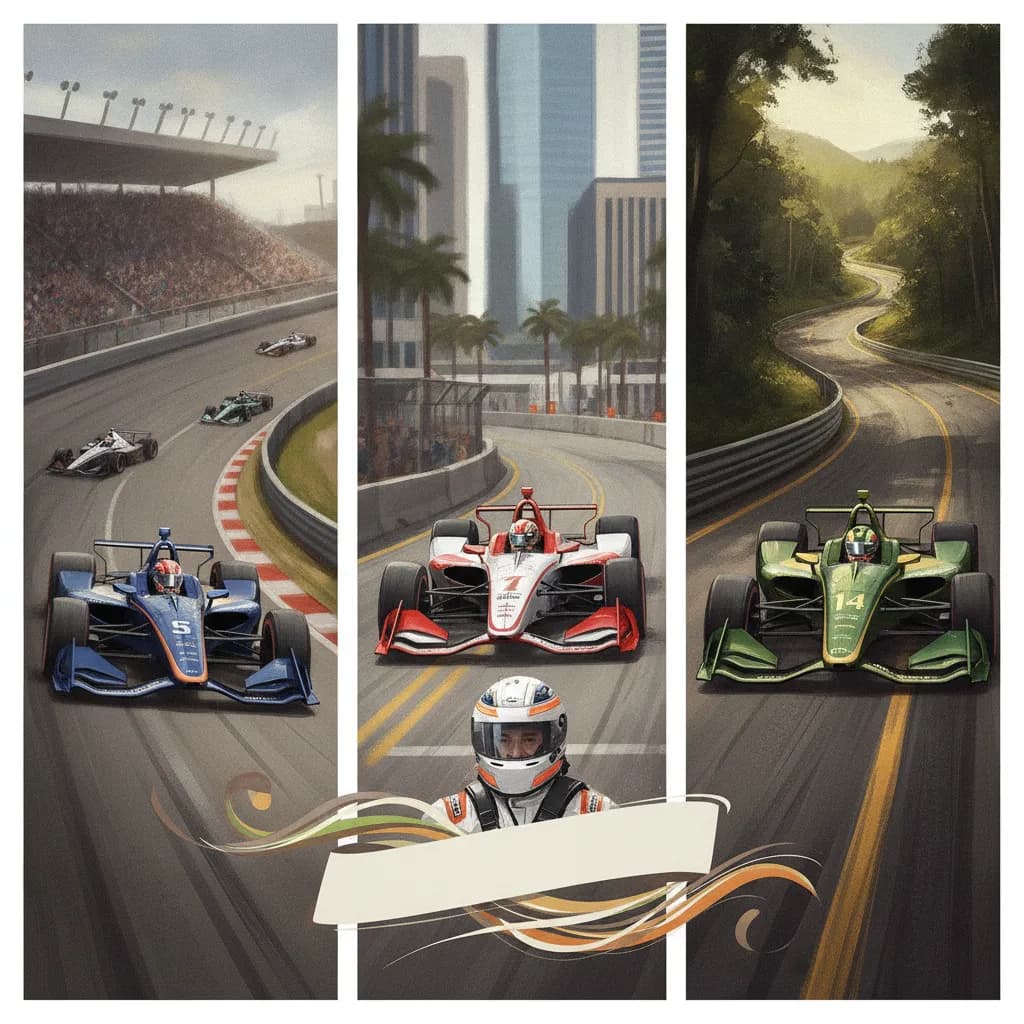
- IndyCar races on three distinct track types in a single season: high-speed ovals, permanent road courses, and temporary street circuits.
- Cars reach speeds exceeding 230 mph on superspeedways like Indianapolis, among the fastest in any motorsport discipline.
- Unlike Formula 1's constructor-driven technical diversity, IndyCar uses a spec chassis (Dallara) shared by all teams, concentrating competition on setup, strategy, and driving.
- IndyCar has historically featured a notably international and gender-diverse driver lineup, including multiple female drivers competing at the Indianapolis 500.
The 60-Second Version
IndyCar's modern identity traces back through a complicated split history, beginning with a 1979 breakaway that created a rival sanctioning body and continuing through a prolonged open-wheel "split era" in the 1990s and 2000s before the series finally reunified in 2008. Its centerpiece event, the Indianapolis 500, has run annually since 1911, interrupted only by the world wars, and has earned a reputation as "the greatest spectacle in racing" through sheer tradition and longevity. What genuinely sets IndyCar apart from other major open-wheel series is its track variety, since a single season asks drivers to compete on high-speed ovals, permanent road courses, and temporary street circuits, each demanding meaningfully different skills and car setups. On the fastest ovals, cars exceed 230 mph, placing IndyCar among the quickest motorsport disciplines anywhere. Unlike Formula 1, where competing manufacturers build distinct chassis, IndyCar uses a single spec chassis shared by every team, which shifts the competitive emphasis toward setup, strategy, and raw driving skill rather than engineering budget. The series has also built a notably international and gender-diverse grid over the decades, including multiple female drivers who have competed in the historically male-dominated Indianapolis 500.
The Long Version
A Complicated Split History
IndyCar's modern identity traces back through a genuinely complicated split history, beginning with a 1979 breakaway that created a rival sanctioning body called CART, and continuing through a prolonged open-wheel "split era" throughout the 1990s and 2000s that divided fan attention and sponsorship before the competing series finally reunified under one banner in 2008.
The Greatest Spectacle in Racing
IndyCar's centerpiece event, the Indianapolis 500, has run annually since 1911, interrupted only by the two world wars, and has earned its enduring reputation as "the greatest spectacle in racing" through more than a century of sustained tradition, making it one of the oldest continuously run motorsport events in the world.
Three Track Types, One Season
What genuinely distinguishes IndyCar from other major open-wheel series is its track variety, since a single season asks drivers to compete across high-speed ovals, permanent road courses, and temporary street circuits laid out on closed public roads, each demanding meaningfully different car setups and driving techniques within the same championship.
Spec Cars, Not Constructor Rivalries
Unlike Formula 1, where competing manufacturers design and build structurally distinct chassis, IndyCar uses a single spec chassis built by Dallara and shared by every team on the grid, a structural choice that shifts competitive emphasis away from engineering budgets and toward setup, race strategy, and raw driving skill. The series has also built a notably international and gender-diverse driver lineup over the decades, including multiple female drivers who have competed in the historically male-dominated Indianapolis 500.
Why People Care
IndyCar's combination of century-old tradition, genuine track variety, and a more level competitive playing field than many motorsport series gives it a distinct identity among open-wheel racing fans, and understanding its history explains why the Indianapolis 500 still carries such outsized cultural weight.
Glossary
- Indianapolis 500
- IndyCar's marquee annual race, held at Indianapolis Motor Speedway since 1911, widely nicknamed 'the greatest spectacle in racing.'
- Spec chassis
- A standardized car chassis used by every team in a series, as IndyCar uses, shifting competitive focus away from constructor technology.
- Superspeedway
- A high-speed oval track, like Indianapolis, where IndyCars reach their highest recorded speeds.
- CART
- Championship Auto Racing Teams, a rival open-wheel series that split from IndyCar's sanctioning body in 1979, contributing to a long open-wheel 'split era.'
- Street circuit
- A temporary racing circuit laid out on closed public roads, one of the three track types IndyCar races on each season.
Go Deeper
More to Explore
- Drag Racing
Top Fuel dragsters cover a quarter-mile in under four seconds at over 330 mph, among the fastest-accelerating vehicles ever built.
- Rally Racing
In rally racing, a co-driver reads pace notes aloud and the driver trusts them at full speed through turns, jumps, and hazards.
- NASCAR
A sport whose roots trace back to Prohibition-era bootleggers modifying their cars to outrun the police, then racing each other for fun.
- MotoGP
Riders lean their bikes into corners at angles that would tip most vehicles over instantly, at speeds exceeding 220 miles per hour.
- Formula 1
Cars so aerodynamically extreme that, in theory, they could drive upside down through a tunnel at high enough speed.