Drag Racing
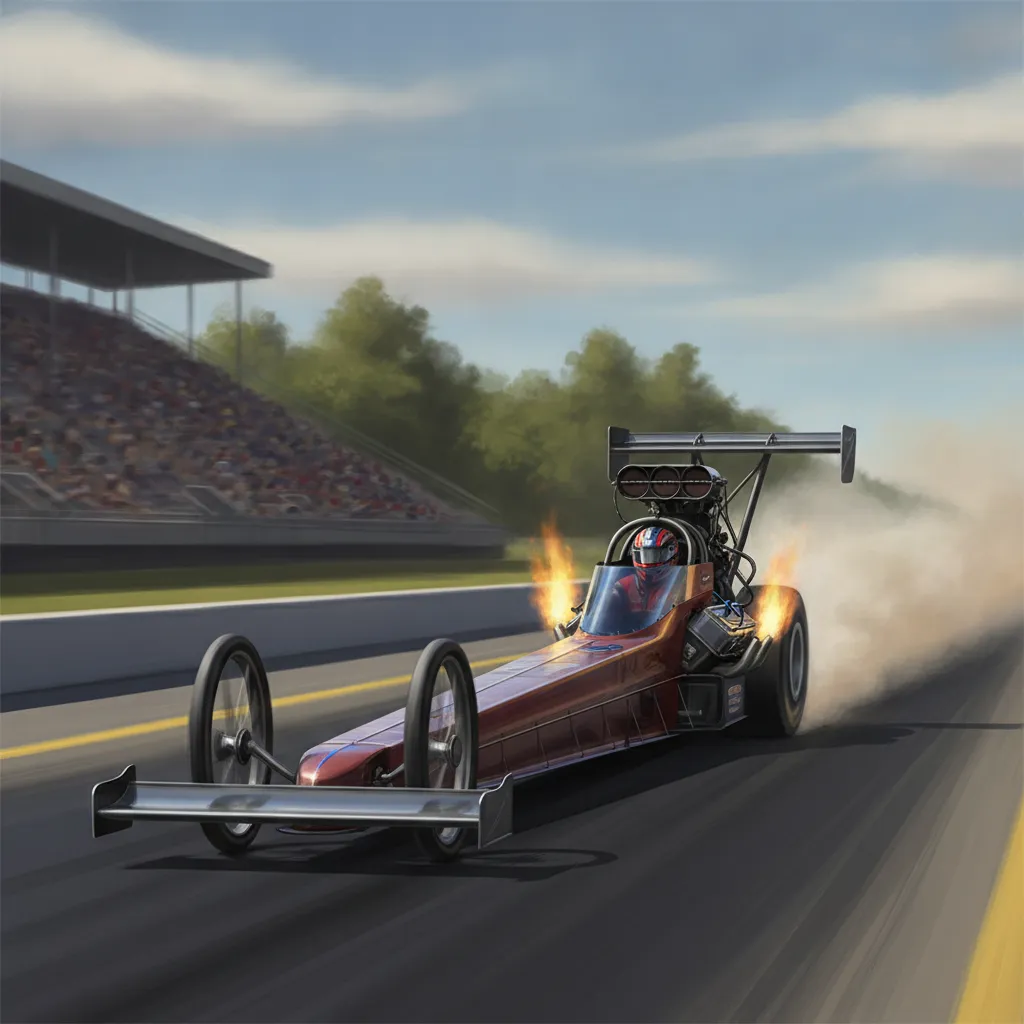
Top Fuel dragsters cover a quarter-mile in under four seconds at over 330 mph, among the fastest-accelerating vehicles ever built.
By Greg Goodwin · Published October 3, 2026 · Updated October 24, 2026
Cheat Sheet
- Drag racing pits two vehicles in a straight-line sprint, typically over a quarter-mile (1,320 feet), decided purely by elapsed time.
- Top Fuel dragsters, the sport's fastest class, can cover the quarter-mile in under 4 seconds at speeds exceeding 330 mph.
- A 'Christmas tree' starting light system (a column of staged lights counting down) replaced human flag-starters in the 1960s for more precise, fair starts.
- 'Reaction time,' how quickly a driver launches after the green light, can decide a race even when one car is objectively slower over the full distance.
- The National Hot Rod Association (NHRA), founded in 1951, became the sport's dominant governing body in the United States.
- Drag racing's roots trace to informal, illegal street racing in 1930s-1950s America, with organized/sanctioned tracks emerging partly to move the activity off public roads.
The 60-Second Version
Drag racing strips motorsport competition down to its most basic form: two vehicles, a straight line, and a race decided purely by elapsed time over a set distance, typically a quarter-mile. At the extreme end of the sport, Top Fuel dragsters complete that quarter-mile in under four seconds at speeds exceeding 330 mph, numbers that place them among the fastest-accelerating vehicles ever built for any purpose. Getting that start exactly right matters enormously, which is why organized drag racing replaced human flag-starters in the 1960s with a "Christmas tree," a column of staged lights that counts down to the green signal with far more precision and fairness than a person waving a flag ever could. That precision start created an entirely new skill to master: reaction time, or how quickly a driver actually launches once the light turns green, which can decide a race outright even when one car is objectively capable of greater speed over the full distance. The sport's organized, sanctioned form owes much of its structure to the National Hot Rod Association, founded in 1951, which became the dominant governing body in the United States and helped move a once-informal, often illegal pastime off public streets and onto dedicated, safer tracks.
The Long Version
Racing Stripped to Its Essentials
Drag racing strips motorsport competition down to its most basic form: two vehicles, a straight line, and a race decided purely by elapsed time over a set distance, typically a quarter-mile, a format that trades the complexity of cornering and strategy for a pure test of acceleration and reaction.
Faster Than a Fighter Jet Off the Line
At the extreme end of the sport, Top Fuel dragsters complete that quarter-mile in under four seconds at speeds exceeding 330 mph, numbers that place them among the fastest-accelerating vehicles ever built for any purpose, genuinely outpacing a fighter jet's acceleration off a runway.
A Light System Built for Fairness
Getting the start exactly right matters enormously in a sport measured in thousandths of a second, which is why organized drag racing replaced human flag-starters in the 1960s with a "Christmas tree," a column of staged lights that counts down to the green signal with far more precision and fairness than a person waving a flag ever could manage.
The Skill of Reacting Fast
That precision start created an entirely new skill central to the sport: reaction time, or how quickly a driver actually launches once the light turns green, which can decide a race outright even when one car is objectively capable of greater speed over the full distance, making split-second reflexes just as important as raw horsepower.
From Illegal Streets to Sanctioned Tracks
The sport's organized, sanctioned form owes much of its modern structure to the National Hot Rod Association, founded in 1951, which became the dominant governing body for drag racing in the United States and helped move what had largely been an informal, often illegal street pastime in 1930s-1950s America off public roads and onto dedicated, purpose-built tracks.
Why People Care
Drag racing's pure, stripped-down format makes it one of the most immediately understandable motorsports to watch, and its emphasis on raw acceleration and split-second reaction time offers a genuinely different kind of racing drama than the cornering and strategy that define most other motorsport disciplines.
Glossary
- Quarter-mile
- The standard drag racing distance (1,320 feet) used to time and compare runs across most classes.
- Top Fuel
- Drag racing's fastest class, featuring dragsters capable of covering the quarter-mile in under 4 seconds.
- Christmas tree
- The column of staged starting lights used in drag racing to signal a precise, fair race start.
- Reaction time
- The time between the starting signal and a driver launching their car, which can determine a race outcome independent of raw speed.
- NHRA
- The National Hot Rod Association, founded in 1951, the dominant sanctioning body for organized drag racing in the United States.
Go Deeper
More to Explore
- IndyCar Racing
IndyCar is the only major motorsport series that asks its drivers to master three completely different kinds of track, sometimes within the same season.
- Rally Racing
In rally racing, a co-driver reads pace notes aloud and the driver trusts them at full speed through turns, jumps, and hazards.
- NASCAR
A sport whose roots trace back to Prohibition-era bootleggers modifying their cars to outrun the police, then racing each other for fun.
- MotoGP
Riders lean their bikes into corners at angles that would tip most vehicles over instantly, at speeds exceeding 220 miles per hour.
- Formula 1
Cars so aerodynamically extreme that, in theory, they could drive upside down through a tunnel at high enough speed.