Food Webs
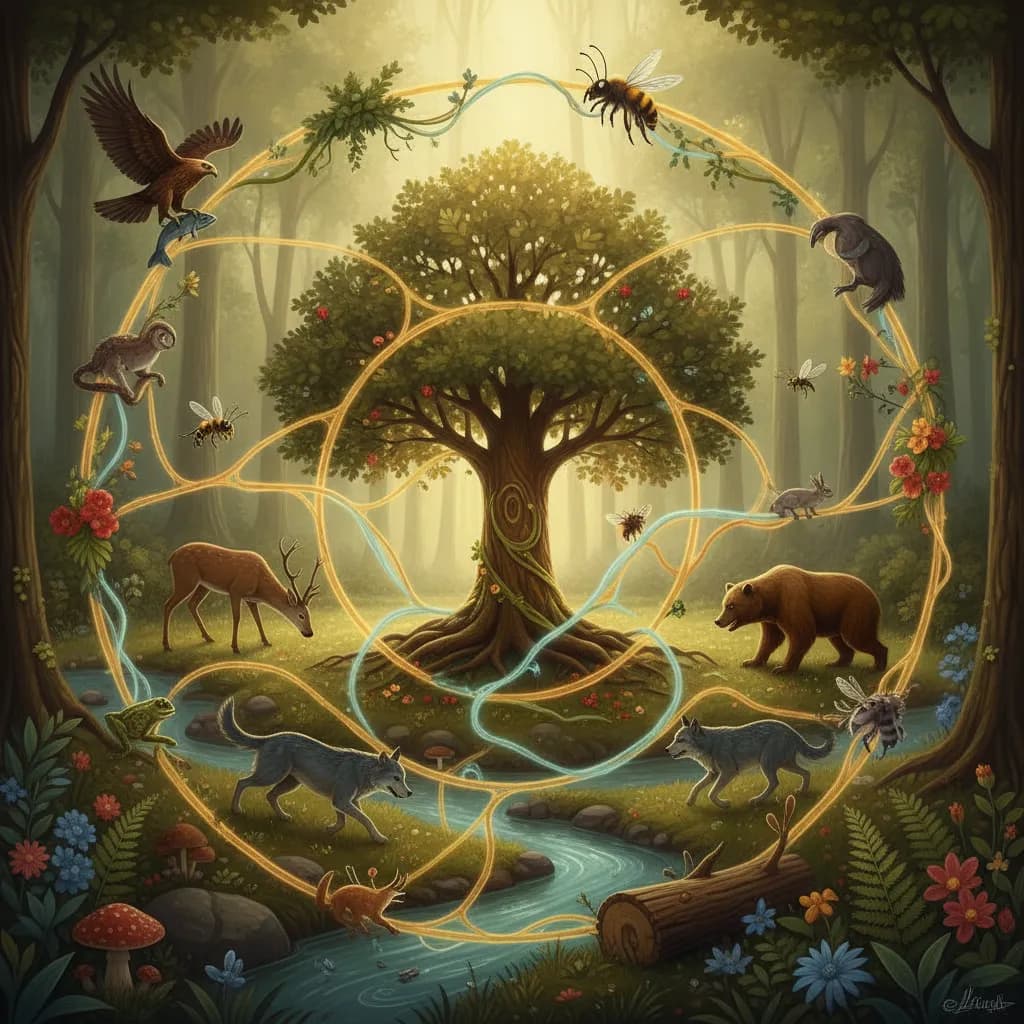
Nobody in nature eats just one thing, which makes the dinner table of an ecosystem look a lot more like a tangled web than a tidy line.
By Greg Goodwin · Published October 17, 2026 · Updated October 24, 2026
Cheat Sheet
- Food chain vs web: a chain is one line of who-eats-whom; a web is many overlapping chains in a community (Britannica).
- Levels: producers, then primary, secondary and tertiary consumers, with detritivores and decomposers recycling nutrients.
- Lindeman: a paper in the journal Ecology (1942), built on Cedar Bog Lake in Minnesota, credited with the idea that roughly 10% of energy passes up each level.
- Paine's experiment: after sea stars were removed at Mukkaw Bay, Washington, 15 species in the pools fell to 8 within three years.
- Naming: Paine proposed the keystone species concept in 1969, using the sea star Pisaster ochraceus and the mussel Mytilus californianus.
- Yellowstone: wolves were released in 1995 and 1996; NPS reports northern-range elk density fell from 12-17 per square kilometer in the late 1980s and early 1990s to 3-5 in 2006-2011.
The 60-Second Version
A food web is a map of who eats whom in an ecosystem. A simple food chain traces a single path, such as grass to rabbit to fox, but real animals eat several things and get eaten by several others, so the chains overlap into a web. At the base are producers, such as plants and algae, which capture energy from sunlight. Herbivores eat them, carnivores eat the herbivores, and decomposers like fungi and bacteria break down whatever dies and return nutrients to the soil or water. Energy does not recycle; most of it is lost as heat at each step, which is why top predators are relatively rare. Because everything is connected, removing or adding one species can send effects rippling through the whole community, sometimes far beyond what you would guess. That is why ecologists care so much about the shape of the web.
The Long Version
From Chains to Webs
Britannica defines a food web as a complex network of interconnecting and overlapping food chains showing feeding relationships within a community. Where a food chain follows matter and energy along one route, a web shows how the routes intertwine. In a temperate forest, for example, an oak tree is eaten by beetles, mice and squirrels, which in turn are eaten by hawks, frogs and raccoons, and those may be eaten by foxes, wolves or bears, while vultures, crows, fungi and bacteria clean up the leftovers. Marine webs follow the same logic, with microscopic phytoplankton at the base and sharks, tuna and marlin near the top. Ecologists group species into trophic levels, counting up from the producers.
Why Energy Runs Out
Energy is lost as it moves up a web. Raymond Lindeman, whose 1942 paper in the journal Ecology drew on his work at Cedar Bog Lake in Minnesota and was published after his early death, is credited with formalizing the idea that only about 10 percent of energy passes from one trophic level to the next. Later researchers stress that the figure is a rule of thumb, and real transfer efficiencies vary a lot between ecosystems. The practical consequence holds anyway: each step up supports far less living material than the one below, which is why a landscape can sustain many mice but only a handful of hawks.
The Starfish That Held It Together
The most famous experiment in the field is Robert Paine's work on the rocky shore at Mukkaw Bay, Washington. Paine removed the predatory sea star Pisaster ochraceus from tide pools and watched what happened. Within three years the 15 species originally present had declined to eight, and after 10 years mussels had taken over as a monoculture. In 1969 he proposed the keystone species concept, using the sea star and the mussel Mytilus californianus as a primary example. A keystone species is one whose influence on a community is far larger than its abundance would suggest. Later studies found that even this classic relationship matters only some of the time, a reminder that webs behave differently in different places.
Wolves in Yellowstone
Wolves were reintroduced to Yellowstone National Park in 1995 and 1996, and the park became the best-known case of a possible trophic cascade. The National Park Service reports that elk density on the northern range dropped from about 12 to 17 per square kilometer in the late 1980s and early 1990s to about 3 to 5 in 2006 to 2011. The popular version of the story adds that vegetation rebounded as a result. The NPS says most researchers agree wolves contributed to fewer elk and changes in elk behavior, but scientists still debate how big the vegetation effect was, since hunting outside the park, other predators and climate also play roles.
Why Webs Matter Now
Food webs are a way of seeing risk. Removing a top predator, overfishing a key prey species or introducing an invader can reshape a web in ways that no one species list would predict. Conservation planners, fisheries managers and farmers all use web thinking to anticipate side effects before they happen. The lesson running through Paine, Lindeman and Yellowstone is the same: you cannot pull on one thread without feeling the rest of the web move.
Why People Care
Food webs explain why losing one species, whether a sea star, a wolf or a fish, can change a whole ecosystem. They are the logic behind conservation, fisheries limits and invasive-species rules, and they make nature's interdependence concrete.
Glossary
- Trophic level
- An organism's step in the feeding sequence, counted from producers upward.
- Producer
- An organism, such as a plant or phytoplankton, that makes its own food from sunlight or chemicals.
- Keystone species
- A species with an outsized effect on its community relative to its numbers.
- Decomposer
- An organism such as a fungus or bacterium that breaks down dead matter and returns nutrients to the soil or water.
- Trophic cascade
- A ripple effect in which changes at one feeding level alter the levels below it.
Go Deeper
More to Explore
- Coral Reefs
Cities built by animals the size of a pencil eraser, now living on the edge of a thermometer.
- The Extinction of the Dinosaurs
One bad rock, one very bad day, and the Age of Dinosaurs got an abrupt ending, with a few feathery survivors.
- Probability
Probability is the math of things you cannot be sure about, which is nearly everything, including whether you will need an umbrella.
- Octopuses and Cephalopods
Eight arms, three hearts, blue blood, and a skin that doubles as a mood ring and a disguise kit.
- Neanderthals
Our stocky, toolmaking cousins who ran the cold half of the Ice Age and still show up in your DNA.