Coral Reefs
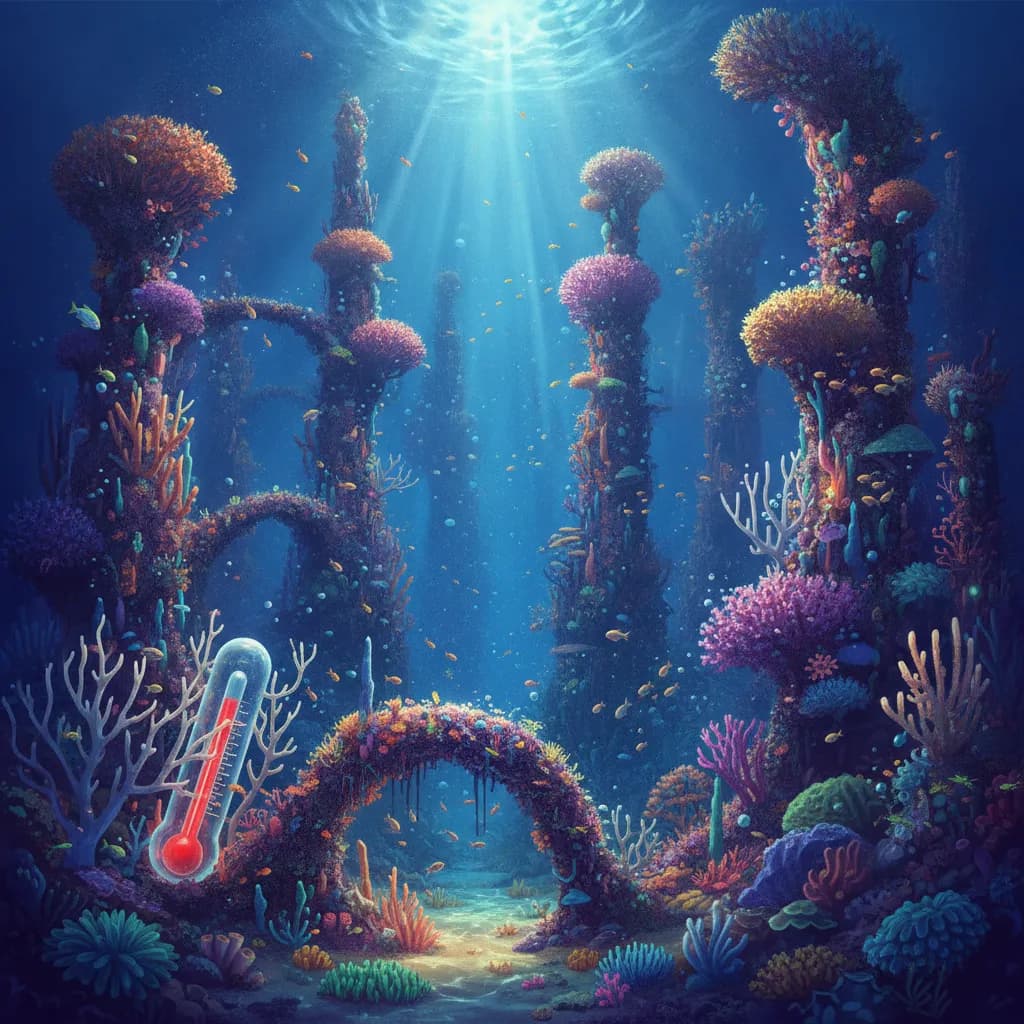
Cities built by animals the size of a pencil eraser, now living on the edge of a thermometer.
By Greg Goodwin · Published October 24, 2026
Cheat Sheet
- Earlier global bleaching events hit 21 percent of reef area in 1998, 37 percent in 2010, and 68.2 percent in 2014 to 2017.
- NOAA confirmed the fourth global bleaching event on April 15, 2024, and said it likely ended in mid-2025.
- The 84.4 percent figure covers 1 January 2023 to 30 September 2025 and was documented in at least 83 countries and territories.
- NOAA's bleaching alert level starts at 1 degree Celsius above a reef's usual summer maximum.
- NOAA warns that even conservative estimates see mass bleaching on most reefs yearly by 2050.
- The Great Barrier Reef stretches roughly 2,300 kilometers along Australia's northeast coast.
The 60-Second Version
Coral reefs are underwater structures built by tiny animals called coral polyps, which secrete limestone skeletons and live in partnership with microscopic algae that supply food and color. Reefs cover less than 1 percent of the ocean floor, according to NOAA, yet are often said to shelter about a quarter of marine species, a rough figure that scientists note is hard to pin down. They buffer coastlines from waves, support fisheries, and draw tourists. They are also sensitive to heat. When water stays too warm, corals expel their algae and turn white in a process called bleaching. Bleached corals can recover if temperatures fall, but may starve and die if the stress lasts. NOAA reports that the fourth global bleaching event, which began in 2023, exposed about 84 percent of the world's reef area to bleaching-level heat stress, the most extensive on record.
The Long Version
Animals That Build Landscapes
A coral reef is the accumulated work of countless polyps, small animals related to jellyfish and sea anemones. Reef-building corals pull calcium and carbonate from seawater to grow hard skeletons, and as colonies grow, die, and are built upon, the structures expand over centuries. The result can be spectacular: the Great Barrier Reef stretches roughly 2,300 kilometers along the northeast coast of Australia. Other reefs form fringes along coastlines, barriers offshore, or atolls, rings of coral around lagoons. Not all corals build reefs, and some live in cold, dark water, but the famous ones grow in shallow, warm, clear water.
The Partnership Under the Skin
Reef-building corals depend on a bargain with algae called zooxanthellae that live inside their tissue. The algae photosynthesize and share sugars with the coral, while the coral supplies shelter and nutrients, and the algae supply much of the color seen on a healthy reef. That arrangement explains why reefs favor sunlit shallows and why they are fragile. If heat or other stress disrupts the partnership, corals expel the algae, and the white skeleton shows through the transparent tissue. A bleached coral is not dead yet, but it is starving and vulnerable to disease.
A Crowded Neighborhood
NOAA says reefs cover less than 1 percent of the seafloor and host about a quarter of known marine species, a statistic that appears across government and museum materials. Another NOAA piece puts the area at about one-tenth of one percent, and a 2020 discussion among coral scientists traced the 25 percent figure to a rough estimate from a 1991 paper, so estimates vary depending on how a reef is defined. What is not in doubt is that reefs concentrate fish, crustaceans, mollusks, and other life, support fishing and tourism, and absorb wave energy that would otherwise batter shorelines.
Bleaching and the Fourth Global Event
NOAA Coral Reef Watch tracks ocean heat stress by satellite. The first global bleaching event, in 1998, exposed 21 percent of reef area to bleaching-level heat stress; the second, in 2010, 37 percent; and the third, from 2014 to 2017, 68.2 percent. The fourth began in 2023 and was confirmed by NOAA on April 15, 2024. By NOAA's count, from 1 January 2023 to 30 September 2025, about 84.4 percent of the world's reef area experienced bleaching-level heat stress, and mass bleaching was documented in at least 83 countries and territories. NOAA experts concluded the event likely ended in mid-2025. These percentages measure area exposed to heat stress, not the share of coral that died.
Threats and Outlook
Heat is the headline threat, but reefs also face pollution, overfishing, coastal development, disease, and ocean acidification, which makes it harder for corals to build skeletons. NOAA warns that even the most conservative estimates suggest mass coral bleaching could occur annually on most reefs worldwide by 2050. Some reefs bounce back after bleaching, and restoration efforts, such as growing corals in nurseries and replanting them, are expanding, though they are small compared with the scale of the problem. The future of reefs largely depends on how quickly ocean warming slows.
Why People Care
Reefs protect coastlines, feed millions of people, and hold an outsized share of marine biodiversity. They are also an early warning system for ocean warming, so news about bleaching is really news about how the oceans are changing.
Glossary
- Polyp
- The tiny soft-bodied animal, related to jellyfish and anemones, that builds a coral's limestone skeleton.
- Zooxanthellae
- Microscopic algae living inside coral tissue that supply food through photosynthesis and give corals their color.
- Bleaching
- When stressed corals expel their algae and turn white; corals can recover if conditions improve but may starve if they do not.
- Atoll
- A ring-shaped reef that encloses a lagoon, often formed around a sunken volcanic island.
- Degree heating weeks
- A NOAA measure of accumulated heat stress, used to predict coral bleaching and death.
Go Deeper
More to Explore
- Food Webs
Nobody in nature eats just one thing, which makes the dinner table of an ecosystem look a lot more like a tangled web than a tidy line.
- The Extinction of the Dinosaurs
One bad rock, one very bad day, and the Age of Dinosaurs got an abrupt ending, with a few feathery survivors.
- Probability
Probability is the math of things you cannot be sure about, which is nearly everything, including whether you will need an umbrella.
- Octopuses and Cephalopods
Eight arms, three hearts, blue blood, and a skin that doubles as a mood ring and a disguise kit.
- Neanderthals
Our stocky, toolmaking cousins who ran the cold half of the Ice Age and still show up in your DNA.