The Extinction of the Dinosaurs
One bad rock, one very bad day, and the Age of Dinosaurs got an abrupt ending, with a few feathery survivors.
By Greg Goodwin · Published October 24, 2026
Cheat Sheet
- K-Pg stands for Cretaceous-Paleogene, the boundary older books label K-T.
- In 1980 Luis and Walter Alvarez and colleagues linked an iridium-rich clay layer to an asteroid impact.
- The crater is buried beneath the Yucatan Peninsula and takes its name from a nearby town, Chicxulub.
- A 2024 study estimated the impact released 67 plus or minus 39 gigatonnes of sulfur, about five times less than earlier models assumed.
- At Tanis in North Dakota, an ejecta-bearing bed was laid down within minutes to hours of the impact.
- More than 10,000 bird species alive today descend from dinosaurs that survived.
The 60-Second Version
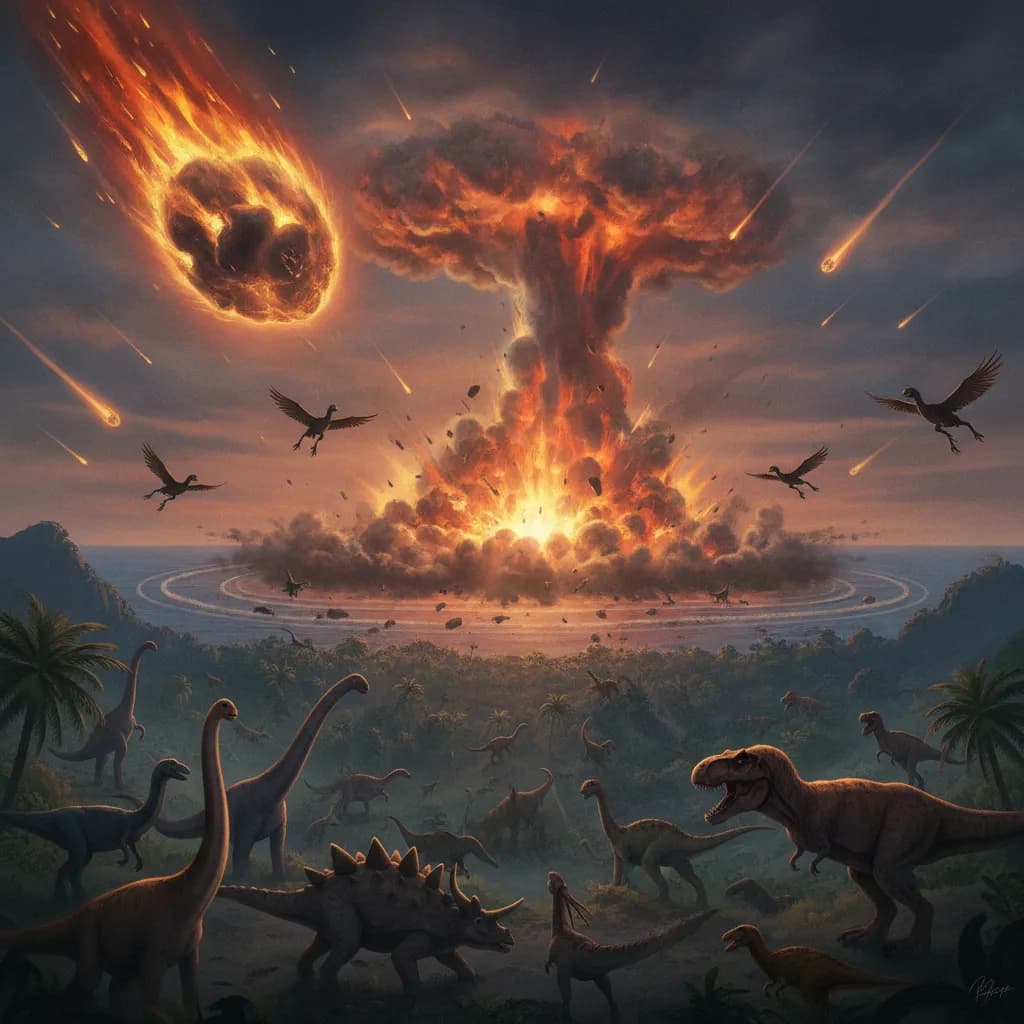
About 66 million years ago, an asteroid roughly 10 to 15 kilometers wide struck what is now Mexico's Yucatan Peninsula, leaving the Chicxulub crater, about 180 to 200 kilometers across. The impact lofted dust, soot, and sulfur gases into the atmosphere, and the leading explanation is that the resulting dimming and cooling collapsed food webs on land and in the sea. Estimates vary, but roughly 75 to 80 percent of species disappeared in what geologists call the Cretaceous-Paleogene extinction, which ended the Mesozoic Era. Every non-avian dinosaur died out, though birds, which are living dinosaurs, survived. Scientists still debate how much other forces, especially massive volcanism in India's Deccan Traps, contributed. Mammals, mostly small until then, inherited the vacated ecological space and eventually produced us.
The Long Version
The Evidence in the Rock
The modern story starts with a thin layer of clay found in rocks worldwide that mark the boundary between the Cretaceous and Paleogene periods. In 1980, a team led by physicist Luis Alvarez and his son, geologist Walter Alvarez, reported that this layer was enriched in iridium, a metal far more common in asteroids than in Earth's crust. Their proposal of a large impact was controversial until geologists identified a matching crater. Oil-exploration surveys had mapped a buried ring structure under the Yucatan decades earlier, and by the early 1990s researchers tied it to the boundary layer. Drilling into the crater's peak ring in 2016 recovered rock cores that continue to be studied.
What Happened After Impact
Britannica and recent studies describe a crater about 180 to 200 kilometers wide, formed by an asteroid roughly 10 to 15 kilometers across. The blast ejected enormous amounts of rock and vapor, and at Tanis in North Dakota, researchers have studied a deposit laid down within minutes to hours of the impact. Over the following months to years, the leading hypothesis holds that dust, soot, and sulfur aerosols blocked sunlight, shutting down photosynthesis and chilling the planet. A 2024 study estimated the sulfur released at about 67 plus or minus 39 gigatonnes, roughly five times lower than earlier models, which would suggest a milder impact winter than once thought. Details of how severe and how long the cooling lasted are still being refined.
Who Died and Who Lived
Britannica describes the loss of about 80 percent of animal species, while a 2024 paper cites about 75 percent, so estimates vary. Non-avian dinosaurs vanished, as did the flying pterosaurs, large marine reptiles such as mosasaurs and plesiosaurs, and ammonites, the coiled-shelled relatives of squid. Survivors included birds, mammals, crocodilians, turtles, and many smaller plants and animals. Being small, able to burrow or hide, or able to eat seeds, insects, or detritus rather than fresh plants likely improved the odds. Birds are the one surviving branch of dinosaurs, so strictly speaking, dinosaurs are still with us, in the form of more than 10,000 bird species.
Was It Only the Asteroid?
Most researchers consider the Chicxulub impact the primary trigger, but the question of how much else contributed remains alive. Around the same time, the Deccan Traps in India were erupting enormous volumes of lava and gas, and some scientists argue that this volcanism stressed ecosystems before or alongside the impact. A study of Gulf of Mexico marine vertebrates found evidence of two separate extinction pulses, an earlier one about 77 million years ago and the end-Maastrichtian event about 66 million years ago, suggesting declines began before the impact. Other work finds that ecosystems were still healthy up to the boundary. Estimates and interpretations vary, so the safest summary is that the impact was central and other factors may have added pressure.
What Came Next
With the dominant land animals gone, the Paleogene Period opened a vast ecological opportunity. Mammals, which had coexisted with dinosaurs for tens of millions of years as mostly small creatures, diversified into new sizes and lifestyles, from whales to bats to primates. Birds also radiated into the thousands of species seen today. The extinction is a reminder that the history of life is not a steady climb but a series of resets, and that one event can redirect everything that follows, including the eventual appearance of humans.
Why People Care
The dinosaur extinction is the best-known example of how a single event can reshape life on Earth. It also shows how science works: a strange clay layer, a buried crater, and decades of argument produced a story that still changes as new evidence arrives.
Glossary
- K-Pg boundary
- The thin geological layer marking the end of the Cretaceous Period and the start of the Paleogene, about 66 million years ago.
- Iridium
- A metal rare in Earth's crust but more common in asteroids, whose spike in the boundary clay pointed to an impact.
- Impact winter
- Global dimming and cooling after a large impact, caused by dust, soot, and sulfur gases blocking sunlight.
- Deccan Traps
- A vast volcanic region in India whose eruptions around the same time are a competing or contributing explanation for the extinction.
- Mass extinction
- A geologically brief period in which a large share of Earth's species disappear.
Go Deeper
More to Explore
- Neanderthals
Our stocky, toolmaking cousins who ran the cold half of the Ice Age and still show up in your DNA.
- Human Evolution
Your family tree turns out to be less a tree than a very crowded, very bushy shrub.
- Probability
Probability is the math of things you cannot be sure about, which is nearly everything, including whether you will need an umbrella.
- Octopuses and Cephalopods
Eight arms, three hearts, blue blood, and a skin that doubles as a mood ring and a disguise kit.
- Mitochondria
Tiny former bacteria living inside nearly every cell you own, quietly paying the electric bill.