Epigenetics
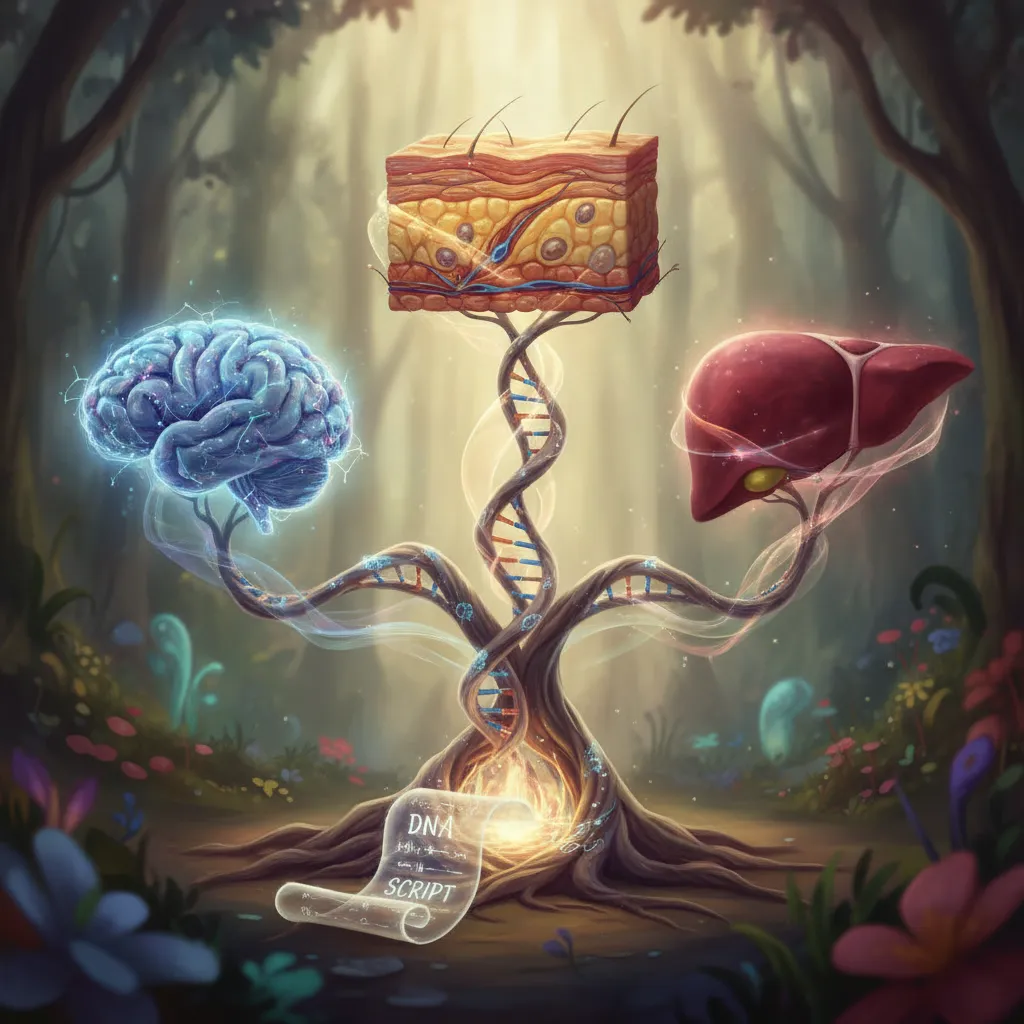
Same script, different performances: how the cells in your body read the same DNA and end up as brain, skin, or liver.
By Greg Goodwin · Published October 24, 2026
Cheat Sheet
- Etymology: embryologist Conrad Waddington introduced the term in the early 1940s.
- Core idea: chemical tags on DNA and its packaging proteins change how strongly genes are switched on or off, without altering the DNA letters.
- Main mechanisms: DNA methylation, histone modification, chromatin remodeling and non-coding RNAs such as microRNAs.
- Methylation: a methyl group is usually added to cytosine, and heavy methylation of CpG islands near a gene typically silences it.
- Natural example: in female mammals one X chromosome in each cell is largely silenced by epigenetic marks.
- Caution: whether epigenetic changes pass down generations in humans remains debated; evidence varies by mechanism.
The 60-Second Version
Almost every cell in your body carries the same DNA, yet a neuron looks and behaves nothing like a liver cell. The difference lies in which genes are active, and epigenetics is the study of how that is controlled. According to the National Human Genome Research Institute, the DNA letters and the proteins that interact with DNA can carry chemical modifications that change the degree to which genes are turned on and off, without altering the underlying sequence. Think of the genome as a cookbook and epigenetic marks as sticky notes saying which recipes to use today. These marks help cells specialize during development, can shift with age, diet, and environmental exposures, and are copied when cells divide. Epigenetics is a real and active field, but it is also heavily oversold in popular media.
The Long Version
Where the Word Came From
Conrad Waddington, a British developmental biologist, introduced the term in the early 1940s to bridge genetics and embryology: how does one fertilized egg, with one genome, build so many cell types? Over the following decades the word narrowed. Today researchers do not all use it the same way; some apply it only to heritable differences not caused by changes in DNA sequence, while others use it for any chemical modification of chromatin. That definitional looseness is worth knowing, because headlines frequently stretch the word beyond what the evidence supports.
The Molecular Toolkit
Several mechanisms are studied most. In DNA methylation, a methyl group is added to DNA, usually at cytosine, and when CpG islands near a gene are heavily methylated, transcription is typically stopped. DNA is also wound around histone proteins, and modifications such as acetylation loosen that packaging so genes can be read, while histone methylation can either boost or dampen activity depending on where it occurs. Chromatin remodeling physically repositions the packaging, and non-coding RNAs, including microRNAs, can also tune gene activity. Together these layers make up the epigenome, which differs between cell types even within one person.
Epigenetics in Everyday Biology
Epigenetic control is not exotic; it is how bodies work. Cell differentiation depends on it, which is why a skin cell does not suddenly start making insulin. X-chromosome inactivation in female mammals silences most of one X chromosome in each cell through epigenetic marks. Genomic imprinting uses methylation to switch off a gene copy depending on which parent supplied it. Methylation patterns also change with age, and researchers such as Steve Horvath have used them to build so-called epigenetic clocks that estimate biological age, a research tool rather than a medical test you should self-order.
Environment, Experience and Disease
Epigenetic patterns can shift with early-life experience, environmental exposure and nutritional status, which makes them a possible link between lifestyle and disease. Abnormal methylation is a hallmark of many cancers, and some drugs used in certain blood cancers target epigenetic machinery. One much-cited human example is the Dutch Hunger Winter of 1944 to 1945: people exposed to famine before birth later showed differences in DNA methylation and in health outcomes, though such studies cannot prove exactly how exposure leads to outcome. Correlation in these studies is common, and clean causal proof in humans is hard to obtain.
Hype, Heredity and Limits
Can parents pass epigenetic changes to children? Some marks are copied when cells divide, and in certain animals and plants there is evidence of inheritance across generations. In humans, most marks are wiped and reset during formation of eggs, sperm and the early embryo, and the extent of transgenerational inheritance remains debated; evidence varies by mechanism. Claims that positive thinking, a supplement, or a detox can reprogram your epigenome are marketing, not science. The sober version is still exciting: epigenetics explains how a fixed genome produces flexible biology, and it opens avenues for diagnosis and treatment.
Why People Care
Epigenetics is the best current answer to why genes are not destiny and why identical twins can grow apart. It also gets abused to sell wellness products, so knowing what the science does and does not show helps you spot hype.
Glossary
- Epigenome
- The full set of chemical marks on a cell's DNA and associated proteins that influence gene activity.
- DNA methylation
- Addition of a methyl group to DNA, usually at cytosine, which often reduces gene activity.
- Histone
- A protein that DNA winds around; chemical changes to histones loosen or tighten that packaging.
- Chromatin
- The combination of DNA and proteins that makes up chromosomes in the cell nucleus.
- Gene expression
- The process of reading a gene to make RNA and, usually, a protein.
Go Deeper
More to Explore
- Mitochondria
Tiny former bacteria living inside nearly every cell you own, quietly paying the electric bill.
- DNA and RNA
DNA is the master recipe book; RNA is the photocopy that actually makes it to the kitchen.
- Genetic Inheritance
Pea plants taught Gregor Mendel the basic rules of inheritance in the 1860s, decades before anyone had identified DNA as the carrier.
- Cell Biology
Your cells' power plants were probably once free-living bacteria, absorbed 1.5 to 2 billion years ago and never let go.
- Photosynthesis
Photosynthesis turns sunlight, water, and carbon dioxide into sugar, releasing the oxygen we breathe almost as an afterthought.