Cell Biology
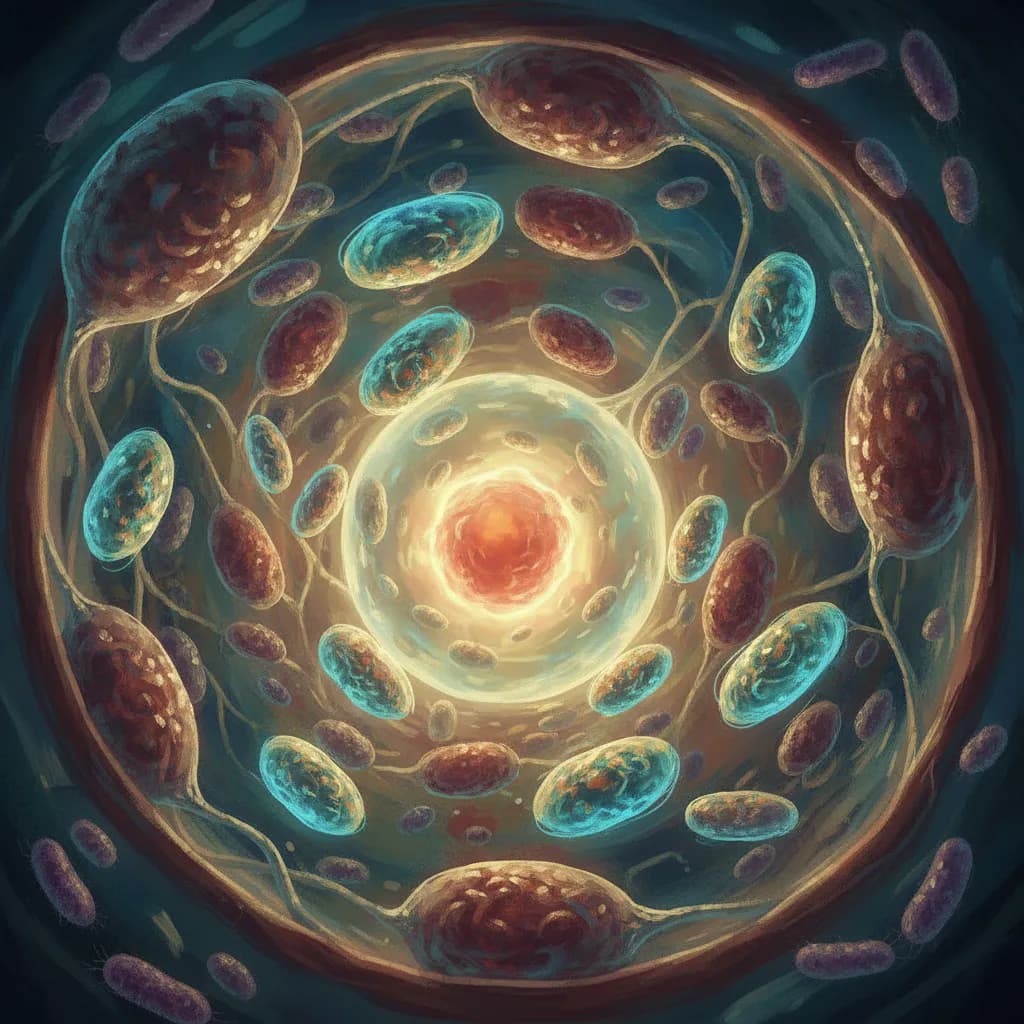
The power plants running inside nearly every cell in the human body were, roughly two billion years ago, independent bacteria that got swallowed and never let go.
Cheat Sheet
- The cell theory, formalized in the 1830s-1850s, holds that all living organisms are composed of cells, and all cells arise from pre-existing cells.
- Two broad cell categories exist: prokaryotic cells (bacteria, no nucleus) and eukaryotic cells (plants, animals, fungi — contain a nucleus).
- Mitochondria, often called the 'powerhouse of the cell,' generate the majority of a cell's usable chemical energy (ATP).
- Mitochondria and chloroplasts likely originated as free-living bacteria absorbed by early cells roughly 1.5-2 billion years ago (endosymbiotic theory).
- The human body contains an estimated 30-40 trillion cells, though estimates vary based on methodology.
- Cell division occurs through mitosis (for growth and repair) or meiosis (for producing sex cells with half the usual chromosome count).
The 60-Second Version
Cell biology rests on a foundational principle formalized in the mid-1800s, cell theory, which holds that every living organism is built from cells and that every cell traces its origin back to a pre-existing cell rather than spontaneously forming from scratch. Biologists split cells into two broad categories based on internal structure: simpler prokaryotic cells like bacteria that lack a nucleus, and more complex eukaryotic cells, found in plants, animals, and fungi, that organize their genetic material inside a dedicated nucleus alongside other specialized internal compartments. One of those compartments, the mitochondria, generates the majority of a cell's usable chemical energy and carries a genuinely strange evolutionary backstory, since a well-supported theory holds that mitochondria originated as independent, free-living bacteria that got absorbed by early host cells roughly 1.5 to 2 billion years ago and simply never left, eventually evolving into a permanent, essential internal component. Every human body is built from an almost incomprehensible number of these units, with estimates commonly landing somewhere between 30 and 40 trillion cells depending on the counting methodology used. Cells reproduce through one of two distinct division processes, mitosis for ordinary growth and tissue repair, or meiosis specifically for producing sex cells carrying half the usual chromosome count.
The Long Version
The Foundational Theory of Biology
Cell biology rests on a foundational principle formalized in the mid-1800s, cell theory, which holds that every living organism is built from cells and that every cell traces its origin back to a pre-existing cell through division, rather than spontaneously arising from non-living material, a principle that unified biology as a coherent science.
Two Fundamentally Different Cell Types
Biologists divide cells into two broad categories based on their internal organization: simpler prokaryotic cells, such as bacteria, which lack a nucleus entirely, and more structurally complex eukaryotic cells, found in plants, animals, and fungi, which organize their genetic material inside a dedicated nucleus alongside a range of other specialized internal compartments.
A Cellular Power Plant With a Strange Past
Among those internal compartments, mitochondria generate the majority of a cell's usable chemical energy and carry a genuinely remarkable evolutionary backstory, since a well-supported theory called endosymbiotic theory holds that mitochondria originated as independent, free-living bacteria absorbed by early host cells roughly 1.5 to 2 billion years ago, eventually evolving into a permanent and essential internal fixture rather than remaining a separate organism.
An Almost Incomprehensible Scale
Every human body is constructed from an almost incomprehensible number of these units, with commonly cited estimates landing somewhere between 30 and 40 trillion cells depending on the counting methodology used, all of it ultimately arising through one of two distinct division processes, mitosis, used for ordinary growth and tissue repair, and meiosis, reserved specifically for producing sex cells carrying half the usual chromosome count.
Ad slot (placeholder — set NEXT_PUBLIC_ADSENSE_SLOT_ID once an ad unit is created)
Why People Care
Cell biology underlies essentially every other area of biological and medical science, and understanding the basic structure and origin of cells, including the genuinely strange evolutionary history hiding inside mitochondria, provides the foundation for making sense of genetics, disease, and how the human body actually functions.
Glossary
- Cell theory
- The foundational biological principle that all living things are made of cells and all cells come from pre-existing cells.
- Prokaryotic cell
- A cell type, such as bacteria, that lacks a nucleus and other membrane-bound organelles.
- Eukaryotic cell
- A cell type found in plants, animals, and fungi, containing a nucleus and other specialized membrane-bound organelles.
- Endosymbiotic theory
- The theory that mitochondria and chloroplasts originated as free-living bacteria absorbed by early host cells billions of years ago.
- Mitosis
- A form of cell division that produces two genetically identical daughter cells, used for growth and tissue repair.
Go Deeper
- National Human Genome Research Institute — Cell Basics
- Molecular Biology of the Cell, by Bruce Alberts et al.
More to Explore
- Genetic Inheritance
A 19th-century monk figured out the basic rules of genetic inheritance decades before anyone had even proven that DNA existed, using nothing more sophisticated than pea plants in a monastery garden.
- Photosynthesis
Nearly every breath of oxygen ever taken traces back to a chemical reaction that microscopic bacteria figured out more than three billion years before humans existed.
- Viruses
A microscopic particle so stripped-down that scientists still debate whether it even counts as truly "alive" at all.
- The Human Genome
A complete genetic blueprint that took an international research effort over a decade and roughly $3 billion to first sequence — now doable for under $1,000.
- Evolution
A theory that doesn't claim organisms get objectively "better" over time — just that whatever happens to work in a given environment tends to stick around.