DNA and RNA
DNA is the master recipe book; RNA is the photocopy that actually makes it to the kitchen.
By Greg Goodwin · Published October 17, 2026 · Updated October 24, 2026
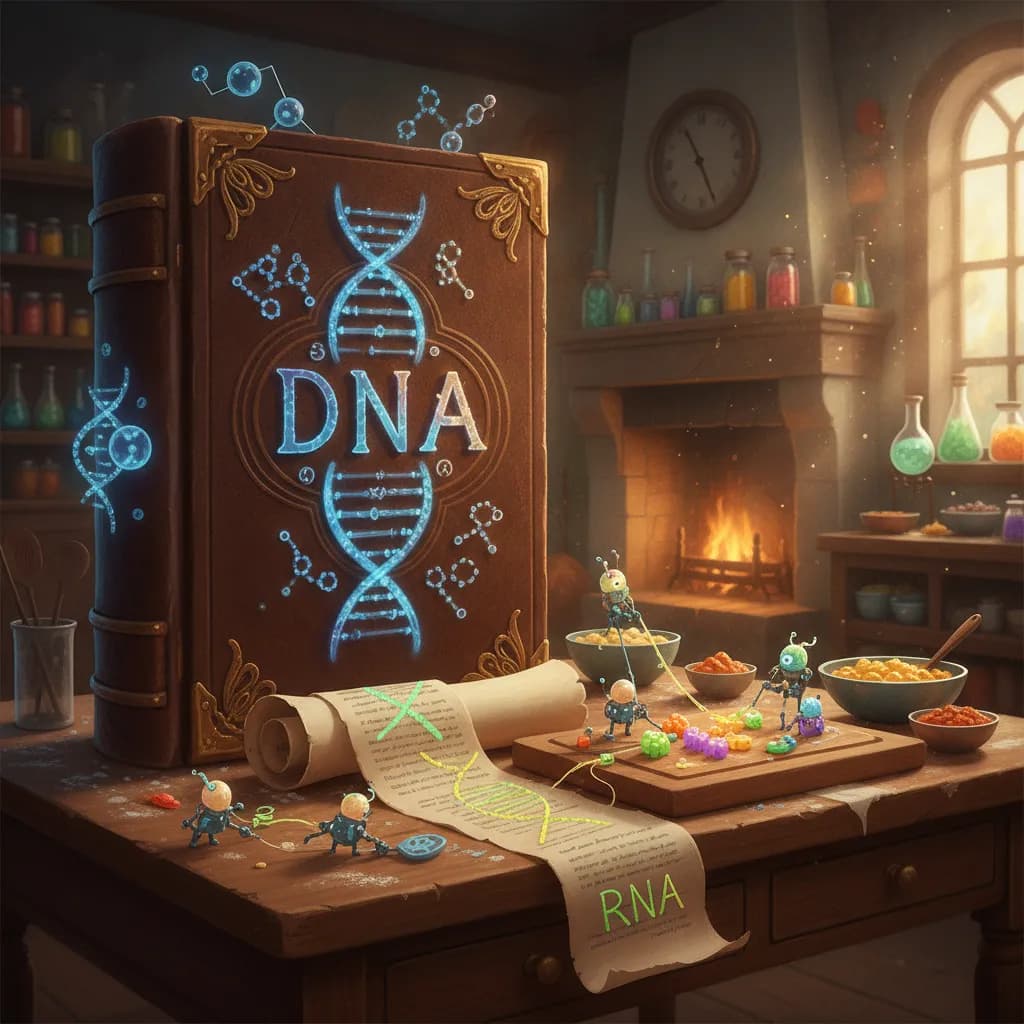
Cheat Sheet
- DNA bases: adenine, cytosine, guanine, and thymine; RNA uses uracil in place of thymine.
- Nucleotide: one base plus a sugar and a phosphate; DNA's sugar is deoxyribose, while RNA's is ribose.
- Person to person: NHGRI says DNA from any two people is 99.9% identical, and the other 0.1% holds the variations.
- Location: most DNA sits in the cell nucleus, with a small amount in mitochondria (mtDNA).
- RNA types: messenger (mRNA), ribosomal (rRNA), transfer (tRNA), plus RNAs that regulate gene expression.
- Viruses: some use RNA rather than DNA as their genetic material.
The 60-Second Version
DNA, or deoxyribonucleic acid, is the hereditary material in humans and almost all other organisms. Its information is stored as a code of four chemical bases, abbreviated A, G, C, and T, arranged along two strands that twist into a double helix, with A always pairing with T and C with G. Human DNA contains about 3 billion bases, and more than 99 percent of them are the same in every person. RNA, or ribonucleic acid, is a close relative found in all living cells. It is usually single-stranded and built on a slightly different sugar. Cells use RNA to put DNA's instructions to work: a messenger RNA copies a gene so the cell can build a protein from it. In short, DNA is the long-term archive, and RNA is the working copy and toolkit. Together they carry information from one generation to the next and run the everyday business of every cell.
The Long Version
A Twisted Ladder
DNA looks like a twisted ladder. The two sides are backbones made of alternating sugar and phosphate groups, and the rungs are pairs of bases that bond to each other: adenine with thymine, cytosine with guanine. A base, its sugar, and its phosphate together form a nucleotide, and a long chain of nucleotides makes up each strand. The order of the bases works like letters in a sentence, spelling out the information needed to build and maintain an organism. A segment that encodes the instructions for a protein or RNA molecule is called a gene.
Copying and Sharing the Code
DNA can replicate. Each strand of the double helix serves as a pattern for building a new partner strand, so when a cell divides, each daughter cell receives an exact copy. That is why nearly every cell in your body carries the same DNA. Most of it lives in the cell nucleus, but a small amount sits in the mitochondria, which convert energy from food into a form cells can use. Between individuals, the code is remarkably similar. The National Human Genome Research Institute puts the overlap at 99.9 percent, and the remaining 0.1 percent, combined with environment and experience, helps shape health and traits.
RNA, the Working Copy
RNA differs from DNA in three key ways. It is most often single-stranded, its sugar is ribose rather than deoxyribose, and it uses the base uracil in place of thymine. Cells make several kinds. Messenger RNA is the transcribed form of a gene, the version that gets read. Ribosomal RNA and transfer RNA are involved in building proteins, with transfer RNA carrying amino acids to where they are needed. Other RNAs help regulate gene expression. The process of copying DNA into RNA is called transcription, and some viruses even use RNA as their genome instead of DNA.
The Double-Helix Discovery
The double-helix structure was proposed in 1953 by James Watson and Francis Crick, building on X-ray diffraction work by Rosalind Franklin and Raymond Gosling. In 1962, the Nobel Prize in Physiology or Medicine was awarded jointly to Crick, Watson, and Maurice Wilkins for their discoveries concerning the molecular structure of nucleic acids and its significance for information transfer in living material. Franklin had died in 1958, and Nobel Prizes are not awarded posthumously. The exact publication date of the famous paper is sometimes given differently in popular accounts, but the year 1953 is not in dispute.
Why the Basics Matter
Most of what people hear about genetics, from ancestry tests to inherited conditions, rests on these two molecules. Changes in the DNA sequence can alter how a gene works, and that is the starting point for many genetic conditions. Understanding the DNA-to-RNA-to-protein flow is the first step to making sense of such headlines. This page is general education, not medical advice, and questions about personal genetic health are best taken to a clinician or genetic counselor.
Why People Care
DNA and RNA are the common thread of all life, tying together heredity, evolution, disease, and medicine. Whether the topic is a genetic test, a virus, or a news story about gene research, these two molecules are the vocabulary you need to follow along.
Glossary
- Nucleotide
- The building block of DNA and RNA: a base, a sugar, and a phosphate.
- Base pair
- Two bases joined across the double helix: A with T, and C with G, in DNA.
- Gene
- A stretch of DNA whose base sequence carries the instructions for making a protein or an RNA molecule.
- Transcription
- The process of copying a gene's DNA sequence into RNA.
- Messenger RNA (mRNA)
- The transcribed form of a gene, the version the cell reads when building a protein.
Go Deeper
More to Explore
- Mitochondria
Tiny former bacteria living inside nearly every cell you own, quietly paying the electric bill.
- Epigenetics
Same script, different performances: how the cells in your body read the same DNA and end up as brain, skin, or liver.
- Genetic Inheritance
Pea plants taught Gregor Mendel the basic rules of inheritance in the 1860s, decades before anyone had identified DNA as the carrier.
- Cell Biology
Your cells' power plants were probably once free-living bacteria, absorbed 1.5 to 2 billion years ago and never let go.
- Photosynthesis
Photosynthesis turns sunlight, water, and carbon dioxide into sugar, releasing the oxygen we breathe almost as an afterthought.