Zoroastrianism
One of the world's oldest living faiths turns daily life into a choice between truth and the lie, with a sacred fire watching.
By Greg Goodwin · Published October 17, 2026 · Updated October 24, 2026
Cheat Sheet
- Scripture: the Avesta, which at the end of the Sasanian era was about four times larger than the portion that survives.
- Gathas: hymns in Old Avestan, the only texts that scholars attribute to Zarathushtra himself, embedded in the liturgy called the Yasna.
- Evil spirit: Angra Mainyu, the Destructive Spirit, called Ahriman in later Pahlavi books.
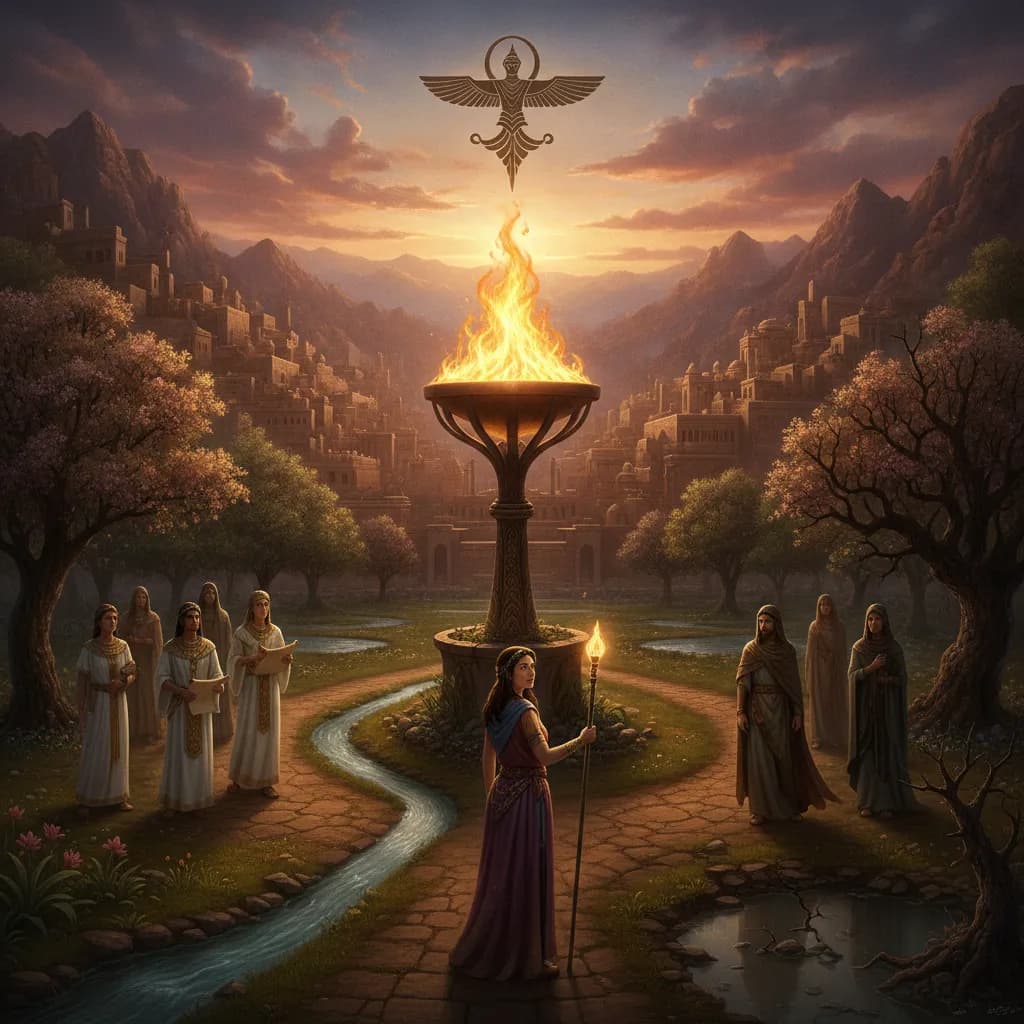
- Fire temples: priests tend a sacred fire; a well-known one is the Fire Temple of Yazd in Iran.
- Later texts: the Bundahishn describes creation, and the Denkart (9th century) is a summary of the religion written in Pahlavi.
- Numbers in India: the census counted 111,791 Parsis (Zoroastrians) in 1951 and 57,264 in 2011.
The 60-Second Version
Zoroastrianism is an ancient religion of Iran, traditionally founded by the prophet Zarathushtra, also called Zoroaster. He taught devotion to a single wise god, Ahura Mazda, and a moral struggle in which every person chooses between asha, truth and right order, and druj, falsehood. When he lived is genuinely uncertain: Britannica notes that later Avestan texts give about 628 to 551 BCE, while other scholars argue for sometime in the second millennium BCE. The hymns attributed to him, the Gathas, sit inside the Avesta, the faith's scripture. The religion flourished under the Sasanian dynasty, which ruled from 224 to 651 CE, and declined after the Islamic conquest of Iran. Some communities survived in Iran, and from the 10th century others settled in India, where they are called Parsis. Today Zoroastrians form a small community whose influence on later religious ideas is still debated.
The Long Version
Zarathushtra and the Dating Problem
Zarathushtra is the figure at the heart of the tradition, yet little can be said about him with certainty. Britannica describes him as an Iranian religious reformer who probably lived in eastern Iran and who flourished, perhaps, in the second millennium BCE; the traditional dates of 628 to 551 BCE come from later texts, and scholars disagree about which to trust. It is also unclear how much of the religion came from his visions and how much from the older tribal religion he inherited, or how closely the later Sasanian religion reflects his teaching. One clue to its roots is the contrast between asha and druj, which Britannica says goes back at least to Indo-Iranian times, since the Vedas of India know a related pairing.
Beliefs: One God, Two Spirits
At the center is Ahura Mazda, the Wise Lord. In the Gathas, a Bounteous Spirit and a Destructive Spirit, called Angra Mainyu, made opposite choices: one became a partisan of asha, the other of druj. Every human is invited to choose the side of truth through good thoughts, words, and deeds, and Britannica adds that the faithful can commune with the wise god. Scholars describe the result as a mix of monotheism and moral dualism. Later developments complicated it: in the Videvdat the two spirits appear as rival creators, and a school called Zurvanism, widespread in Sasanian times, made Time the father of both. After Christian missionaries criticized their dualism, Parsis in India emphasized the monotheistic side of the faith.
Scripture
The Avesta is a collection of texts compiled in stages and completed under the Sasanians, when it was about four times larger than what survives. Its main parts include the Yasna, the liturgy that holds the Gathas; the Yashts, hymns to 21 deities such as Mithra and Anahita; and the Videvdat, a law book. Later books in the Pahlavi language include the Bundahishn, a cosmology, and the Denkart, or Acts of the Religion, written in the 9th century as the faith faced Islamic rule.
Empire and Decline
Under the Sasanian dynasty, founded by Ardashir, Zoroastrianism had a priestly hierarchy and royal backing. A priest named Karter left inscriptions boasting that he persecuted Jews, Buddhists, Christians, and others, and the prophet Mani died in prison under Bahram I (273 to 276). After the Arab victory at al-Qadisiyyah in 635 over the last Sasanian king, Yazdegerd III, many people converted, willingly or under pressure. Britannica says exactly how the decline happened is not known. Zoroastrians survived in Iran as a minority in small enclaves around Yazd and Kerman.
Parsis and Today
From the 10th century, Zoroastrian groups emigrated to Gujarat in India. Under British rule the Parsis, formerly humble agriculturists, prospered in commerce and industry and became a leading community in Bombay (Mumbai). Contact with Iran, broken for centuries, was restored in 1477. The community is small and shrinking: India's census recorded 111,791 Parsis and Zoroastrians in 1951 and 57,264 in 2011. Global totals are uncertain because estimates vary by source and method.
Why People Care
Zoroastrianism is one of the oldest continuously practiced faiths and a key to understanding ancient Persia. Its ideas of a good-versus-evil struggle, a final reckoning, and angelic beings are often discussed as possible influences on later religions, though scholars debate how much.
Glossary
- Ahura Mazda
- The Wise Lord, the supreme god of Zoroastrianism.
- Asha
- Truth, order, and righteousness, set against druj, falsehood or the Lie.
- Gathas
- The hymns in Old Avestan that are attributed to Zarathushtra himself.
- Parsis
- Descendants of Zoroastrians who emigrated from Iran to India, many of them centered in Mumbai.
- Zurvanism
- A branch of belief that made Zurvan, or Time, the father of the good and destructive spirits.
Go Deeper
More to Explore
- Taoism
One of Taoism's central ideas sounds almost like a contradiction: that the most effective way to act is often to not force anything at all.
- Sikhism
Walk into a Sikh gurdwara anywhere in the world and you can eat a free meal, whatever your religion or background.
- Judaism
Older than both Christianity and Islam, Judaism is among the oldest continuously practiced monotheistic religions on Earth.
- Islam
The country with the largest Muslim population in the world isn't in the Middle East at all — it's Indonesia, in Southeast Asia.
- Hinduism
A major world religion with well over a billion followers today, and no single founder, no single holy book, and no single fixed moment of origin.