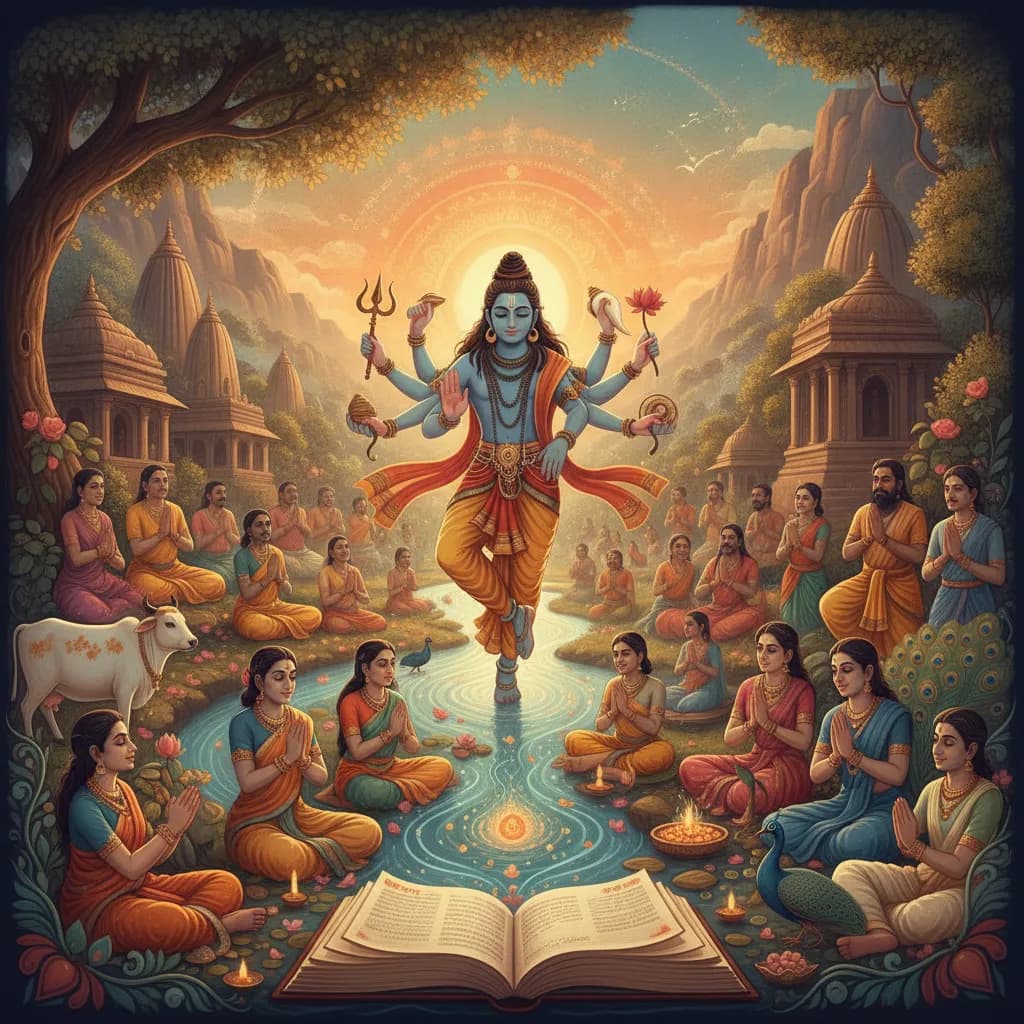
Hinduism
A major world religion with well over a billion followers today, and no single founder, no single holy book, and no single fixed moment of origin.
Cheat Sheet
- Hinduism is one of the world's oldest continuously practiced religions, originating in the Indian subcontinent with roots stretching back thousands of years.
- Unlike many other major world religions, Hinduism doesn't trace back to a single founder or a single unified holy text, instead developing gradually from a diverse range of ancient traditions and texts.
- Core Hindu concepts include karma (the principle that actions have moral consequences), dharma (one's duty or righteous path), and samsara (the ongoing cycle of death and rebirth).
- Hinduism includes both traditions emphasizing a single ultimate divine reality, Brahman, and a rich tradition of worshipping numerous distinct deities, who are often understood as different expressions or aspects of that same underlying reality.
- Major Hindu texts include the Vedas, among the religion's oldest sacred texts, and the Bhagavad Gita, a widely influential philosophical and spiritual dialogue.
- Hinduism is practiced by well over a billion people, the vast majority living in India, making it one of the largest religions in the world by total adherents.
The 60-Second Version
Hinduism is one of the world's oldest continuously practiced religions, originating in the Indian subcontinent with roots stretching back thousands of years. Unlike many other major world religions, Hinduism doesn't trace back to a single founder or a single unified holy text, instead developing gradually from a diverse range of ancient traditions and texts. Core Hindu concepts include karma, the principle that actions have moral consequences, dharma, one's duty or righteous path, and samsara, the ongoing cycle of death and rebirth. Hinduism includes both traditions emphasizing a single ultimate divine reality, Brahman, and a rich tradition of worshipping numerous distinct deities, who are often understood as different expressions or aspects of that same underlying reality. Major Hindu texts include the Vedas, among the religion's oldest sacred texts, and the Bhagavad Gita, a widely influential philosophical and spiritual dialogue. Hinduism is practiced by well over a billion people, the vast majority living in India, making it one of the largest religions in the world by total adherents.
The Long Version
A Religion Without a Single Founder
Unlike many other major world religions that trace their origin to a specific founding figure and a specific historical moment, Hinduism developed gradually over thousands of years from a diverse range of ancient traditions, texts, and practices originating in the Indian subcontinent, making it notably difficult to point to any single founder or precise founding date.
Karma, Dharma, and the Cycle of Rebirth
Several core concepts run through most Hindu traditions: karma, the principle that a person's actions carry moral consequences shaping their future circumstances, dharma, one's duty or righteous path in life, and samsara, the ongoing cycle of death and rebirth that Hindu spiritual practice is often oriented toward ultimately transcending.
One Divine Reality, Many Deities
Hinduism encompasses both philosophical traditions emphasizing a single ultimate divine reality, often referred to as Brahman, and a rich, widely practiced tradition of devotion to numerous distinct deities, who are frequently understood within Hindu theology as different expressions or aspects of that same underlying divine reality rather than entirely separate, competing gods.
Foundational Texts: The Vedas and the Bhagavad Gita
Among Hinduism's vast body of religious literature, the Vedas stand as some of the religion's oldest sacred texts, while the Bhagavad Gita, a philosophical dialogue addressing duty, action, and devotion, remains one of the most widely read and influential texts both within Hinduism and among readers and philosophers well beyond it.
Ad slot (placeholder — set NEXT_PUBLIC_ADSENSE_SLOT_ID once an ad unit is created)
Glossary
- Karma
- The Hindu principle that actions have moral consequences, shaping future circumstances or rebirths.
- Dharma
- One's duty, righteous path, or proper conduct within Hindu belief and practice.
- Samsara
- The ongoing cycle of death and rebirth central to Hindu belief.
- Brahman
- The concept of a single ultimate divine reality underlying existence in much of Hindu philosophy.
- Bhagavad Gita
- A widely influential Hindu philosophical and spiritual text presented as a dialogue on duty and devotion.