The Industrial Revolution
A single improved machine, patented in 1769, is widely credited with helping trigger one of the most transformative economic shifts in human history.
Cheat Sheet
- Began in Britain in the mid-to-late 18th century, later spreading to continental Europe and the United States through the 19th century.
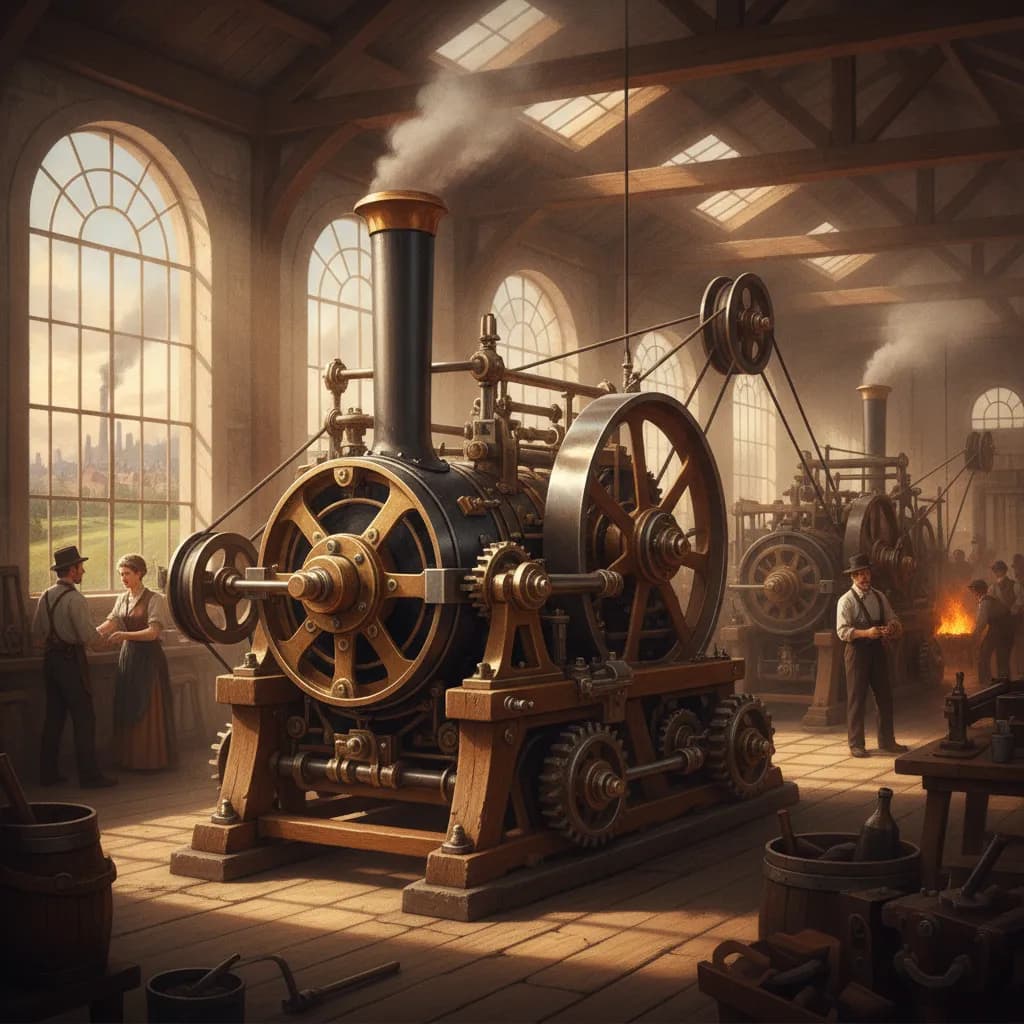
- James Watt's significantly improved steam engine (patented 1769) is widely considered a central catalyst, powering factories, trains, and ships.
- The shift from small-scale home-based production to centralized factories fundamentally reorganized how goods were manufactured and how people worked.
- Urbanization accelerated dramatically as workers moved from rural agricultural areas into rapidly growing industrial cities in search of factory jobs.
- Working conditions in early industrial factories were often severe, including long hours, dangerous machinery, and extensive use of child labor, eventually prompting labor reform movements.
- The 'Second Industrial Revolution' (roughly 1870-1914) introduced further transformative technologies, including electricity, the internal combustion engine, and mass production techniques.
The 60-Second Version
The Industrial Revolution began in Britain during the mid-to-late 18th century before gradually spreading to continental Europe and the United States over the following century, fundamentally reshaping how goods were produced and how the vast majority of people actually earned their living. A central catalyst behind this transformation was James Watt's significantly improved steam engine, patented in 1769, which provided a reliable, powerful new energy source capable of running factories, trains, and ships at a scale earlier technology simply couldn't match. That new industrial power fueled a dramatic shift from small-scale, home-based production toward large, centralized factories, fundamentally reorganizing manufacturing around specialized machinery and coordinated labor rather than individual craftspeople working independently. This economic shift triggered rapid urbanization as workers left rural agricultural areas in large numbers to seek factory jobs in fast-growing industrial cities, transforming the basic demographic shape of entire nations within a few generations. Early industrial working conditions were often genuinely severe, marked by long hours, dangerous machinery, and extensive reliance on child labor, harsh realities that eventually helped spark organized labor reform movements. The transformation didn't stop with Britain's original wave, either, since a so-called Second Industrial Revolution, roughly spanning 1870 to 1914, introduced further transformative technologies including electricity, the internal combustion engine, and modern mass production techniques.
The Long Version
A Machine That Changed Everything
The Industrial Revolution began in Britain during the mid-to-late 18th century, with a central catalyst commonly credited as James Watt's significantly improved steam engine, patented in 1769, which provided a reliable, powerful new energy source capable of running factories, trains, and ships at a scale earlier water- or animal-powered technology simply couldn't match.
From Home Workshops to Factories
That new industrial power fueled a dramatic shift from small-scale, home-based production toward large, centralized factories, fundamentally reorganizing manufacturing around specialized machinery and coordinated labor forces rather than individual craftspeople working largely independently out of their own homes or small workshops.
Cities Grew Almost Overnight
This economic shift triggered rapid urbanization as workers left rural agricultural areas in large numbers to seek factory jobs in fast-growing industrial cities, transforming the basic demographic shape of entire nations, including Britain itself, within just a few generations rather than over centuries.
Harsh Conditions That Sparked Reform
Early industrial working conditions were often genuinely severe, marked by long working hours, dangerous unguarded machinery, and extensive reliance on child labor, harsh realities that eventually helped spark organized labor reform movements demanding safer conditions, shorter hours, and restrictions on employing children in factories.
A Second Wave of Transformation
The transformation didn't stop with Britain's original 18th-century wave, either, since a so-called Second Industrial Revolution, roughly spanning 1870 to 1914, introduced further genuinely transformative technologies including electricity, the internal combustion engine, and modern mass production techniques, extending industrialization's reach well into the 20th century.
Ad slot (placeholder — set NEXT_PUBLIC_ADSENSE_SLOT_ID once an ad unit is created)
Why People Care
The Industrial Revolution reshaped nearly every aspect of daily life, from where people live and work to how goods get made and sold, and understanding both its transformative achievements and its harsh human costs provides essential context for the modern global economy it directly gave rise to.
Glossary
- Steam engine
- A machine converting steam-generated pressure into mechanical work, significantly improved by James Watt and central to early industrialization.
- Factory system
- A method of organizing production in centralized facilities with specialized machinery, replacing small-scale home-based manufacturing.
- Urbanization
- The growth of cities as populations shift from rural to urban areas, dramatically accelerated during the Industrial Revolution.
- Child labor
- The widespread employment of children in factories during early industrialization, eventually restricted through labor reform legislation.
- Second Industrial Revolution
- A later wave of industrialization, roughly 1870-1914, introducing electricity, the internal combustion engine, and mass production.
Go Deeper
- The Industrial Revolution: A Very Short Introduction, by Robert C. Allen
- The British Library — Industrial Revolution
More to Explore
- The Haitian Revolution
Napoleon Bonaparte sent one of the largest military expeditions of his career to crush a slave rebellion in the Caribbean — and lost, creating the first nation in history founded by formerly enslaved people themselves.
- The Russian Revolution
A single tumultuous year saw a centuries-old monarchy collapse, then a second revolution just months later hand power to an entirely different group altogether.
- The French Revolution
A revolution that began by demanding liberty and equality, and ended less than a decade later with a self-crowned emperor.
- The American Revolution
A rebellion by thirteen colonies against the era's most powerful empire, that ultimately succeeded partly thanks to Britain's own longtime rival stepping in to help.
- Decolonization
A wave of independence movements so large that dozens of new nations joined the world map within just a few decades of the mid-20th century.