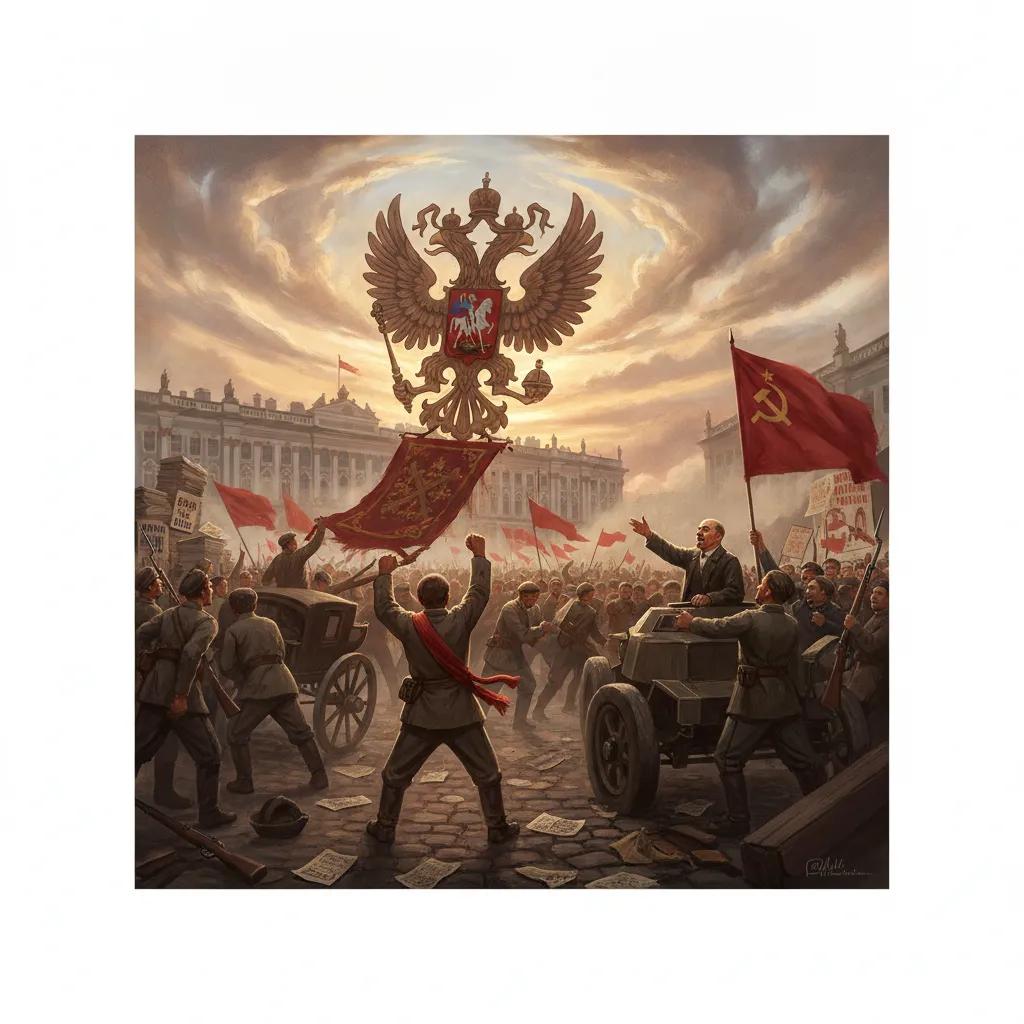
The Russian Revolution
A single tumultuous year saw a centuries-old monarchy collapse, then a second revolution just months later hand power to an entirely different group altogether.
Cheat Sheet
- The Russian Revolution of 1917 refers to two related upheavals that year — the February Revolution, which overthrew the Russian monarchy, and the October Revolution, which brought the Bolsheviks under Vladimir Lenin to power.
- Widespread war weariness from World War I, combined with severe food shortages and deep economic hardship, created the volatile conditions that ultimately triggered revolution.
- The February Revolution led to the abdication of Tsar Nicholas II, ending centuries of Romanov dynastic rule and establishing a short-lived provisional government.
- The October Revolution saw the Bolsheviks, a revolutionary Marxist faction led by Vladimir Lenin, seize power from the provisional government, establishing the world's first Communist-led state.
- A prolonged and brutal civil war followed the revolution, fought between the Bolshevik "Red" forces and a loose coalition of "White" forces opposed to Communist rule.
- The Russian Revolution's outcome directly led to the eventual founding of the Soviet Union in 1922, profoundly shaping 20th-century global politics through the subsequent Cold War rivalry with the West.
The 60-Second Version
The Russian Revolution of 1917 refers to two related upheavals that year, the February Revolution, which overthrew the Russian monarchy, and the October Revolution, which brought the Bolsheviks under Vladimir Lenin to power. Widespread war weariness from World War I, combined with severe food shortages and deep economic hardship, created the volatile conditions that ultimately triggered revolution. The February Revolution led to the abdication of Tsar Nicholas II, ending centuries of Romanov dynastic rule and establishing a short-lived provisional government. The October Revolution saw the Bolsheviks, a revolutionary Marxist faction led by Vladimir Lenin, seize power from the provisional government, establishing the world's first Communist-led state. A prolonged and brutal civil war followed the revolution, fought between the Bolshevik "Red" forces and a loose coalition of "White" forces opposed to Communist rule. The Russian Revolution's outcome directly led to the eventual founding of the Soviet Union in 1922, profoundly shaping 20th-century global politics through the subsequent Cold War rivalry with the West.
The Long Version
Conditions That Made Revolution Possible
By 1917, Russia faced severe war weariness from its costly and increasingly unpopular participation in World War I, compounded by widespread food shortages and deep economic hardship affecting much of the population, a combination of pressures that created the volatile conditions ultimately triggering revolutionary upheaval that year.
Two Revolutions in a Single Year
The February Revolution led directly to the abdication of Tsar Nicholas II, ending centuries of Romanov dynastic rule over Russia and establishing a provisional government in its place. This provisional government, however, proved short-lived, as the October Revolution soon followed, with the Bolsheviks, a revolutionary Marxist faction led by Vladimir Lenin, successfully seizing power and establishing what would become the world's first Communist-led state.
A Brutal Civil War Follows
The Bolshevik seizure of power triggered a prolonged and brutal civil war, fought between Bolshevik "Red" forces and a loose, often internally divided coalition of "White" forces opposed to Communist rule, a conflict that caused enormous suffering and ultimately concluded with Bolshevik victory, cementing Communist control over the newly forming Soviet state.
Founding the Soviet Union and Reshaping Global Politics
The Russian Revolution's ultimate outcome directly led to the formal founding of the Soviet Union in 1922, establishing a Communist superpower that would go on to profoundly shape 20th-century global politics, most significantly through the extended Cold War rivalry with the United States and other Western powers that dominated much of the remainder of the century.
Ad slot (placeholder — set NEXT_PUBLIC_ADSENSE_SLOT_ID once an ad unit is created)
Glossary
- February Revolution
- The 1917 uprising that overthrew the Russian monarchy and ended Romanov dynastic rule.
- October Revolution
- The 1917 uprising in which the Bolsheviks under Vladimir Lenin seized power from Russia's provisional government.
- Bolsheviks
- A revolutionary Marxist political faction led by Vladimir Lenin that seized power during the October Revolution.
- Tsar Nicholas II
- The last Russian emperor, whose abdication during the February Revolution ended centuries of Romanov rule.
- Russian Civil War
- The prolonged, brutal conflict following the revolution, fought between Bolshevik "Red" forces and anti-Communist "White" forces.