The Chinese Revolution
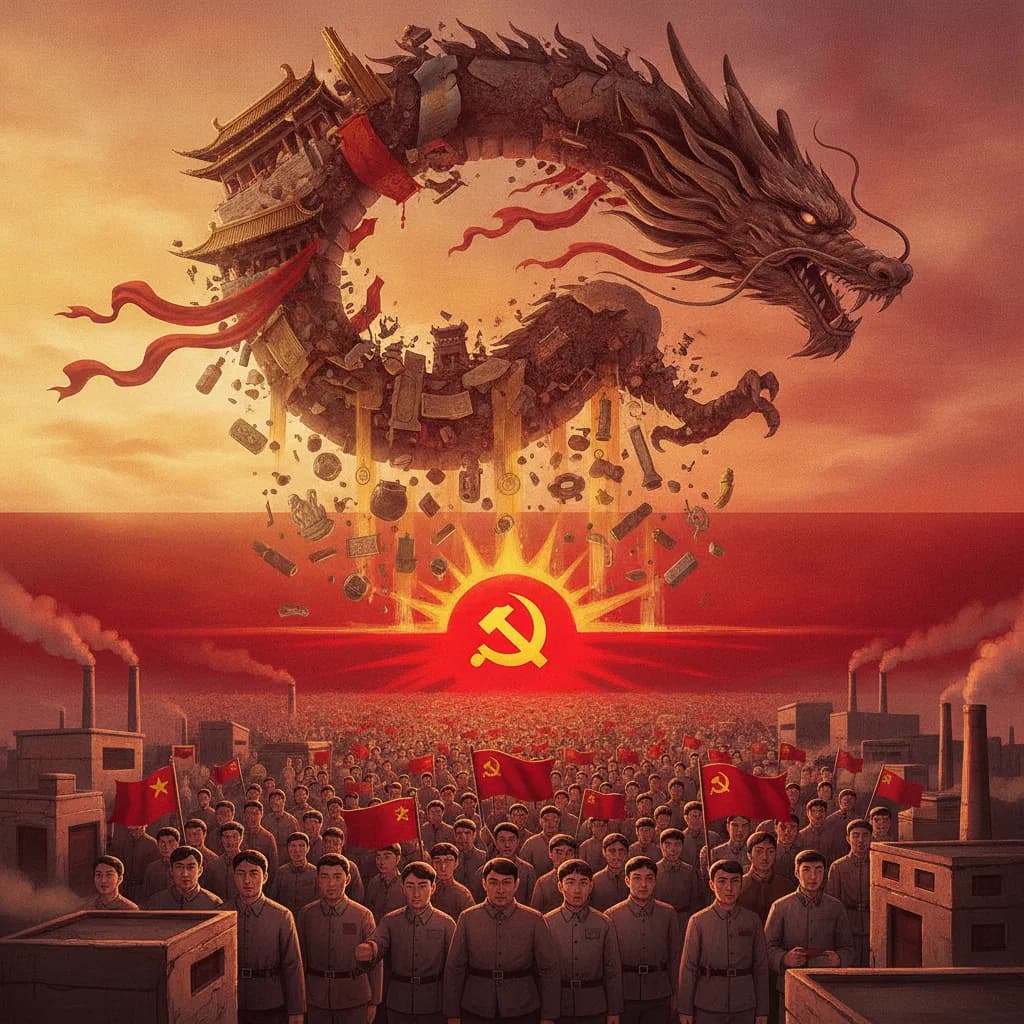
China went from a 2,000-year-old empire to a communist state in less than four decades.
By Greg Goodwin · Published October 16, 2026 · Updated October 24, 2026
Cheat Sheet
- Two phases: the 1911 Xinhai Revolution that ended imperial rule, and the Communist victory in 1949.
- Key dates: Wuchang uprising October 10, 1911; Republic proclaimed January 1, 1912; Qing emperor abdicated February 1912.
- Parties: the Kuomintang (Nationalists), led by Sun Yat-sen then Chiang Kai-shek, and the Chinese Communist Party, founded in 1921.
- Long March: roughly 1934-1935, a retreat of about 6,000 miles that made Mao Zedong the party's leading figure.
- War with Japan: 1937-1945, which devastated China and interrupted the civil war.
- Outcome: Mao proclaimed the People's Republic of China on October 1, 1949; the Nationalists retreated to Taiwan.
The 60-Second Version
For two millennia, China was ruled by emperors. By the late 19th century, the Qing dynasty was weakened by defeats against foreign powers, internal rebellions, and failed reforms. In October 1911, an uprising at Wuchang set off a wave of provincial revolts, and the last emperor abdicated in early 1912. The new Republic, however, was fragile, and regional warlords seized real power. Two modern parties emerged to try to reunify the country: Sun Yat-sen's Nationalists and the Chinese Communist Party. They allied, split, fought a civil war, and set it aside when Japan invaded in 1937. After Japan's defeat in 1945, the war resumed, and the Communists won. On October 1, 1949, Mao Zedong proclaimed the People's Republic of China.
The Long Version
The Fall of the Qing
China's 19th century was a series of shocks: the Opium Wars, the Taiping Rebellion, and defeat by Japan in 1894-95. Reformers urged the court to modernize, but the dynasty's response was slow. Revolutionary groups, including Sun Yat-sen's, gained support among students, overseas Chinese, and army officers. The Wuchang uprising on October 10, 1911, sparked by an accidental bomb explosion and a rushed revolt, spread quickly. Within weeks, most provinces had declared independence from Qing rule. Sun was named provisional president on January 1, 1912, and the six-year-old emperor Puyi abdicated in February.
A Republic Without Power
Sun stepped aside for the powerful general Yuan Shikai, who soon undermined parliament and tried to make himself emperor in 1915-16. After he died, China fragmented. Warlords controlled territories, and the government in Beijing was little more than a prize. The May Fourth Movement of 1919, a student protest against the Versailles settlement, which handed German concessions in Shandong to Japan, galvanized a generation of intellectuals. Many turned to new ideas, including Marxism, which led to the founding of the Chinese Communist Party in 1921.
Nationalists and Communists
With Soviet help, Sun reorganized the Kuomintang and allied it with the Communists in 1923. After Sun died in 1925, Chiang Kai-shek led the Northern Expedition to defeat the warlords. In 1927, he turned on his Communist allies in Shanghai, killing thousands. The surviving Communists retreated to the countryside. Mao Zedong argued that peasants, not city workers, would be the revolutionary force. Facing Nationalist encirclement campaigns, the Red Army broke out in 1934 and made the Long March, a grueling trek of thousands of miles. Only a fraction of the original force reached northern Shaanxi, but the experience forged the party's leadership.
War with Japan
Japan seized Manchuria in 1931 and began a full invasion in 1937, committing atrocities such as the Nanjing Massacre. Under pressure, Chiang and the Communists agreed to a second United Front. The war killed millions of Chinese, ruined the Nationalist economy, and let the Communists expand their base through guerrilla warfare and land reform. By 1945, the party had roughly a million members and considerable armed strength.
Civil War and Victory
After Japan's surrender, the US brokered talks that failed, and civil war broke out in 1946. The Nationalists had more troops and weapons at first, but inflation, corruption, and defections weakened them. The Communists won major campaigns in 1948-49, took Beijing and Nanjing, and drove the Nationalists to Taiwan. Mao announced the new state in Tiananmen Square on October 1, 1949.
Why People Care
The Chinese Revolution explains why modern China is ruled by the Communist Party, why Taiwan has a separate government, and how the party tells its own history. It is essential background for understanding one of the world's most important countries.
Glossary
- Xinhai Revolution
- The 1911 revolution (named for the year in the Chinese calendar) that overthrew the Qing dynasty.
- Warlord era
- The period after 1916 when regional military leaders held real power and the central government was weak.
- United Front
- An alliance of Nationalists and Communists, first formed in 1923 and again against Japan.
- Three Principles of the People
- Sun Yat-sen's ideology of nationalism, democracy, and people's livelihood.
- Land reform
- Communist redistribution of land from landlords to peasants, a key source of rural support.
Go Deeper
- Encyclopaedia Britannica — Chinese Revolution of 1911-1912
- The Search for Modern China, by Jonathan Spence
More to Explore
- The Glorious Revolution
England swapped kings in 1688 with barely a shot fired, and Parliament has held the upper hand ever since.
- The Scientific Revolution
For roughly 1,500 years, Europeans trusted Aristotle and Ptolemy on how the universe worked, then a few stubborn people started checking.
- The Industrial Revolution
A single improved machine, patented in 1769, is widely credited with helping trigger one of the most transformative economic shifts in human history.
- The Haitian Revolution
Napoleon sent a large expedition to restore slavery in Haiti and failed, leaving the first nation founded by an enslaved people's uprising.
- The Russian Revolution
Russia managed two revolutions in 1917: the first toppled the tsar, the second handed power to the Bolsheviks.