The Glorious Revolution
England swapped kings in 1688 with barely a shot fired, and Parliament has held the upper hand ever since.
By Greg Goodwin · Published October 16, 2026 · Updated October 24, 2026
Cheat Sheet
- Time: 1688-1689, when King James II was replaced by his daughter Mary II and her husband William III (William of Orange).
- Trigger: the birth of James's Catholic son on June 10, 1688, which threatened a lasting Catholic dynasty.
- Invitation: seven English nobles ('the Immortal Seven') invited William to intervene on June 30, 1688.
- Landing: William arrived at Torbay on November 5, 1688, with an army of about 20,000 and a large fleet.
- Settlement: the Bill of Rights (1689) barred the monarch from suspending laws or taxing without Parliament's consent.
- Related law: the Toleration Act (1689) allowed Protestant dissenters to worship openly, though Catholics remained restricted.
The 60-Second Version
When James II became king in 1685, England was a Protestant country with a Catholic monarch. Tolerated at first because he was old and his heirs were Protestant, James alarmed people by appointing Catholics to the army and government and by suspending laws without Parliament's consent. Then in 1688 his second wife gave birth to a son, who would be raised Catholic and would displace James's Protestant daughters in the line of succession. A group of English leaders invited James's son-in-law, the Dutch ruler William of Orange, to come with an army. James's support melted away and he fled. Parliament offered the crown jointly to William and his wife Mary, James's daughter, on condition that they accept the Bill of Rights.
The Long Version
A Catholic King in a Protestant Land
James II was the brother of Charles II and inherited the throne in 1685. Many English people feared Catholic rule, having associated it with France's absolutism and religious persecution, particularly after Louis XIV revoked the Edict of Nantes in 1685. James claimed the right to dispense with laws, issued Declarations of Indulgence granting religious freedom, and expanded the standing army. When seven bishops petitioned against reading his declaration in churches, he had them tried for seditious libel in June 1688. They were acquitted to public celebration.
The Invitation
The birth of a son on June 10 transformed the political situation, since the Protestant heirs, Mary and Anne, were now behind a Catholic prince. On June 30, seven prominent figures sent a letter to William of Orange urging him to come. William had his own reasons: the Netherlands was threatened by Louis XIV, and England's resources would help check France. He gathered a large fleet and army.
A Bloodless Takeover
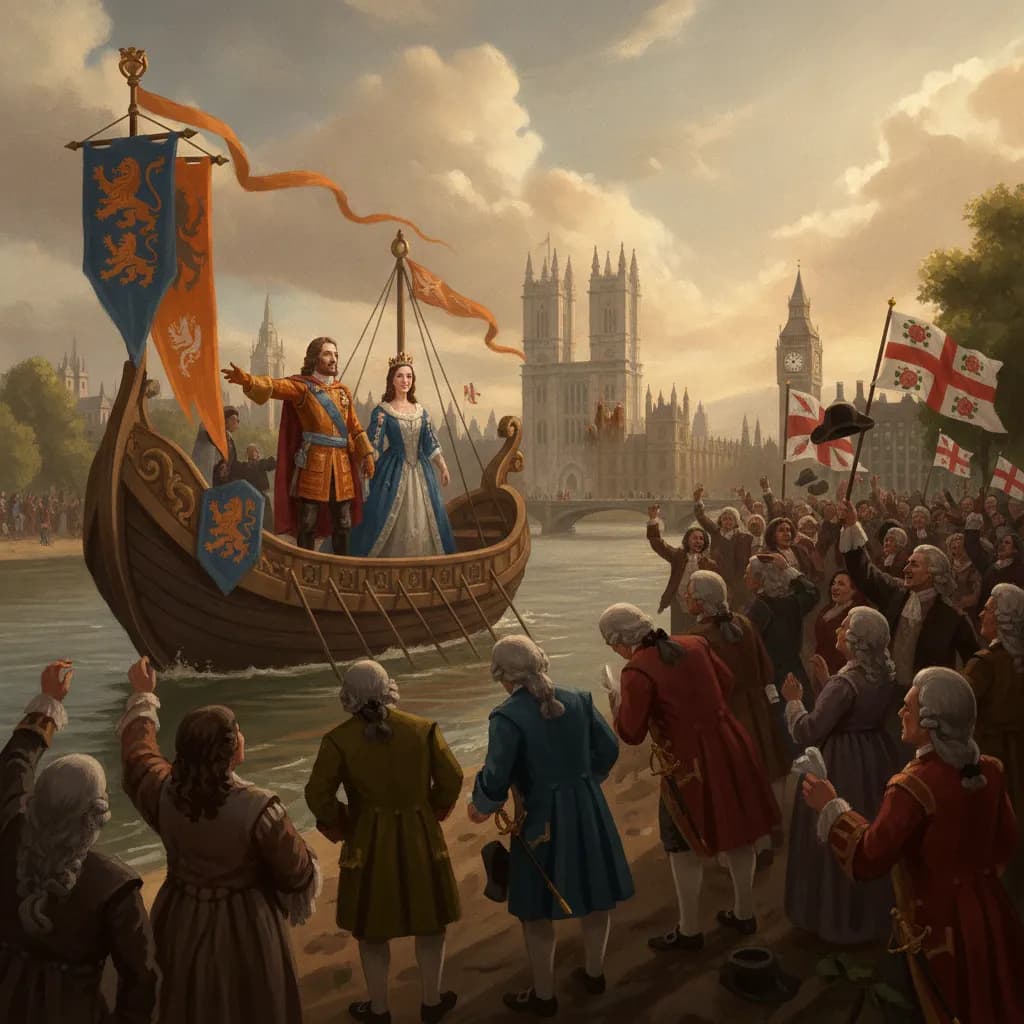
William landed at Torbay in Devon on November 5, 1688. Instead of rallying behind James, many officers, including John Churchill, defected. James's own daughter Anne sided with William. After a failed attempt to flee, the king escaped to France in December. There was little fighting in England, a fact that gave the event its "Glorious" label, though there was more bloodshed in Ireland and Scotland as Jacobite supporters resisted. The Battle of the Boyne in 1690, where William defeated James, secured the settlement.
The Settlement
A Convention Parliament declared that James had abdicated and the throne was vacant. William and Mary became joint monarchs in April 1689 after accepting the Declaration of Rights, which was enacted as the Bill of Rights later that year. It forbade the crown from suspending laws, raising taxes, or keeping a standing army in peacetime without Parliament's consent, and it guaranteed free elections and freedom of speech in Parliament. It also barred Catholics from the throne, a rule reinforced by the 1701 Act of Settlement.
Long-Term Effects
Parliament now had to meet regularly because the crown needed funds, which fostered a stable political system and, in 1694, the Bank of England. John Locke's *Two Treatises of Government*, published in 1689, argued that governments rest on consent and that people may resist tyranny, ideas that later influenced American revolutionaries. The Bill of Rights inspired parts of the US Bill of Rights, including the prohibition on cruel and unusual punishment.
Why People Care
The Glorious Revolution is widely seen as the moment Britain's constitutional monarchy was established, with sovereignty shared between crown and Parliament. It shaped the political culture that influenced the American founders and many democracies afterward.
Glossary
- Bill of Rights 1689
- The act that set out Parliament's rights and limits on royal power, still part of British constitutional law.
- Divine right of kings
- The doctrine that monarchs derive authority directly from God and answer to no earthly body.
- Jacobite
- A supporter of James II and his descendants, from the Latin for James.
- Dispensing power
- The king's claim to exempt individuals from laws, which James used to appoint Catholics.
- Constitutional monarchy
- A system in which a monarch reigns under legal limits set by parliament.
Go Deeper
More to Explore
- The Scientific Revolution
For roughly 1,500 years, Europeans trusted Aristotle and Ptolemy on how the universe worked, then a few stubborn people started checking.
- The Chinese Revolution
China went from a 2,000-year-old empire to a communist state in less than four decades.
- The Industrial Revolution
A single improved machine, patented in 1769, is widely credited with helping trigger one of the most transformative economic shifts in human history.
- The Haitian Revolution
Napoleon sent a large expedition to restore slavery in Haiti and failed, leaving the first nation founded by an enslaved people's uprising.
- The Russian Revolution
Russia managed two revolutions in 1917: the first toppled the tsar, the second handed power to the Bolsheviks.