Drums and Percussion
One drummer on a modern kit now does the job that once took several players, with four limbs moving independently.
By Greg Goodwin · Published October 3, 2026 · Updated October 24, 2026
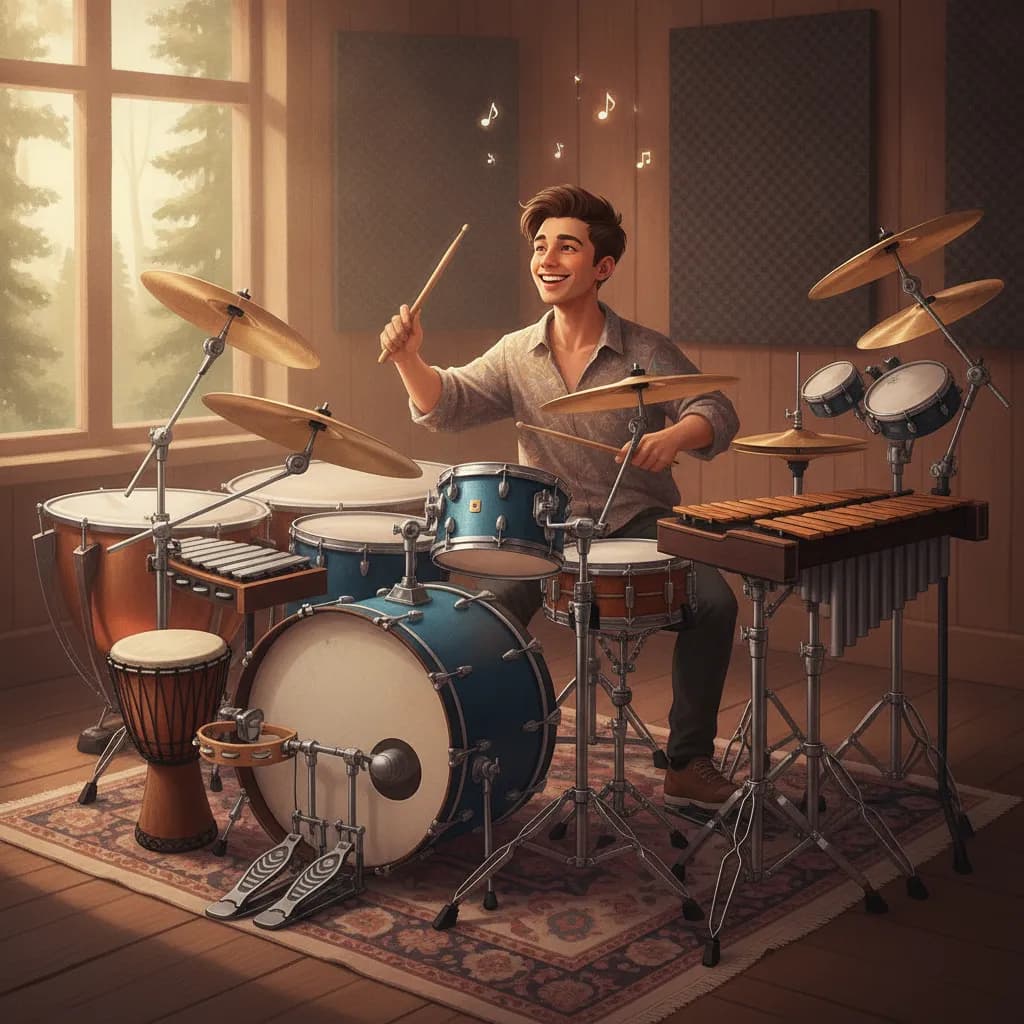
Cheat Sheet
- A standard modern drum kit (snare, bass drum, hi-hats, toms, cymbals) emerged gradually in the early 20th century as drummers combined separate percussion instruments into one setup.
- The bass drum, played with a foot pedal, and the hi-hat, also foot-controlled via a separate pedal, let one drummer coordinate four limbs independently.
- Percussion instruments are broadly divided into 'pitched' (like timpani or xylophone, tuned to specific notes) and 'unpitched' (like most drums and cymbals).
- Drummers typically establish a song's tempo and rhythmic feel before other musicians even begin playing, functioning as the band's internal clock.
- Rudiments — standardized stick patterns like single strokes, double strokes, and paradiddles — form the technical foundation of most drumming styles.
- Percussion represents one of humanity's oldest instrument categories, with evidence of rhythmic instruments predating most pitched instruments by a wide margin.
The 60-Second Version
The standard modern drum kit, combining a snare drum, bass drum, hi-hats, toms, and cymbals into one unified setup, emerged gradually during the early 20th century as drummers began combining what had previously been separate percussion instruments played by different musicians. Key to this consolidation were the bass drum, played with a foot pedal, and the hi-hat, also controlled via its own separate foot pedal, which together let a single drummer coordinate all four limbs independently to produce a far more complex rhythm than one person could otherwise manage. Percussion instruments more broadly are divided into two major categories: "pitched" percussion, like timpani or xylophone, which are tuned to specific musical notes, and "unpitched" percussion, like most drums and cymbals, which produce rhythmic sound without a definite musical pitch. Within a band, drummers typically establish a song's tempo and overall rhythmic feel before other musicians even begin playing, effectively functioning as the group's internal clock that everyone else locks into. Underlying most drumming styles are rudiments, standardized stick patterns like single strokes, double strokes, and paradiddles, which form the technical foundation drummers practice and combine to build more complex patterns. It's worth appreciating that percussion represents one of humanity's oldest instrument categories overall, with evidence of rhythmic instruments predating most pitched instruments by a genuinely wide historical margin.
The Long Version
One Drummer, Instruments That Used to Need Several
The standard modern drum kit, combining a snare drum, bass drum, hi-hats, toms, and cymbals into one unified setup, emerged gradually during the early 20th century as drummers began combining what had previously been separate percussion instruments played by different musicians into a single, cohesive setup for one performer.
Four Limbs, Moving Independently
Key to this consolidation were the bass drum, played with a foot pedal, and the hi-hat, also controlled via its own separate foot pedal, which together let a single drummer coordinate all four limbs independently to produce a far more complex, layered rhythm than one person could otherwise manage with hands alone.
Pitched Versus Unpitched Percussion
Percussion instruments more broadly are divided into two major categories: "pitched" percussion, like timpani or xylophone, which are tuned to specific musical notes, and "unpitched" percussion, like most drums and cymbals, which produce rhythmic sound without a definite musical pitch, a distinction that shapes how each type functions within an ensemble.
The Band's Internal Clock
Within a band, drummers typically establish a song's tempo and overall rhythmic feel before other musicians even begin playing, effectively functioning as the group's internal clock that everyone else locks into throughout a performance, a role that makes drumming far more foundational than its sometimes flashy image suggests.
Building Blocks, and an Ancient Lineage
Underlying most drumming styles are rudiments, standardized stick patterns like single strokes, double strokes, and paradiddles, which form the technical foundation drummers practice and combine to build more complex patterns. It's worth appreciating that percussion represents one of humanity's oldest instrument categories overall, with evidence of rhythmic instruments predating most pitched instruments by a genuinely wide historical margin.
Why People Care
Drumming's role as a band's rhythmic foundation is easy to take for granted precisely because it's designed to feel steady and unobtrusive, and understanding the coordination and technical vocabulary behind it reveals just how much skill sits behind what can look, from the outside, like simple repetitive motion.
Glossary
- Drum kit
- A standardized collection of drums and cymbals (snare, bass drum, hi-hats, toms) played by one musician, developed in the early 20th century.
- Hi-hat
- A pair of cymbals mounted on a stand and controlled by a foot pedal, used for consistent rhythmic timekeeping on a drum kit.
- Rudiment
- A standardized stick pattern, such as single strokes or paradiddles, forming the technical foundation of drumming technique.
- Pitched percussion
- Percussion instruments tuned to specific musical notes, such as timpani or xylophone, as opposed to unpitched instruments like most drums.
- Backbeat
- A rhythmic emphasis on the second and fourth beats of a measure, a drumming pattern foundational to rock, pop, and R&B.
Go Deeper
- Modern Drummer Magazine — Drumming Fundamentals
- The Drummer's Bible, by Mick Berry and Jason Gianni
More to Explore
- Saxophone
A brass-colored instrument that is secretly a woodwind, invented by a man who spent a decade in court defending it.
- Woodwind Instruments
The flute counts as a woodwind even though modern ones are typically metal, a naming leftover from history.
- Violin
Stradivarius violins from the early 1700s have sold for over $10 million, and their acoustic magic is still debated.
- Synthesizers
A synthesizer records nothing and amplifies nothing: it builds every sound electronically from scratch.
- Piano and Keyboard
The piano's original Italian name means roughly "soft-loud," a brag about dynamics the harpsichord couldn't deliver.