Woodwind Instruments
The flute counts as a woodwind even though modern ones are typically metal, a naming leftover from history.
By Greg Goodwin · Published October 3, 2026 · Updated October 24, 2026
Cheat Sheet
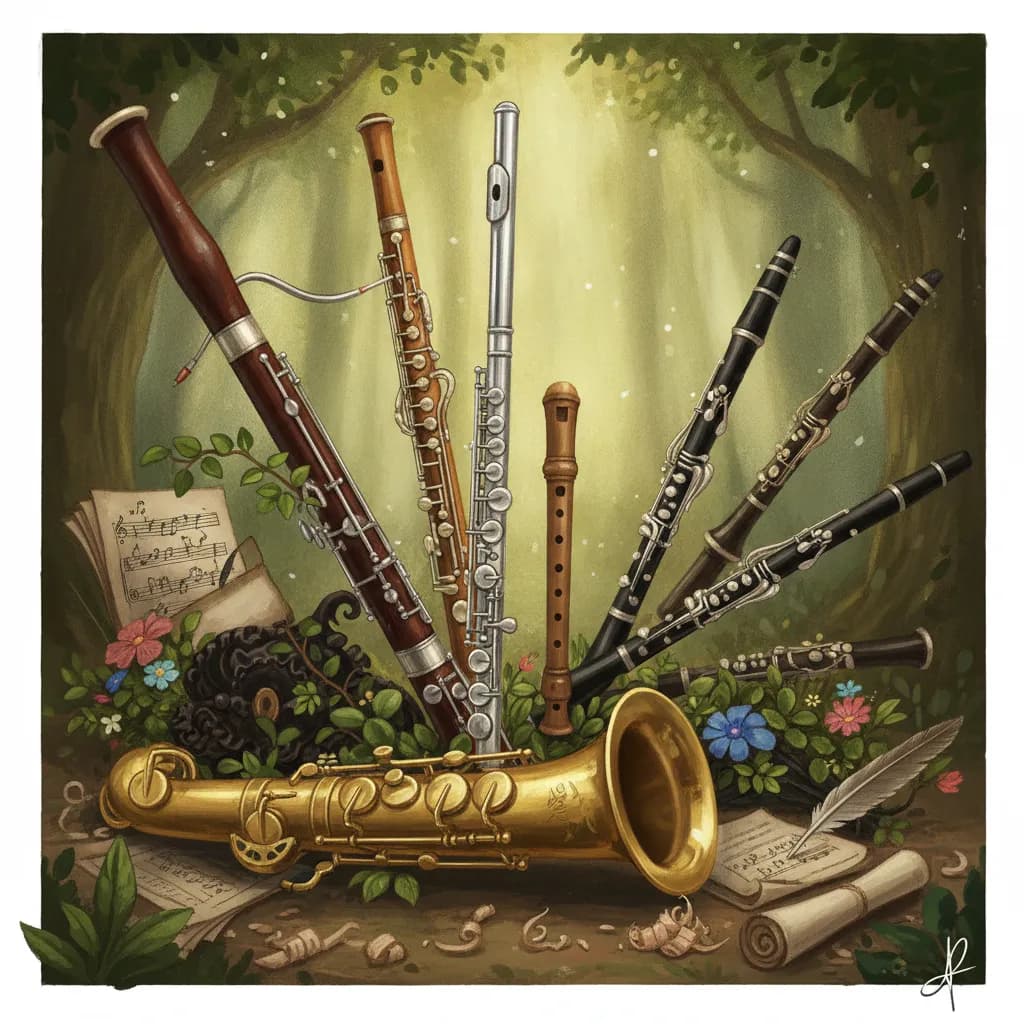
- Woodwinds (clarinet, saxophone, oboe, bassoon, flute) produce sound either through a vibrating reed or, in the flute's case, by blowing air directly across an opening.
- Despite its name, the modern flute is typically made of metal rather than wood — the category reflects historical construction, not current materials.
- Single-reed instruments (clarinet, saxophone) use one vibrating reed against a mouthpiece, while double-reed instruments (oboe, bassoon) vibrate two reeds against each other.
- The saxophone, invented by Adolphe Sax in 1840s Belgium, is a relatively young instrument compared to the centuries-old clarinet, oboe, and flute.
- Finger holes and keys on a woodwind change pitch by altering the effective length of the air column vibrating inside the instrument's body.
- Reed instruments require reed maintenance (moistening, adjusting, replacing) as an ongoing, often finicky part of regular playing and performance preparation.
The 60-Second Version
Woodwind instruments, including the clarinet, saxophone, oboe, bassoon, and flute, produce sound either through a vibrating reed or, in the flute's distinctive case, by blowing air directly across an opening rather than through any reed mechanism at all. Despite the category's name, the modern flute is typically made of metal rather than wood, since the "woodwind" label reflects the family's historical construction materials rather than what instruments in the category are actually built from today. Among the reed instruments specifically, single-reed instruments like the clarinet and saxophone use one vibrating reed pressed against a mouthpiece, while double-reed instruments like the oboe and bassoon vibrate two reeds directly against each other, producing a notably different, often more nasal or piercing tonal character. The saxophone, invented by Adolphe Sax in 1840s Belgium, stands out as a relatively young instrument within this family compared to the centuries-old clarinet, oboe, and flute, which trace their lineages back considerably further. Across the entire woodwind family, finger holes and keys change an instrument's pitch by altering the effective length of the air column vibrating inside its body, the same basic acoustic principle underlying every instrument in the category despite their different reed mechanisms. For reed instruments specifically, reed maintenance, including moistening, adjusting, and periodically replacing reeds, remains an ongoing and often genuinely finicky part of regular playing and performance preparation that non-reed instrumentalists simply don't have to deal with.
The Long Version
Reeds, and One Notable Exception
Woodwind instruments, including the clarinet, saxophone, oboe, bassoon, and flute, produce sound either through a vibrating reed or, in the flute's distinctive case, by blowing air directly across an opening rather than through any reed mechanism at all, making the flute something of an outlier within its own instrument family.
A Name That Outlived Its Materials
Despite the category's name, the modern flute is typically made of metal rather than wood, since the "woodwind" label reflects the family's historical construction materials rather than what instruments in the category are actually built from today, a naming quirk that trips up a lot of people encountering the term for the first time.
One Reed or Two
Among the reed instruments specifically, single-reed instruments like the clarinet and saxophone use one vibrating reed pressed against a mouthpiece, while double-reed instruments like the oboe and bassoon vibrate two reeds directly against each other, producing a notably different, often more nasal or piercing tonal character that's immediately recognizable to a trained ear.
The Family's Youngest Member
The saxophone, invented by Adolphe Sax in 1840s Belgium, stands out as a relatively young instrument within this family compared to the centuries-old clarinet, oboe, and flute, which trace their lineages back considerably further into European musical history, giving the saxophone a very different design philosophy informed by more modern instrument-making techniques.
The Shared Principle, and an Ongoing Chore
Across the entire woodwind family, finger holes and keys change an instrument's pitch by altering the effective length of the air column vibrating inside its body, the same basic acoustic principle underlying every instrument in the category despite their different reed mechanisms. For reed instruments specifically, reed maintenance, including moistening, adjusting, and periodically replacing reeds, remains an ongoing and often genuinely finicky part of regular playing and performance preparation that non-reed instrumentalists simply don't have to deal with.
Why People Care
The woodwind family's shared acoustic principle but wildly different reed mechanisms explain why instruments as different-sounding as a flute and a bassoon end up grouped together, and understanding reed maintenance demands gives real insight into why reed players often talk about their instruments with a very particular kind of exasperated affection.
Glossary
- Reed
- A thin strip of material that vibrates to produce sound on woodwind instruments like the clarinet, saxophone, oboe, and bassoon.
- Single-reed instrument
- A woodwind, such as the clarinet or saxophone, that uses one vibrating reed against a mouthpiece to produce sound.
- Double-reed instrument
- A woodwind, such as the oboe or bassoon, that uses two reeds vibrating against each other to produce sound.
- Adolphe Sax
- The Belgian instrument maker who invented the saxophone in the 1840s.
- Air column
- The column of vibrating air inside a woodwind instrument's body, whose effective length is altered by finger holes and keys to change pitch.
Go Deeper
- The Woodwind Instrument Family, Oxford Music Online
- The Cambridge Companion to the Clarinet
More to Explore
- Saxophone
A brass-colored instrument that is secretly a woodwind, invented by a man who spent a decade in court defending it.
- Violin
Stradivarius violins from the early 1700s have sold for over $10 million, and their acoustic magic is still debated.
- Synthesizers
A synthesizer records nothing and amplifies nothing: it builds every sound electronically from scratch.
- Piano and Keyboard
The piano's original Italian name means roughly "soft-loud," a brag about dynamics the harpsichord couldn't deliver.
- Music Theory Basics
Music theory is a vocabulary for describing how music works, not a universal rulebook: even the 12-note scale is a cultural choice.