Bass Guitar
The bass guitar barely existed before 1951 — before Leo Fender's invention, anyone wanting a low end had to lug around a full-sized upright double bass.
By Greg Goodwin · Published October 3, 2026 · Updated October 24, 2026
Cheat Sheet
- Typically has four strings tuned an octave below a guitar's lowest four strings, though five- and six-string basses add extended low or high range.
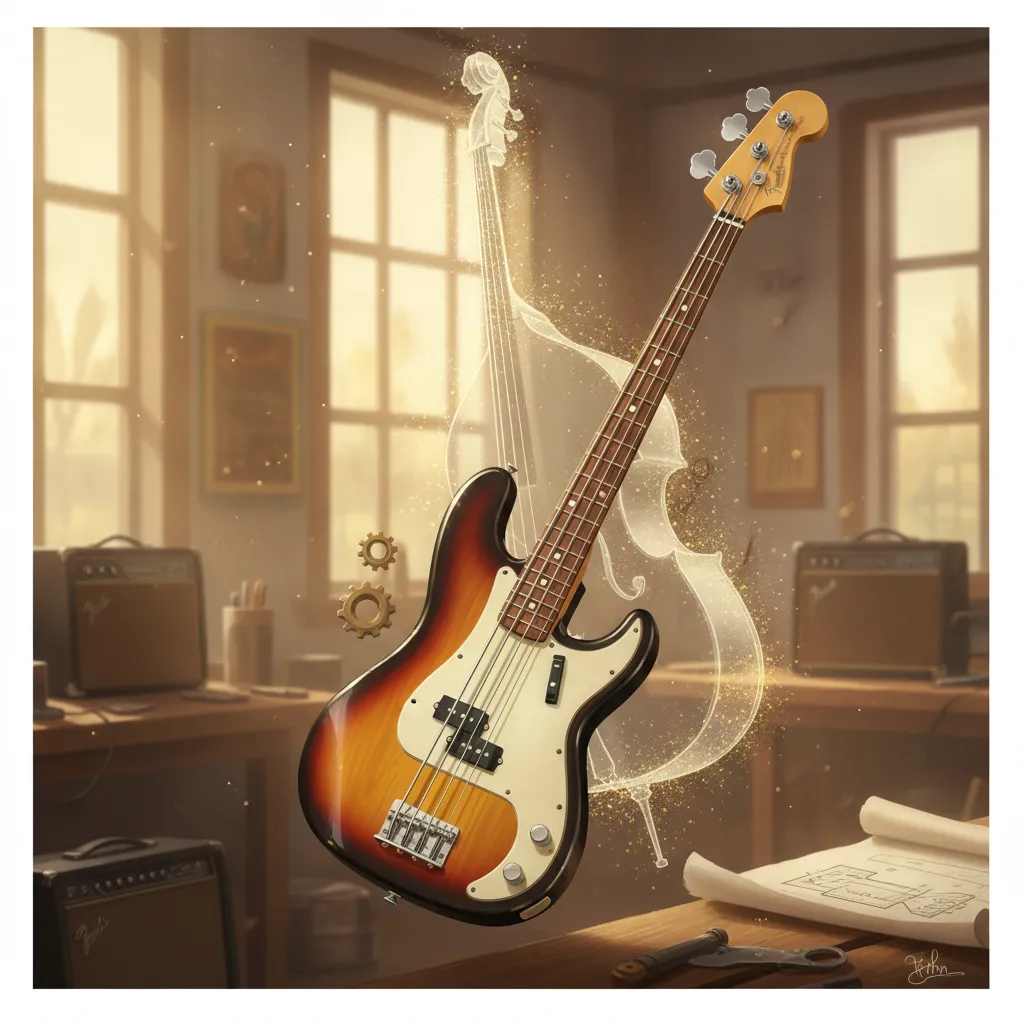
- Invented in its modern solid-body form by Leo Fender in 1951 (the Fender Precision Bass), replacing the much bulkier upright double bass in many settings.
- Primarily plays a song's root notes and rhythmic foundation, linking the harmonic content of chords to the rhythmic pulse of the drums.
- Common playing techniques include fingerstyle (plucking with fingers), using a pick, and slap technique (percussive thumb-slapping popularized in funk).
- A bass's 'pocket' refers to how tightly its rhythm locks in with the drums — considered one of the most important, if least flashy, skills in the instrument.
- Though often overlooked by casual listeners, bass lines are frequently credited by musicians as the glue holding a song's harmony and rhythm together.
The 60-Second Version
A bass guitar typically has four strings tuned an octave below a standard guitar's lowest four strings, though five- and six-string basses exist as well, adding extended low or high range for players who need it. The instrument in its modern solid-body electric form was invented by Leo Fender in 1951 with the Fender Precision Bass, a design that quickly replaced the much bulkier upright double bass in many musical settings where portability and volume mattered. Within a band, the bass primarily plays a song's root notes and provides its rhythmic foundation, functioning as the crucial link between the harmonic content supplied by chords and the rhythmic pulse laid down by the drums. Common playing techniques on the instrument include fingerstyle, plucking the strings directly with the fingers, using a pick for a sharper attack, and slap technique, a percussive thumb-slapping style popularized heavily within funk music. A particularly important, if less flashy, skill among bassists is what's often called "the pocket," referring to how tightly a bass line's rhythm locks in with the drums to create a tight, cohesive groove. Though frequently overlooked by casual listeners focused on melody or vocals, bass lines are often credited by musicians themselves as the actual glue holding a song's harmony and rhythm together underneath everything else.
The Long Version
Four Strings, an Octave Lower
A bass guitar typically has four strings tuned an octave below a standard guitar's lowest four strings, though five- and six-string basses exist as well, adding extended low or high range for players who need more tonal territory than the standard four-string configuration provides.
Replacing a Much Bulkier Instrument
The instrument in its modern solid-body electric form was invented by Leo Fender in 1951 with the Fender Precision Bass, a design that quickly replaced the much bulkier upright double bass in many musical settings where portability, volume, and ease of amplification mattered more than the acoustic bass's traditional orchestral sound.
The Link Between Harmony and Rhythm
Within a band, the bass primarily plays a song's root notes and provides its rhythmic foundation, functioning as the crucial link between the harmonic content supplied by chords and the rhythmic pulse laid down by the drums, a connective role that makes the instrument essential even when it's not drawing much attention.
Fingers, Picks, and Slapping
Common playing techniques on the instrument include fingerstyle, plucking the strings directly with the fingers, using a pick for a sharper attack, and slap technique, a percussive thumb-slapping style popularized heavily within funk music, each producing a distinctly different tonal character from the same instrument.
The Unglamorous Skill That Matters Most
A particularly important, if less flashy, skill among bassists is what's often called "the pocket," referring to how tightly a bass line's rhythm locks in with the drums to create a tight, cohesive groove. Though frequently overlooked by casual listeners focused on melody or vocals, bass lines are often credited by musicians themselves as the actual glue holding a song's harmony and rhythm together underneath everything else.
Why People Care
The bass guitar's role is easy to underestimate precisely because it's designed to support rather than stand out, and understanding its actual function in a band explains why professional musicians often rate a tight, well-played bass line as more important to a song's feel than flashier instruments getting more attention.
Glossary
- Fender Precision Bass
- The first widely successful solid-body electric bass guitar, introduced by Leo Fender in 1951.
- Fingerstyle
- A bass-playing technique using the fingers to pluck strings, as opposed to using a pick.
- Slap technique
- A percussive bass technique involving thumb-slapping and finger-plucking, strongly associated with funk music.
- A term describing how tightly a bassist's rhythm locks in with the drums, considered a core skill of the instrument.
- Root note
- The fundamental note of a chord, which the bass guitar frequently plays to anchor a song's harmonic foundation.
Go Deeper
- Fender — History of the Bass Guitar
- Standing in the Shadows of Motown (documentary, on session bassist James Jamerson)
More to Explore
- Saxophone
A brass-colored instrument that is secretly a woodwind, invented by a man who spent a decade in court defending it.
- Woodwind Instruments
The flute counts as a woodwind even though modern ones are typically metal, a naming leftover from history.
- Violin
Stradivarius violins from the early 1700s have sold for over $10 million, and their acoustic magic is still debated.
- Synthesizers
A synthesizer records nothing and amplifies nothing: it builds every sound electronically from scratch.
- Piano and Keyboard
The piano's original Italian name means roughly "soft-loud," a brag about dynamics the harpsichord couldn't deliver.