The Standard Model of Particle Physics
Physicists predicted a specific particle in 1964 and then spent nearly five decades and billions of dollars building a machine powerful enough to actually go find it.
Cheat Sheet
- The Standard Model classifies all known fundamental particles into two broad types: fermions (matter particles) and bosons (force-carrying particles).
- It successfully describes three of the four fundamental forces — electromagnetic, weak, and strong — but does not incorporate gravity.
- The Higgs boson, predicted by the model in 1964, wasn't experimentally confirmed until 2012 at CERN's Large Hadron Collider.
- Quarks, a category of fermion, combine in groups to form composite particles like protons and neutrons — they're never observed alone in nature.
- The model has been tested to extraordinary precision and has correctly predicted the existence of several particles years before they were observed.
- Known gaps include dark matter, dark energy, and gravity, meaning the Standard Model is considered accurate but explicitly incomplete.
The 60-Second Version
The Standard Model of particle physics functions as science's current best framework for classifying every known fundamental particle and describing how three of the universe's four fundamental forces actually operate. It sorts particles into two broad categories: fermions, which make up matter itself, and bosons, which carry forces between other particles, with the model successfully accounting for electromagnetic, weak, and strong nuclear forces while notably leaving gravity outside its framework entirely. One of its most famous predictions, a particle now known as the Higgs boson, was theorized all the way back in 1964 but wasn't actually confirmed experimentally until 2012, when researchers at CERN's Large Hadron Collider finally detected it using one of the most complex machines humanity has ever built. Some of the model's particles, like quarks, behave in genuinely strange ways, always appearing bound together in composite particles like protons and neutrons and never showing up alone in nature under normal conditions. Despite this remarkable predictive track record, physicists are explicit that the Standard Model remains incomplete, since it currently offers no explanation at all for gravity, dark matter, or dark energy, phenomena that make up the vast majority of the universe's actual content.
The Long Version
Sorting the Universe's Building Blocks
The Standard Model classifies every known fundamental particle into two broad categories, fermions, which combine to make up matter itself, and bosons, which carry forces between other particles, providing physics with its current best organizing framework for understanding what the universe is actually built from at its most basic level.
Three Forces Down, One to Go
The model successfully describes three of the universe's four fundamental forces, electromagnetic, weak nuclear, and strong nuclear, unifying their behavior into a single coherent mathematical framework, though it notably does not incorporate gravity at all, a well-known gap that remains one of theoretical physics' biggest unsolved challenges.
A Nearly 50-Year Wait for Confirmation
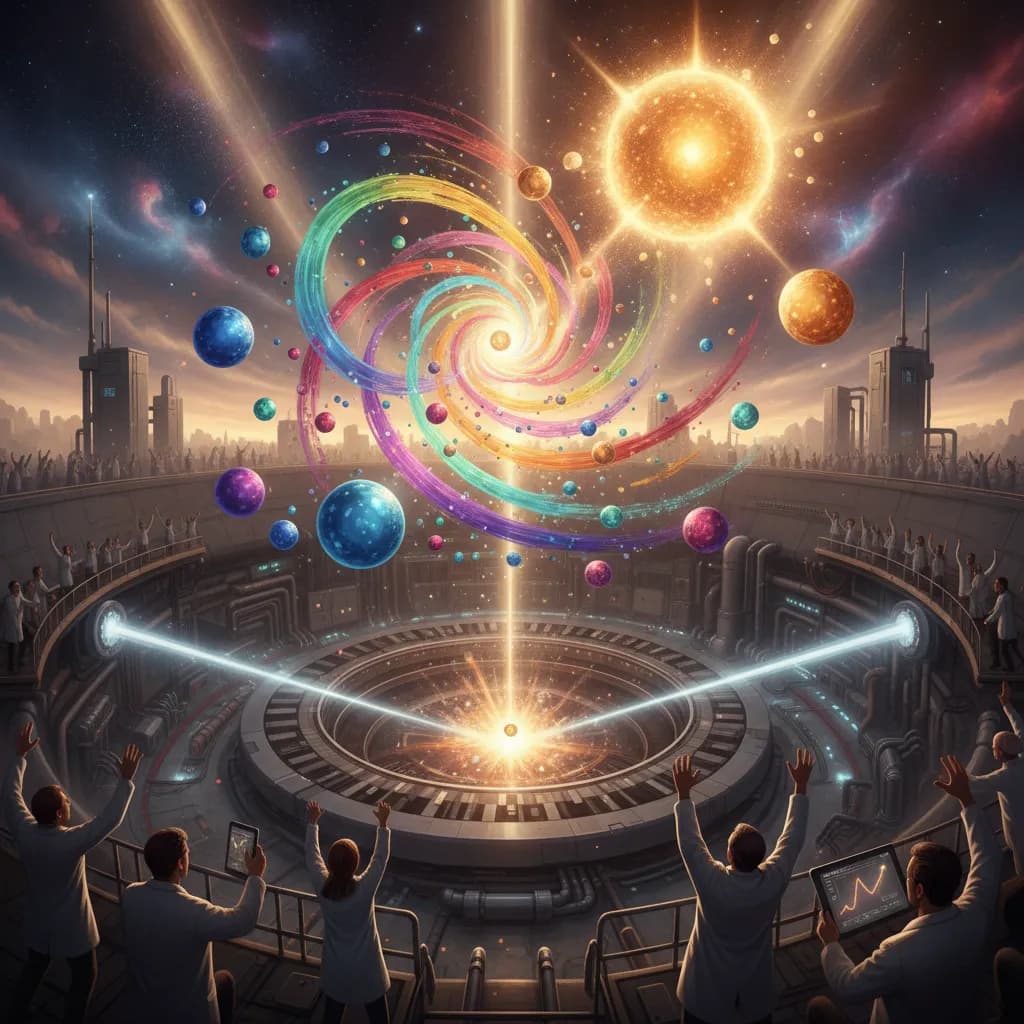
Among its most celebrated predictions is a particle now known as the Higgs boson, theorized back in 1964 as part of a mechanism explaining why other particles have mass at all, but not actually confirmed experimentally until 2012, when physicists at CERN's Large Hadron Collider finally detected it using one of the most complex and expensive scientific instruments ever constructed.
Particles That Refuse to Go It Alone
Some Standard Model particles behave in genuinely strange ways: quarks, a category of fermion, are never observed in isolation in nature, instead always appearing bound together in composite particles like protons and neutrons. Despite the model's remarkable predictive track record, physicists openly acknowledge it remains incomplete, since it offers no explanation whatsoever for gravity, dark matter, or dark energy, phenomena that together account for the overwhelming majority of the universe's actual mass and energy content.
Ad slot (placeholder — set NEXT_PUBLIC_ADSENSE_SLOT_ID once an ad unit is created)
Why People Care
The Standard Model represents one of science's most rigorously tested achievements, correctly predicting particles years before they were observed, and understanding both its remarkable successes and its acknowledged gaps explains why physicists are still actively searching for a more complete theory of the universe.
Glossary
- Fermion
- A category of fundamental particle that makes up matter, including quarks and electrons, as classified by the Standard Model.
- Boson
- A category of fundamental particle that carries forces between other particles, including photons and the Higgs boson.
- Higgs boson
- A particle predicted in 1964 and confirmed in 2012, associated with the mechanism that gives other particles mass.
- Quark
- A fundamental fermion that combines with others to form composite particles like protons and neutrons, never observed in isolation.
- Large Hadron Collider (LHC)
- The world's largest particle accelerator, operated by CERN, used to experimentally confirm the Higgs boson in 2012.
Go Deeper
More to Explore
- Electromagnetism
Light, radio waves, and the current running through a phone charger are, at a fundamental level, all exactly the same physical phenomenon.
- Nuclear Energy
A power source capable of generating enormous amounts of electricity with zero direct greenhouse gas emissions — while also carrying a small number of accidents serious enough to shape global energy policy for decades.
- Thermodynamics
Four simple laws that explain why your coffee always goes cold, and never once has it spontaneously reheated itself back to piping hot.
- Relativity
A theory built almost entirely from thought experiments in a patent office — later confirmed true down to fractions of a second.
- Quantum Mechanics
The rules of the universe change once you zoom in far enough — and even the physicists who discovered this found it deeply unsettling.