Optics and Light
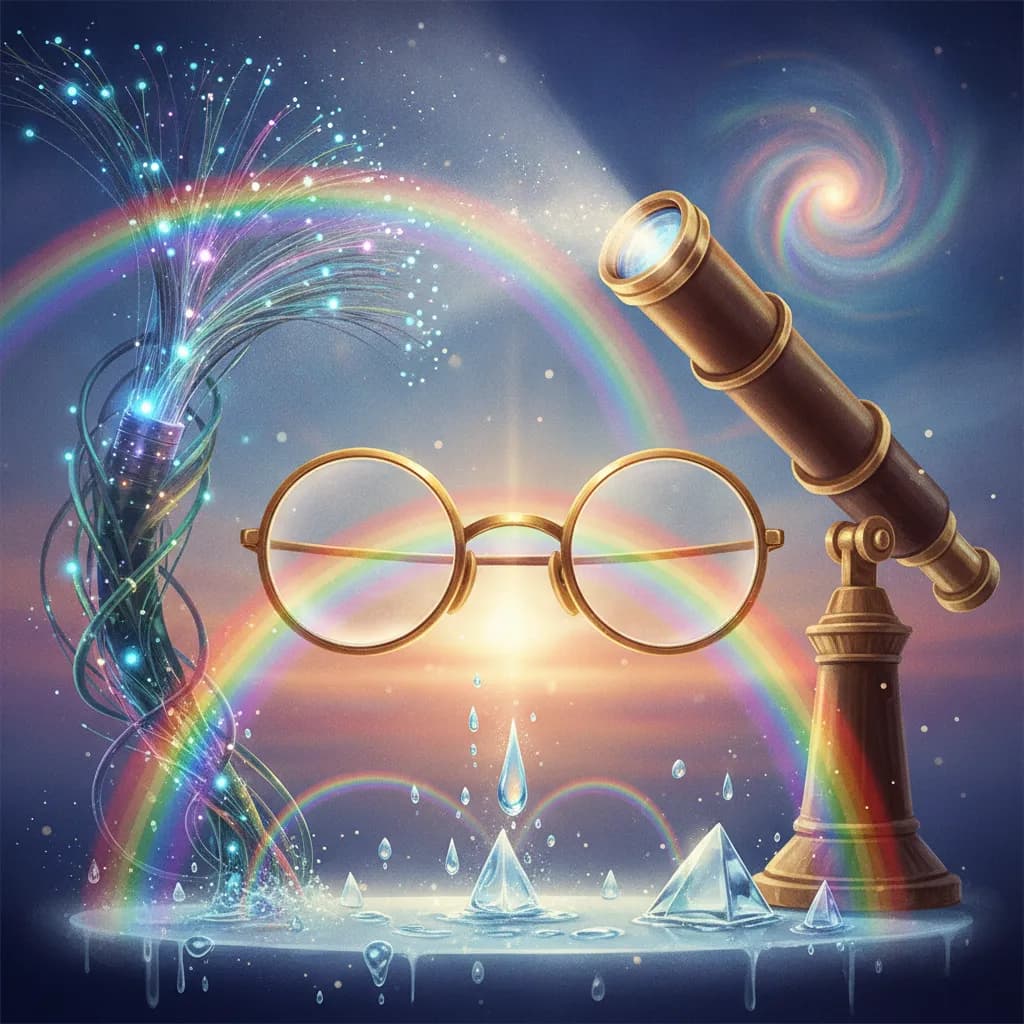
Rainbows, eyeglasses, fiber-optic internet, and telescopes all come down to how light bends.
By Greg Goodwin · Published October 16, 2026 · Updated October 24, 2026
Cheat Sheet
- Speed: 299,792,458 meters per second in a vacuum, a fundamental constant of nature.
- Visible range: wavelengths of roughly 380 to 750 nanometers, a thin slice of the electromagnetic spectrum.
- Dual nature: light behaves as a wave (interference, diffraction) and as particles called photons (the photoelectric effect).
- Snell's law: describes how much light bends when crossing from one material into another.
- Newton (1666): showed that a prism separates white light into colors rather than adding color to it.
- Total internal reflection: the effect that keeps light trapped inside optical fibers carrying internet data.
The 60-Second Version
Optics is the branch of physics that studies light and how it interacts with matter. For everyday purposes, you can picture light as straight rays that bounce off mirrors and bend when passing through glass or water. That simple picture explains how lenses focus images in cameras, microscopes, and your own eye. A deeper picture treats light as a wave, which accounts for colors in soap bubbles and the way light spreads around edges. Quantum physics adds that light also comes in discrete packets called photons. All of these views are useful, and which one you choose depends on the question. Modern optics powers lasers, fiber-optic communication, medical imaging, and displays.
The Long Version
Rays, Mirrors, and Reflection
When light hits a smooth surface, it reflects at the same angle it arrived. That's why a flat mirror gives a clear image, while a rough surface scatters light in all directions and looks matte. Curved mirrors can focus light: a concave mirror concentrates it to a point, which is how reflecting telescopes gather faint starlight and how satellite dishes collect signals.
Refraction and Lenses
Light slows down in materials such as water or glass, which makes it change direction when it crosses an interface at an angle. Snell's law describes the relationship. A convex lens bends parallel rays toward a focal point, forming an image; a concave lens spreads them out. The eye's cornea and lens focus light on the retina, and glasses correct focusing errors by adding or subtracting bending power. Cameras, telescopes, and microscopes combine multiple lenses.
Color and the Spectrum
White light is a mixture of wavelengths. Because glass bends short (blue) wavelengths slightly more than long (red) wavelengths, a prism spreads white light into a spectrum, as Isaac Newton demonstrated in 1666. Rainbows form when sunlight is refracted and reflected inside raindrops, which is why you see them with the sun behind you at an angle of about 42 degrees from the antisolar point. Objects look colored because they absorb some wavelengths and reflect others.
Light as a Wave
In 1801, Thomas Young shone light through two narrow slits and saw alternating bright and dark bands, evidence of interference that could only be explained if light were a wave. James Clerk Maxwell later showed in the 1860s that light is an electromagnetic wave, sharing the spectrum with radio waves, microwaves, X-rays, and others. Polarization, the orientation of a wave's oscillation, explains why polarized sunglasses cut glare from reflecting surfaces.
Light as Particles, and Technology
In 1905, Albert Einstein explained the photoelectric effect by proposing that light comes in quanta, helping launch quantum mechanics. Modern devices exploit both properties. Lasers produce coherent light for surgery, barcode scanners, and cutting. Optical fibers guide light by total internal reflection, carrying most of the world's long-distance data. Solar cells, camera sensors, and LEDs all convert between light and electricity.
Why People Care
Light is how we gather most information about the world, and optics underlies tools from eyeglasses to telescopes to the internet. Understanding it also reveals one of physics's great lessons: sometimes nature requires more than one description.
Glossary
- Refraction
- The bending of light as it passes from one medium to another, caused by a change in speed.
- Diffraction
- The spreading of waves when they pass an edge or through a narrow opening.
- Photon
- A quantum, or packet, of light energy.
- Polarization
- The orientation of a light wave's oscillations, used in sunglasses and LCD screens.
- Focal length
- The distance from a lens to the point where parallel rays converge.
Go Deeper
More to Explore
- Gravity
The force that keeps you in your chair, the Moon in the sky, and physicists awake at night.
- Fluid Dynamics
We can predict the orbit of a planet centuries ahead, but we still can't fully explain the swirl of smoke rising from a candle.
- The Standard Model of Particle Physics
Physicists predicted the Higgs boson in 1964, then waited until 2012 and a giant collider at CERN to actually catch it.
- Electromagnetism
Light, radio waves, and the current running through a phone charger are, at a fundamental level, all exactly the same physical phenomenon.
- Nuclear Energy
Nuclear plants make electricity with no direct greenhouse gas emissions, yet Chernobyl and Fukushima still shape energy policy.