Dark Matter
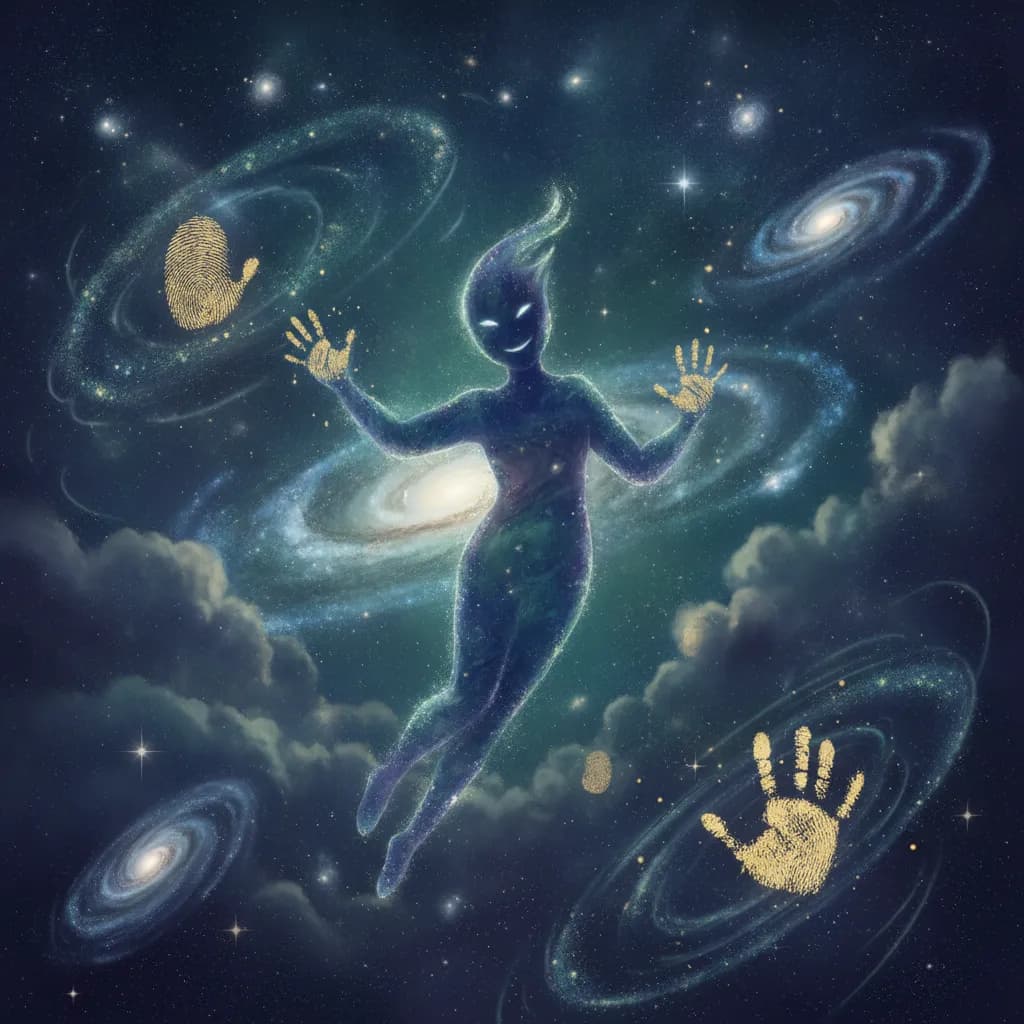
Most of the matter in the universe is invisible, which makes it the cosmos's longest-running case of a missing person who left plenty of fingerprints.
By Greg Goodwin · Published November 4, 2026
Cheat Sheet
- Cosmic budget: about 5% ordinary matter, 27% dark matter, and 68% dark energy (CERN's rounded figures).
- Ratio: dark matter appears to outweigh visible matter roughly six to one, according to CERN.
- First hint: Fritz Zwicky studied the Coma cluster in 1933 and found far more mass than the visible stars account for; sources differ on the factor.
- Rotation curves: in the 1970s Vera Rubin and Kent Ford measured spiral galaxies whose outer stars orbit too fast for visible matter alone.
- Lensing map: Hubble data suggest a ring of dark matter about five million light-years across around galaxy cluster CL0024+17.
- Search status: the LUX-ZEPLIN experiment's 2025 result, from 4.2 tonne-years of exposure, reported no WIMP signal.
The 60-Second Version
Dark matter is the name for whatever is producing extra gravity that astronomers can measure but cannot see. Galaxies spin faster than the gravity of their visible stars and gas should allow, and clusters of galaxies behave the same way, so something unseen seems to be adding mass. The leading explanation is that this is a new kind of matter that does not interact with light, which is why it is called dark. What we actually observe is the gravitational effect. What we hypothesize is the cause, and nobody has yet identified the particles, if particles they are. Several independent kinds of evidence point the same way, including lensing and the afterglow of the Big Bang, which is why most cosmologists treat dark matter as likely real. Others have proposed that gravity itself needs rewriting. The question remains open, and the experiments hunting for it keep tightening the net.
The Long Version
What We Actually Observe
Start with the part that is not in dispute: the measurements. CERN describes galaxies rotating with such speed that the gravity generated by their observable matter could not hold them together, and the same is true of galaxies within clusters. Fritz Zwicky applied the virial theorem to the Coma cluster in 1933 and found far more mass than the visible stars supplied, with sources giving different factors, from more than a hundred times upward. In the 1970s Vera Rubin and Kent Ford measured spiral galaxy rotation curves, and the outer stars kept orbiting quickly, as if wrapped in extra mass. Those are observations. The label "dark matter" is the leading interpretation.
More Than One Line of Evidence
Gravitational lensing offers an independent check, since mass bends light whether or not the mass glows. NASA's Hubble team used the way galaxy cluster CL0024+17 distorts distant galaxies behind it to infer a ring of dark matter about five million light-years across. One hypothesis for the ring is a collision with another cluster about a billion years ago. The Bullet Cluster, two recently collided clusters, shows hot gas separated from the mass mapped by lensing, which is hard to explain by visible matter alone. The cosmic microwave background and the large-scale structure of galaxies point the same direction, which is why independent lines of evidence matter here.
How Much Is There?
The Planck satellite's 2018 results give a dark matter density parameter of 0.120 plus or minus 0.001 and a total matter density parameter of 0.315 plus or minus 0.007 in the standard cosmological model. Rounded, CERN states that dark matter makes up about 27% of the universe, ordinary matter about 5%, and dark energy approximately 68%. Counted as a share of matter alone, dark matter is roughly 85%, which is why you will see both 27% and 85% quoted; they use different denominators. Estimates vary slightly between analyses, but the overall picture is stable: ordinary matter is the minority.
Candidates and the Hunt
The leading candidates are hypothetical particles. WIMPs, weakly interacting massive particles, have dominated searches since the mid-1980s. Axions are another candidate, searched for with experiments called haloscopes, and some theories involve supersymmetric partners of known particles. CERN notes that if dark matter particles were created at the Large Hadron Collider, they would escape the detectors unnoticed and be inferred from missing energy and momentum. In 2025 the LUX-ZEPLIN team published results from 4.2 tonne-years of exposure, with 280 days of data, and reported no WIMP detection; the experiment is planned to run until 2028. A null result narrows the options without ending the search.
Alternatives and What Comes Next
Some physicists suggest changing gravity instead of adding matter. MOND was designed to explain rotation curves, but reviews note that it struggles with most of the other observations. For now, most cosmologists favor dark matter. New instruments keep adding data: the Vera C. Rubin Observatory, named for the astronomer whose rotation curve work helped build the case, began its ten-year Legacy Survey of Space and Time in mid-2026, scanning the southern sky every three to four nights. Dark matter research is among its goals. Whether the answer is a particle, several, or a gap in our theory of gravity is still unknown.
Why People Care
Dark matter is the clearest sign that most of the universe is something we have not yet identified, and discovering it would change physics. It is also a model for how science works: strong measurements, an open gap in explanation, and experiments still trying to close it.
Glossary
- Dark matter
- Unseen matter inferred from its gravity; it does not absorb, reflect, or emit light.
- Rotation curve
- A plot of how fast stars and gas orbit at different distances from a galaxy's center.
- Gravitational lensing
- The bending of light by mass, which lets astronomers map where mass sits even if it is invisible.
- WIMP
- Weakly interacting massive particle, a long-hypothesized dark matter candidate that has not been detected.
- MOND
- Modified Newtonian dynamics, an alternative idea that changes gravity's rules instead of adding unseen matter.
Go Deeper
More to Explore
- Gravity
The force that keeps you in your chair, the Moon in the sky, and physicists awake at night.
- Optics and Light
Rainbows, eyeglasses, fiber-optic internet, and telescopes all come down to how light bends.
- Fluid Dynamics
We can predict the orbit of a planet centuries ahead, but we still can't fully explain the swirl of smoke rising from a candle.
- The Standard Model of Particle Physics
Physicists predicted the Higgs boson in 1964, then waited until 2012 and a giant collider at CERN to actually catch it.
- Electromagnetism
Light, radio waves, and the current running through a phone charger are, at a fundamental level, all exactly the same physical phenomenon.