Dopamine
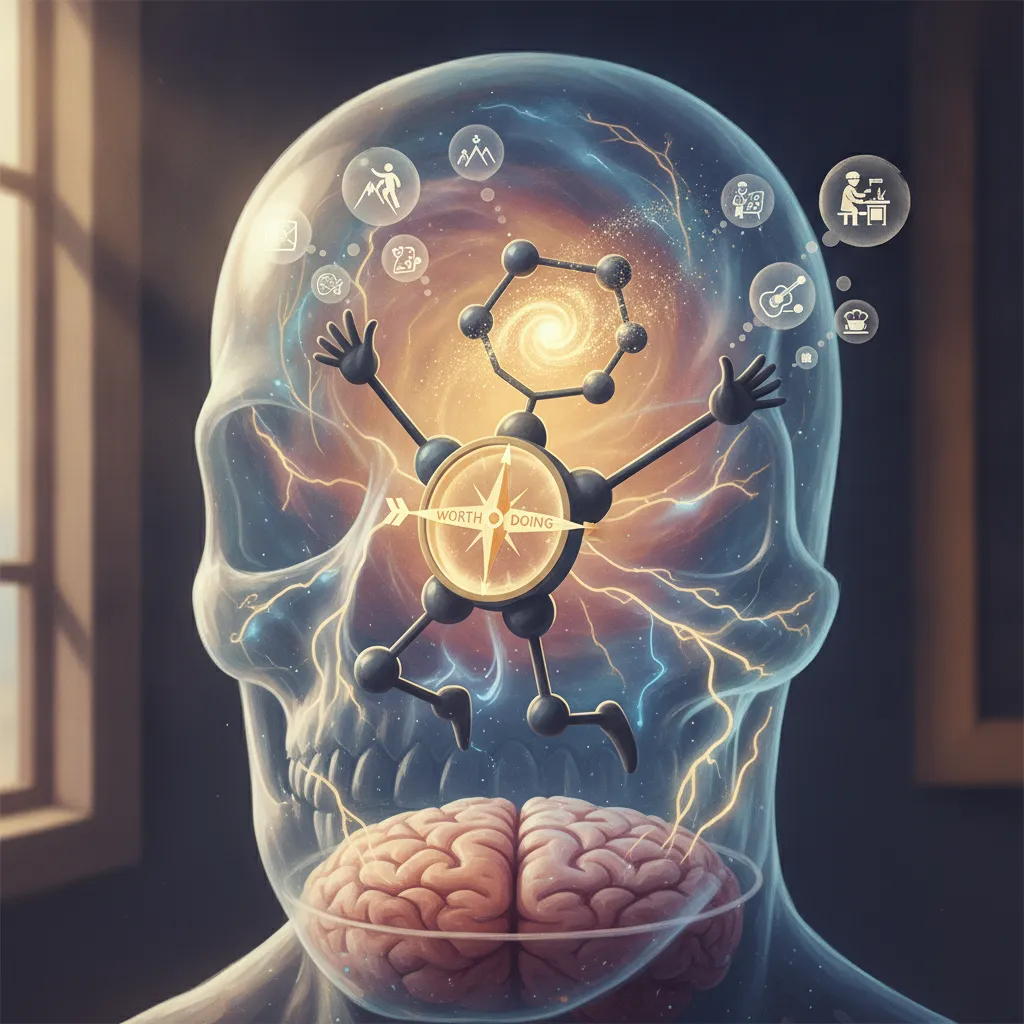
The most misunderstood molecule in your skull: less "feel-good chemical," more "this seems worth doing."
By Greg Goodwin · Published October 24, 2026
Cheat Sheet
- Type: dopamine is a catecholamine neurotransmitter, made from the amino acid tyrosine.
- Receptors: five main subtypes, D1 through D5.
- Landmark finding: Arvid Carlsson's work in the 1950s showed dopamine is a brain neurotransmitter in its own right; he shared the 2000 Nobel Prize in Physiology or Medicine.
- Parkinson's: motor symptoms are tied to loss of dopamine-producing neurons in the substantia nigra, with older autopsy estimates of 50% to 80% loss by symptom onset (newer imaging suggests it may be lower).
- Reward science: Wolfram Schultz's primate recordings in the 1990s showed dopamine neurons fire to unexpected rewards, not predicted ones.
- Myth check: dopamine is not simply the pleasure chemical; it is tied more to learning, motivation and movement.
The 60-Second Version
Dopamine is a chemical messenger, or neurotransmitter, that nerve cells use to talk to one another. A small number of neurons in the midbrain make it, but their reach is wide, touching circuits for movement, learning, attention and motivation. Popular culture calls it the pleasure chemical, and that is an oversimplification. Research on reward points to dopamine as a teaching and motivating signal: it fires strongly when something is better than expected, dips when it is worse, and helps the brain learn what to pursue. Separate dopamine pathways handle movement, which is why losing dopamine-producing cells in Parkinson's disease causes tremor and stiffness. Dopamine also acts outside the brain in minor roles. So no, a "dopamine detox" does not reset your brain, and a text notification is not a drug.
The Long Version
What It Is and Where It Lives
Dopamine belongs to the catecholamine family and is built in neurons from the amino acid tyrosine. It is also a chemical precursor to norepinephrine and epinephrine. Most brain dopamine comes from groups of neurons in the midbrain, mainly the substantia nigra and the ventral tegmental area, which project to other regions through several pathways. The nigrostriatal pathway supports movement, the mesolimbic pathway links to reward and motivation, and the mesocortical pathway reaches the frontal cortex for planning and attention. Cells respond through five receptor subtypes, D1 to D5.
From Neurotransmitter to Nobel
For years dopamine was dismissed as a mere stepping stone to norepinephrine. In the 1950s, the Swedish pharmacologist Arvid Carlsson showed it was a neurotransmitter in its own right and that it was concentrated in brain areas controlling movement. He also found that depleting it produced Parkinson-like stiffness in animals, a result that led directly to treatment with L-DOPA, a precursor that can cross into the brain. Carlsson shared the 2000 Nobel Prize in Physiology or Medicine with Paul Greengard and Eric Kandel. Dopamine itself does not cross the blood-brain barrier well, which is why precursors, not dopamine, entered medicine.
The Reward Prediction Error Story
In the 1990s, Wolfram Schultz recorded single dopamine neurons in monkeys. Neurons fired when an unexpected juice reward arrived. Once a cue reliably predicted the reward, firing shifted to the cue, and the reward itself produced no extra response. If an expected reward failed to arrive, activity dipped below baseline. This pattern matches a reward prediction error, the difference between expected and actual outcome, which is the key quantity in machine learning algorithms too. The finding recast dopamine as a learning and valuation signal, not simply a pleasure readout.
Wanting Versus Liking
Researchers such as Kent Berridge have argued that dopamine contributes more to "wanting," the motivational pull toward something, than to "liking," the pleasure of enjoying it. In animal studies, dramatic dopamine reductions did not remove the facial signs of enjoying sweet tastes but did reduce motivation to seek them. The picture is still debated, and dopamine plays several roles depending on pathway and timing. This framing nonetheless helps explain why addictive drugs, many of which raise dopamine, and attention-grabbing apps can generate strong urges that do not match how much a person enjoys the result.
Dopamine and Disease
Parkinson's disease is defined by loss of dopamine neurons in the substantia nigra, causing tremor, rigidity and slowed movement. Older autopsy-based estimates say symptoms emerge after roughly 50% to 80% of these cells or their function is lost, but recent imaging work suggests the figure may be lower, so treat it as an estimate. Dopamine systems are also involved in schizophrenia, where many antipsychotic medicines block D2 receptors, and in addiction and attention disorders. Diagnosis and treatment of any of these belong with a clinician. This page is general information, not medical advice.
Why People Care
Dopamine has become shorthand for everything from social media habits to productivity hacks. Knowing it is about learning, motivation and movement, not just pleasure, helps you judge claims about "boosting" or "detoxing" it.
Glossary
- Neurotransmitter
- A chemical messenger that carries signals between nerve cells.
- Reward prediction error
- The gap between the reward received and the reward expected, which dopamine neurons help signal.
- Substantia nigra
- A midbrain region whose dopamine neurons support movement and degenerate in Parkinson's disease.
- Mesolimbic pathway
- A dopamine route from the midbrain to limbic areas, central to reward and motivation.
- Receptor
- A protein on a cell that a neurotransmitter binds to in order to trigger a response.
Go Deeper
More to Explore
- How Neurons Work
Your thoughts are a very large number of tiny cells passing electrical sparks and chemical notes to one another.
- The Extinction of the Dinosaurs
One bad rock, one very bad day, and the Age of Dinosaurs got an abrupt ending, with a few feathery survivors.
- Probability
Probability is the math of things you cannot be sure about, which is nearly everything, including whether you will need an umbrella.
- Octopuses and Cephalopods
Eight arms, three hearts, blue blood, and a skin that doubles as a mood ring and a disguise kit.
- Neanderthals
Our stocky, toolmaking cousins who ran the cold half of the Ice Age and still show up in your DNA.