Human Evolution
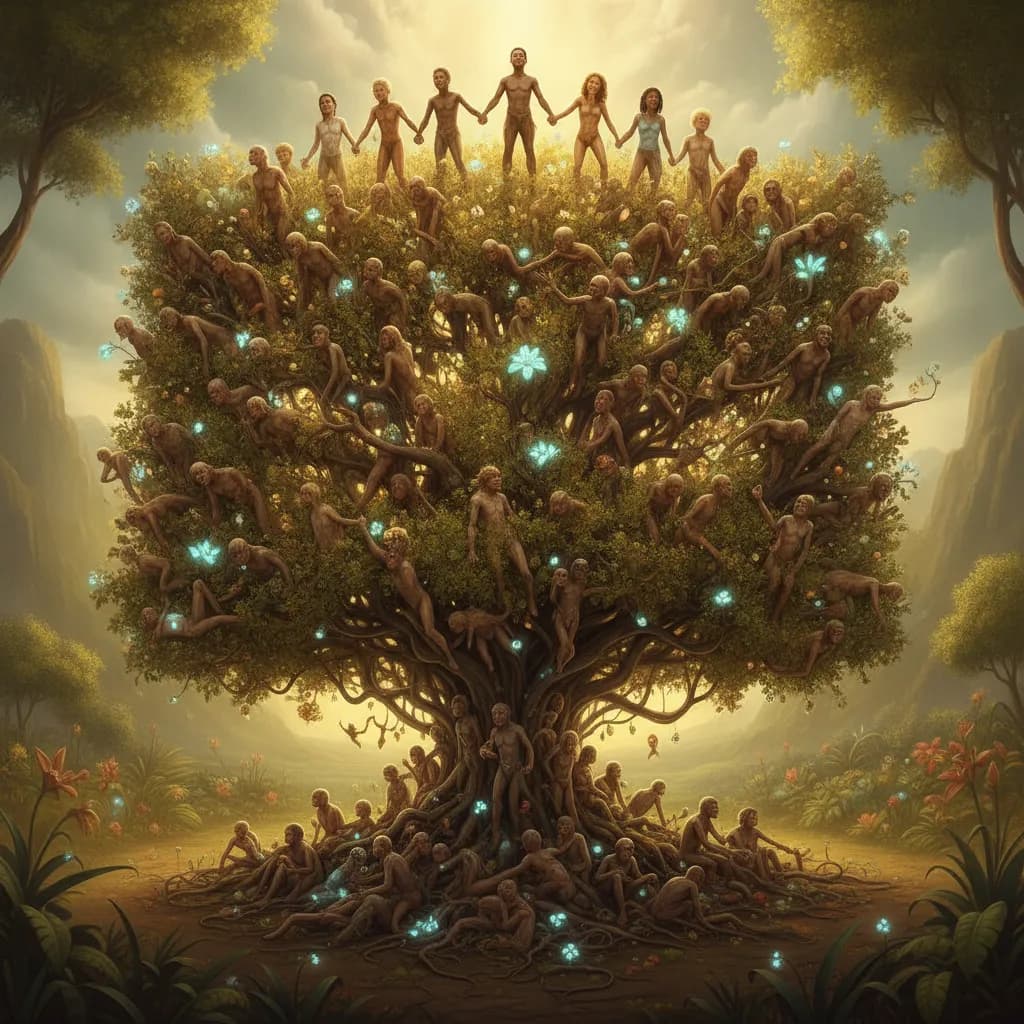
Your family tree turns out to be less a tree than a very crowded, very bushy shrub.
By Greg Goodwin · Published October 17, 2026 · Updated October 24, 2026
Cheat Sheet
- Hominin: any species on the human side of the split from the chimpanzee line, including extinct relatives such as Australopithecus.
- Lucy's species, Australopithecus afarensis, lived about 3.85 to 2.95 million years ago; remains of more than 300 individuals are known.
- Turkana Boy: the most complete Homo erectus skeleton, about 1.6 million years old, with long legs and shorter arms like ours.
- Neanderthals lived about 400,000 to 40,000 years ago; males averaged roughly 164 cm (5 ft 5 in) and 65 kg.
- Modern human brains average about 1,300 cubic centimeters.
- Genomes: humans and chimpanzees are 98-99% similar overall; people with non-African ancestry carry about 1-4% Neanderthal-derived DNA.
The 60-Second Version
Humans belong to a family of upright-walking primates that scientists call hominins. According to the Smithsonian's Human Origins Program, the first hominins diverged from apes sometime between 6 and 7 million years ago in Africa. Since then evolution has produced many species rather than one tidy march toward us: small-brained walkers like Australopithecus, long-legged Homo erectus, whose fossils turn up in Africa, Asia, and the Republic of Georgia, and the stocky, cold-adapted Neanderthals of Eurasia. Our own species, Homo sapiens, evolved in Africa about 300,000 years ago. Museums now lay out the human family as branching groups rather than a straight line from ape to person, and several branches overlapped in time. Ancient DNA shows that some of them even interbred. Because new fossils and genetic methods keep arriving, dates and relationships are best read as current estimates, not final answers.
The Long Version
Our Place on the Tree
Scientists place humans among the apes, but on a branch of our own. The Smithsonian notes that humans and chimpanzees are 98 to 99 percent similar across the whole genome, so the differences that matter are concentrated in a small share of DNA and in how it is used. The word hominin covers the species on the human side of the split from the chimpanzee line, living or extinct. The earliest defining traits are walking upright on two legs and smaller canine teeth; large brains came much later. Compared with earlier humans, modern people have a lighter skeleton, and our brains average about 1,300 cubic centimeters. The Smithsonian's Human Family Tree sorts the known species into four groups, Ardipithecus, Australopithecus, Paranthropus, and Homo, which is a good hint that the picture is a bush with many twigs, not a ladder.
The Earliest Upright Walkers
Sahelanthropus tchadensis, found in Chad in 2001 by a French-led team, is one of the oldest known members of the family, dated to sometime between 7 and 6 million years ago. Only nine cranial specimens are known, including one skull, but the spinal cord opening sits underneath the skull as it does in upright walkers, and the canine teeth are small. Its brain was slightly smaller than a chimpanzee's. Researchers still ask whether it was a common ancestor of humans and chimpanzees. Millions of years later came Australopithecus afarensis, famous from the Lucy skeleton at Hadar, Ethiopia. It lived between about 3.85 and 2.95 million years ago in eastern Africa, a span of more than 900,000 years, roughly three times as long as our species has existed so far. Males averaged about 151 cm (4 ft 11 in) and females about 105 cm (3 ft 5 in). Its apelike face and jaw sat on a body that walked upright, and the Laetoli footprint trails in Tanzania are the oldest documented bipedal tracks.
The Genus Homo Spreads Out
Homo erectus lived between about 1.89 million and 110,000 years ago. The earliest African fossils, sometimes called Homo ergaster, are the oldest known early humans with modern-style body proportions: long legs and shorter arms, suited to walking and perhaps running long distances on the ground. The best-preserved example is Turkana Boy, a skeleton about 1.6 million years old whose teeth show he grew up at a rate similar to a great ape. Heights ranged from roughly 145 to 185 cm, and African fossils were larger than those from China, Indonesia, and Georgia. The Smithsonian's tree also lists other Homo species, including Homo habilis, Homo rudolfensis, Homo heidelbergensis, and Homo floresiensis, the "hobbit" of Flores, Indonesia.
Neanderthals and Our Own Species
Neanderthals, our closest extinct relatives, lived about 400,000 to 40,000 years ago. Their short, stocky bodies, thick limb bones, and large noses suited cold, dry ice-age climates, and their brains were as large as ours, often larger relative to their heavier frames. Homo sapiens, by the Smithsonian's account, evolved in Africa about 300,000 years ago during a period of dramatic climate change. A 2017 report from Jebel Irhoud, Morocco, put early sapiens-like fossils at roughly 300,000 to 315,000 years old, though experts still debate exactly which features define modern humans.
Interbreeding and a Moving Target
Ancient DNA has redrawn the picture. According to the Smithsonian, Neanderthals contributed about 1 to 4 percent of the genomes of people with non-African ancestry, and modern humans who lived about 40,000 years ago had up to 6 to 9 percent. Denisovans, another extinct group, contributed up to 4 to 6 percent in some non-African populations. These numbers describe a small share of the variable parts of the genome, not a fraction of the whole. Fossil dates and species relationships are revised often, so treat any single date as the best current estimate, and expect the Smithsonian and other museums to update their pages as new finds are published.
Why People Care
Human evolution answers "where did we come from" with evidence you can hold: bones, footprints, tools, and DNA. It explains why our bodies are built the way they are, and because the science is still moving, it helps you make sense of the next headline about a surprising fossil.
Glossary
- Hominin
- A member of the human branch of the family tree, including us and our extinct bipedal relatives.
- Bipedalism
- Walking upright on two legs, one of the earliest distinctively human traits.
- Foramen magnum
- The opening at the base of the skull where the spinal cord exits; its position helps reveal whether a species held its head upright.
- Denisovans
- An extinct human relative known largely from ancient DNA, which contributed up to roughly 4-6% of the genome of some non-African populations.
- Paleoanthropology
- The study of human evolution through fossils, stone tools, footprints, and other physical evidence.
Go Deeper
More to Explore
- The Extinction of the Dinosaurs
One bad rock, one very bad day, and the Age of Dinosaurs got an abrupt ending, with a few feathery survivors.
- Neanderthals
Our stocky, toolmaking cousins who ran the cold half of the Ice Age and still show up in your DNA.
- Probability
Probability is the math of things you cannot be sure about, which is nearly everything, including whether you will need an umbrella.
- Octopuses and Cephalopods
Eight arms, three hearts, blue blood, and a skin that doubles as a mood ring and a disguise kit.
- Mitochondria
Tiny former bacteria living inside nearly every cell you own, quietly paying the electric bill.