Keystone Species
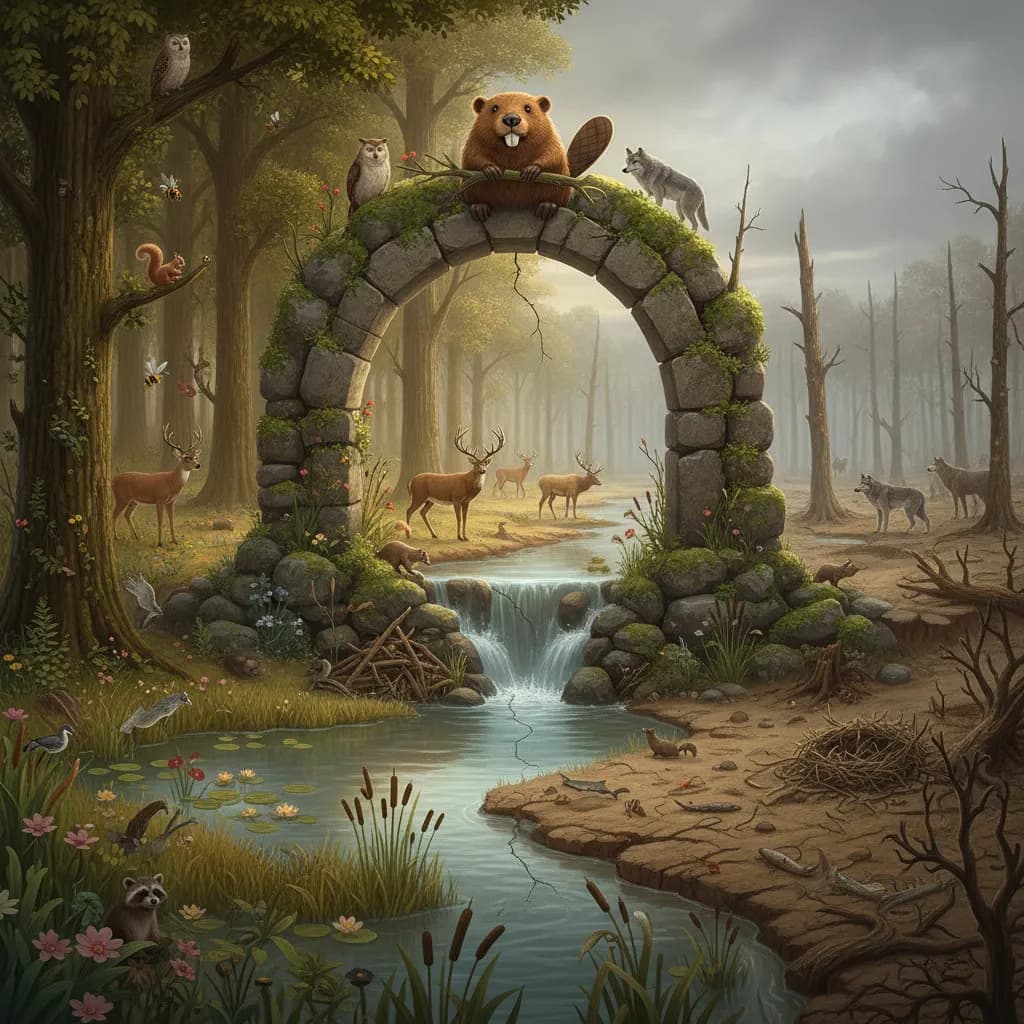
Remove one species and the whole neighborhood changes, which is why ecologists named the idea after the stone that holds up an arch.
By Greg Goodwin · Published November 4, 2026
Cheat Sheet
- Origin: ecologist Robert Paine laid out the keystone hypothesis in 1969, based on tide pools at Mukkaw Bay, Washington.
- Classic test: removing the ochre sea star (Pisaster ochraceus) let mussels quickly overrun the site and crowd out other species.
- Yellowstone: 41 wild wolves from Canada and northwest Montana were released in the park from 1995 to 1997 (National Park Service).
- Wolf diet: elk make up about 90% of the winter diet of Yellowstone wolves, per the National Park Service.
- Kelp link: a sea star die-off that began around 2013 removed a key urchin predator in California, and urchins then ate through kelp forests.
- Fine print: Pisaster's influence is weaker at sheltered sites, and in one study a different sea star, Leptasterias, controlled the snail Tegula.
The 60-Second Version
A keystone species is one whose effect on its ecosystem is far larger than its numbers would suggest. The name borrows from architecture: pull the central stone from an arch and the whole structure sags, even though that stone is a small part of the total. In ecology the stone is usually a predator that keeps one competitor from taking over, so that many other species can share the same patch of habitat. Take it away and the community can slide into something simpler, with a few winners and many losers. The idea grew out of tide pool research and has since been applied to sea otters, wolves, and many other animals. It is also an idea scientists keep refining, because whether a species counts as keystone often depends on the place, the season, and who else happens to live nearby.
The Long Version
The Arch and the Stone
The keystone idea answers a simple question: which species matter most to an ecosystem? The tempting answer is the ones there are the most of, but keystone species are defined the other way around. They matter far more than their abundance would predict. A keystone is not necessarily the biggest, the most numerous, or the most charismatic animal in the neighborhood. Its job is structural. By eating, building, or otherwise shaping what happens around it, it holds a community in a particular shape. According to the Smithsonian's account of the idea's history, the insight has been applied far beyond the coast where it began, in the half century since it was proposed.
Paine's Tide Pools
In 1969, ecologist Robert Paine laid out the keystone hypothesis based on his observations in the tide pools of Mukkaw Bay, Washington. He argued that the ochre sea star, Pisaster ochraceus, played a crucial role in controlling the tide pool community. When he removed Pisaster from tide pools, mussels quickly overran the site, crowding out other species and establishing a monoculture. Within months he wrote a second paper on Pisaster and the black turban snail, Tegula funebralis, suggesting the sea star was the snails' major predator even though snails were not its favorite food. His long career at essentially one study site produced an unusually deep understanding of how that shoreline works.
Otters, Urchins, and Kelp
Sea otters are another textbook case. Coverage of the research, including a National Science Foundation story, describes them as a keystone predator that keeps kelp forests healthy by controlling the sea urchins that graze on kelp. When urchins go unchecked, kelp can disappear and leave an urchin barren. In California, a sea star die-off that began around 2013 removed another urchin predator, and the urchins steadily ate their way through kelp forests. Otters there appear to feed on urchins in the remaining kelp patches rather than on the barrens. Recovery has varied by region: in British Columbia otters had a strong effect on urchins, while California's ecosystem involves additional competing species.
Wolves in Yellowstone
The best-known land example is the gray wolf. The National Park Service says habitat loss and extermination programs wiped wolves out across most of the United States by early in the 1900s. They were listed as endangered in 1973, and from 1995 to 1997 41 wild wolves from Canada and northwest Montana were released in Yellowstone. The park notes that elk make up about 90% of the wolves' winter diet and that it has become a place for research on how wolves may affect many aspects of the ecosystem. One widely reported 20-year study found willow growth surging as wolves returned. Scientists still debate how large the full effect really is.
Why the Label Is Debated
Follow-up work has shown that keystone status is not a fixed property of a species. Oregon State ecologist Bruce Menge found that Pisaster rules freely on exposed coasts like Paine's site, but its influence is weaker in more sheltered areas, and it depends on there being enough mussels and enough sea stars. Researcher Sarah Gravem found that a small, shy sea star called Leptasterias, not Pisaster, controlled the Tegula snails: when an algal bloom wiped out Leptasterias in 2010, the snail population doubled, while a wasting disease that hit Pisaster the next year barely moved it. Ecologists now picture a mosaic of interlocking dependencies rather than a single stone holding up an arch.
Why People Care
Keystone thinking explains why protecting or restoring one animal can reshape an entire coast or valley, and why losing one can quietly unravel a place. It also warns against assuming that the famous predator is always the one doing the work.
Glossary
- Keystone species
- A species whose effect on its ecosystem is much larger than its abundance would predict.
- Trophic cascade
- A chain reaction in which changes at the predator level ripple down through the species they eat and the plants below.
- Urchin barren
- A patch of seafloor where grazing sea urchins have eaten away the kelp and little else grows.
- Monoculture
- An area dominated by a single species, as when mussels crowd out everything else on a rock.
- Apex predator
- A predator at the top of its food chain that has few or no natural predators of its own.
Go Deeper
More to Explore
- Coral Reefs
Cities built by animals the size of a pencil eraser, now living on the edge of a thermometer.
- Food Webs
Nobody in nature eats just one thing, which makes the dinner table of an ecosystem look a lot more like a tangled web than a tidy line.
- Tornadoes
A thunderstorm's spinning arm reaches the ground, gets graded by the damage it leaves, and is forecast better than ever but never perfectly.
- The Periodic Table
One chart organizes every known element and predicts how each behaves, which is frankly rude of it to be so tidy.
- Natural Selection
Natural selection is evolution's bookkeeper: it plans nothing and simply tallies who leaves more offspring.