REM Sleep and Dreams
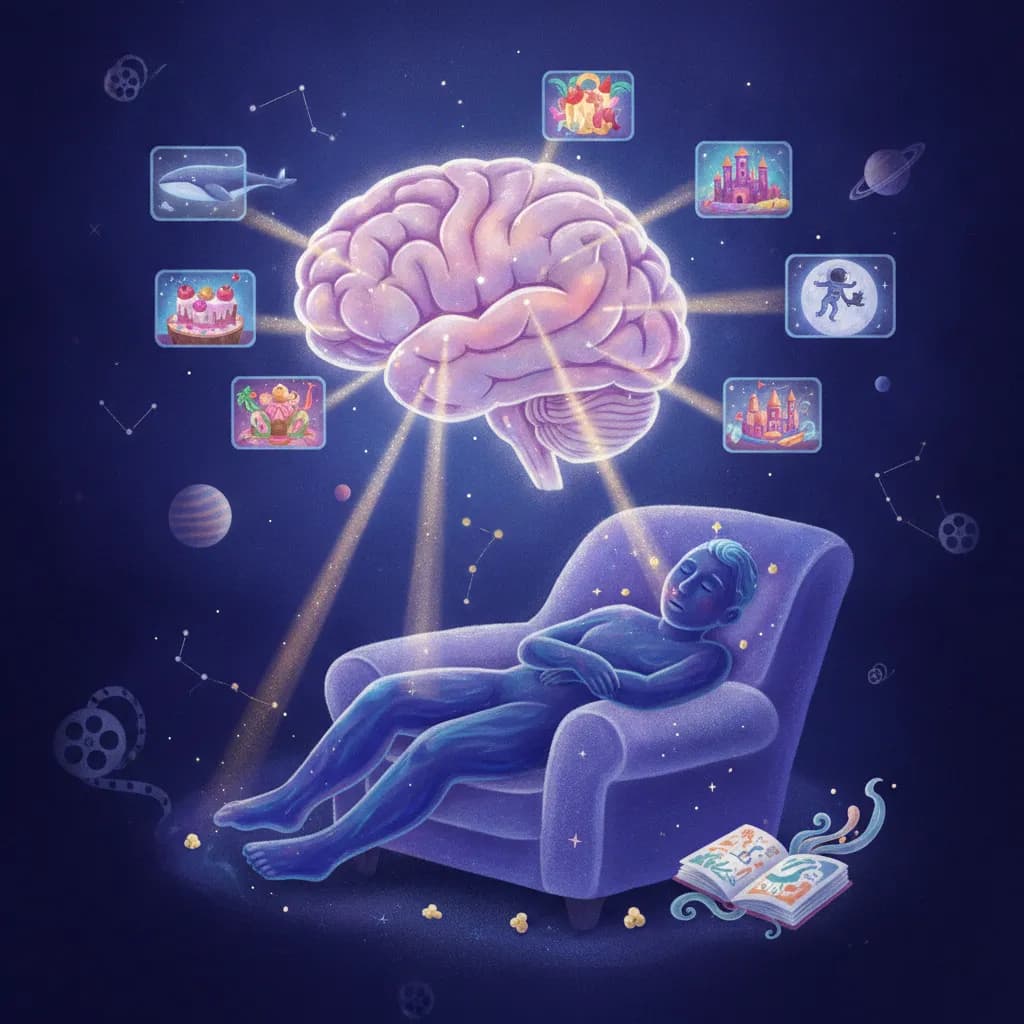
Your brain runs a nightly film festival while your body politely stays in its seat.
By Greg Goodwin · Published October 24, 2026
Cheat Sheet
- Share: REM sleep makes up roughly 20% to 25% of a healthy adult's night.
- Cycle length: sleep cycles through NREM and REM about every 90 minutes, with estimates ranging from roughly 70 to 120.
- First REM: the first episode typically arrives 70 to 90 minutes after falling asleep and is short, with later episodes longer.
- Discovery: Eugene Aserinsky and Nathaniel Kleitman reported REM sleep in 1953 at the University of Chicago.
- Paralysis: during REM the body's voluntary muscles are largely switched off, a state called REM atonia.
- Not exclusive: dreams also occur in non-REM sleep, though they tend to be less vivid and more thought-like.
The 60-Second Version
Sleep is not one long blackout. It cycles between non-REM stages, which range from light drowsing to deep, slow-wave sleep, and REM, or rapid eye movement sleep. In REM, the eyes dart beneath closed lids, brain activity looks surprisingly similar to waking, breathing and heart rate become more variable, and the large voluntary muscles are temporarily switched off. This is the stage most closely tied to vivid, story-like dreams. The pattern repeats roughly every 90 minutes, and REM makes up roughly a fifth to a quarter of an adult's night, with the longest REM periods coming in the early morning hours. Why we dream is still debated. Researchers connect REM to memory processing and emotional regulation, but no theory has settled the question. This page is general information, not medical advice.
The Long Version
The 1953 Discovery
For most of history, sleep was assumed to be a passive off switch. That changed in 1953, when Eugene Aserinsky, a graduate student working with Nathaniel Kleitman at the University of Chicago, recorded bursts of rapid eye movements in sleeping subjects and noticed that their brain waves looked nearly awake. People woken during these periods often reported vivid dreams. The finding opened the modern era of sleep research and showed that the sleeping brain is highly organized, not idle. Later work by Kleitman, William Dement and others mapped how REM alternates with the other stages across a night.
Anatomy of a Night
A typical night is built from stacked cycles lasting about 90 minutes each, though estimates run from roughly 70 to 120 minutes and vary between people. Each cycle moves from lighter NREM sleep into deep slow-wave sleep and then into REM. The first REM episode usually arrives 70 to 90 minutes after sleep onset and may last only 10 to 15 minutes. Deep sleep dominates the early cycles, while REM episodes grow longer toward morning, sometimes approaching an hour. That is why cutting a night short, by waking up early, tends to trim REM more than other stages. Overall, REM accounts for about 20% to 25% of adult sleep.
What the Brain and Body Are Doing
REM is sometimes called paradoxical sleep because the brain looks awake while the person is anything but. Brainstem circuits activate the cortex, and the chemical mix shifts: acetylcholine stays active while monoamine neurotransmitters such as serotonin, norepinephrine and histamine fall quiet. Meanwhile, signals to the voluntary muscles are blocked, producing REM atonia, which keeps dreamers from physically acting out what they see. In REM sleep behavior disorder, that block fails and people can move, shout or flail during dreams, which is a reason to see a clinician. The eye muscles and breathing muscles are largely spared.
Why Do We Dream?
Nobody knows for certain. The activation-synthesis hypothesis, proposed by J. Allan Hobson and Robert McCarley in 1977, held that dreams are the cortex weaving a story out of random brainstem signals. Later views emphasize that dream content draws on recent waking experience and emotion. Research links REM to memory consolidation and emotional processing, but the Sleep Foundation notes that the exact purpose of dreaming remains unclear. Plausible ideas coexist, and the claim that dreams carry hidden coded messages has no solid scientific backing. Much dream research also depends on what people report after waking, which is imperfect, because dreams fade fast.
Dreams Beyond REM
A popular myth says dreaming happens only in REM. In fact, people woken from non-REM sleep also report dream-like experiences, though those reports tend to be shorter, more thought-like, and less vivid. Researchers have also questioned how sharp the line between REM and non-REM dreaming really is. REM does remain the stage richest in elaborate, emotional, story-like dreams, which is why nightmares and the dreams you remember in the morning often come from it. Lucid dreaming, where a sleeper realizes they are dreaming, has been documented in REM sleep in laboratory studies. Persistent sleep trouble, loud dream enactment, or exhausting nightmares are worth bringing to a clinician.
Why People Care
Everyone dreams, and almost everyone wonders why. REM sleep also shows what is lost when sleep is cut short, since later cycles carry the most REM. If sleep or nightmares are a problem, a clinician is the right person to ask. This is general information, not medical advice.
Glossary
- REM
- Rapid eye movement sleep, a stage with fast eye movements, vivid dreaming, and brain activity that resembles waking.
- NREM
- Non-rapid eye movement sleep, the lighter and deeper stages that alternate with REM through the night.
- REM atonia
- The temporary loss of muscle tone during REM that keeps people from acting out their dreams.
- Lucid dream
- A dream in which the sleeper realizes they are dreaming, sometimes while still asleep and in REM.
- Activation-synthesis
- A 1977 theory that dreams are the forebrain's attempt to make sense of random signals generated by the brainstem.
Go Deeper
More to Explore
- How Sleep Works
Every night you voluntarily go unconscious for hours, and science is still arguing about exactly why.
- Vitamins
Tiny molecules with enormous résumés: you need them in minuscule amounts, and you cannot do without them.
- Stroke
A brain attack: no warning bell, no waiting room, and a clock that starts the moment symptoms do.
- Menopause
A natural biological milestone that arrives with a long runway and surprisingly little advance briefing.
- Diabetes
Your body's fuel system works great until the key that lets sugar into your cells goes missing or stops fitting the lock.