How Sleep Works
Every night you voluntarily go unconscious for hours, and science is still arguing about exactly why.
By Greg Goodwin · Published October 17, 2026 · Updated October 24, 2026
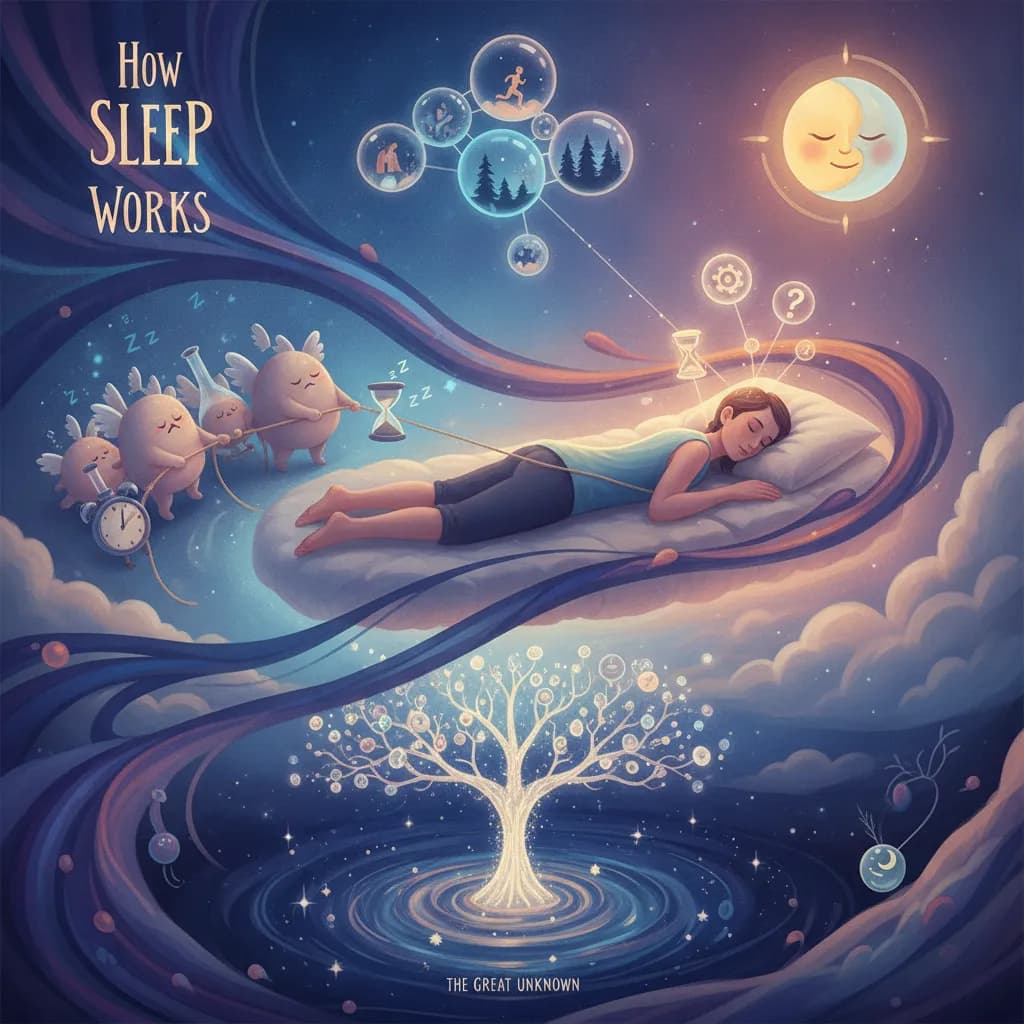
Cheat Sheet
- Time budget: you spend about one-third of your life asleep.
- Duration: the CDC lists 7 or more hours for ages 18-60, while NINDS says most adults need 7-9 hours.
- Architecture: three non-REM stages plus REM, repeated several times a night.
- First REM: arrives about 90 minutes after you fall asleep.
- Night shape: deep stage 3 sleep comes in longer stretches early on; REM periods get longer later.
- Caffeine: works by blocking adenosine, the chemical that builds sleepiness.
The 60-Second Version
Sleep is an active, organized process, not a nightly power-off. Two systems steer it. A body clock, driven by light and centered in the brain's hypothalamus, makes you sleepy at night and alert in the morning. Meanwhile a sleep drive builds the longer you stay awake, which is why an all-nighter feels so heavy. Once you drift off, the brain cycles through lighter and deeper non-REM stages and into REM sleep, the stage most associated with vivid dreaming. Deep sleep dominates the early night, and REM stretches out toward morning. Researchers know sleep touches memory, mood, immunity, and metabolism, yet its core biological purpose remains a mystery. Most adults do best with about seven to nine hours. This is general information, not medical advice, so see a clinician if sleep trouble persists.
The Long Version
A Third of Your Life, Purpose Unknown
You spend roughly one-third of your time asleep, and the National Institute of Neurological Disorders and Stroke calls quality sleep as essential to survival as food and water. Without it, the brain struggles to form and maintain the pathways behind learning and new memories, and concentration and reaction time suffer. Chronic short or poor sleep is linked to higher risks of high blood pressure, cardiovascular disease, diabetes, depression, and obesity. Yet NINDS is candid that the biological purpose of sleep remains a mystery. Some recent findings suggest a housekeeping role, with sleep helping clear waste products that build up while you are awake, but that is an active research area rather than a settled answer.
Two Clocks Running Your Night
Two internal mechanisms work together. The circadian rhythm is a roughly 24-hour clock. Its master timer, the suprachiasmatic nucleus in the hypothalamus, takes light information straight from the eyes. As darkness falls, the pineal gland increases melatonin, which helps put you to sleep. The second mechanism, sleep-wake homeostasis, tracks how long you have been awake; that drive gets stronger every hour and makes recovery sleep longer and deeper. A chemical called adenosine contributes to sleepiness, and caffeine counteracts it by blocking adenosine's action. Light exposure is perhaps the biggest outside influence, which is why night-shift work and jet lag, both of which scramble the match between body clock and real clock, feel so rough.
A Night in Stages
Sleep has two basic types: REM and non-REM, with non-REM divided into three stages. Stage 1 is the brief changeover from wakefulness, lasting several minutes. Stage 2 is light sleep with slowing heartbeat and breathing and a dropping body temperature, and you spend more of the night here than in any other stage. Stage 3 is deep sleep, when heart rate and breathing hit their lowest levels and it can be hard to wake you; it occurs in longer periods during the first half of the night. You cycle through these stages several times, with REM periods growing longer and deeper later in the night.
REM and Dreaming
REM sleep first arrives about 90 minutes after you fall asleep. Your eyes dart side to side behind closed lids, breathing becomes faster and irregular, and heart rate and blood pressure rise toward waking levels. Most dreaming happens here, although it can occur in other stages too. The brainstem sends signals that temporarily paralyze the arm and leg muscles, which keeps you from acting out dreams. NINDS notes that the thalamus, quiet during most sleep stages, becomes active in REM and feeds the cortex images and sensations, and that the emotion-processing amygdala becomes more active. People spend about two hours a night dreaming, and REM time declines with age. Memory consolidation most likely needs both non-REM and REM sleep.
How Much, and When to Get Help
Needs vary between individuals, but the CDC lists 7 or more hours for adults aged 18 to 60, 7 to 9 hours for ages 61 to 64, and 7 to 8 hours for 65 and older, while teens need 8 to 10. NINDS adds that weekend sleeping-in may not fully repay a heavy sleep debt. Habits that help include a consistent schedule, a cool, quiet bedroom, avoiding caffeine late in the day, and limiting large meals and alcohol before bed. Signs of poor quality sleep include trouble falling asleep, repeated waking, and feeling tired despite enough hours. Common sleep disorders include insomnia, restless legs syndrome, narcolepsy, and sleep apnea. If you regularly struggle, talk to a healthcare provider, who may order a sleep study.
Why People Care
Sleep affects nearly everything people want more of: focus, mood, energy, and long-term health. Knowing how the body clock and sleep drive work turns vague advice like "keep a schedule" into something you can actually plan around, and it helps you spot when it is time to ask a clinician for help.
Glossary
- Circadian rhythm
- The roughly 24-hour internal clock that shapes sleepiness, body temperature, and hormone release.
- Sleep drive (homeostasis)
- The pressure to sleep that grows with every hour you stay awake.
- REM sleep
- The stage with rapid eye movements, vivid dreams, and temporarily paralyzed arm and leg muscles.
- Melatonin
- A hormone released by the pineal gland that helps signal nighttime to the body.
- Suprachiasmatic nucleus
- A cluster of cells in the hypothalamus that receives light information from the eyes and times your body clock.
Go Deeper
More to Explore
- REM Sleep and Dreams
Your brain runs a nightly film festival while your body politely stays in its seat.
- Vitamins
Tiny molecules with enormous résumés: you need them in minuscule amounts, and you cannot do without them.
- Stroke
A brain attack: no warning bell, no waiting room, and a clock that starts the moment symptoms do.
- Menopause
A natural biological milestone that arrives with a long runway and surprisingly little advance briefing.
- Diabetes
Your body's fuel system works great until the key that lets sugar into your cells goes missing or stops fitting the lock.