The History of Denim
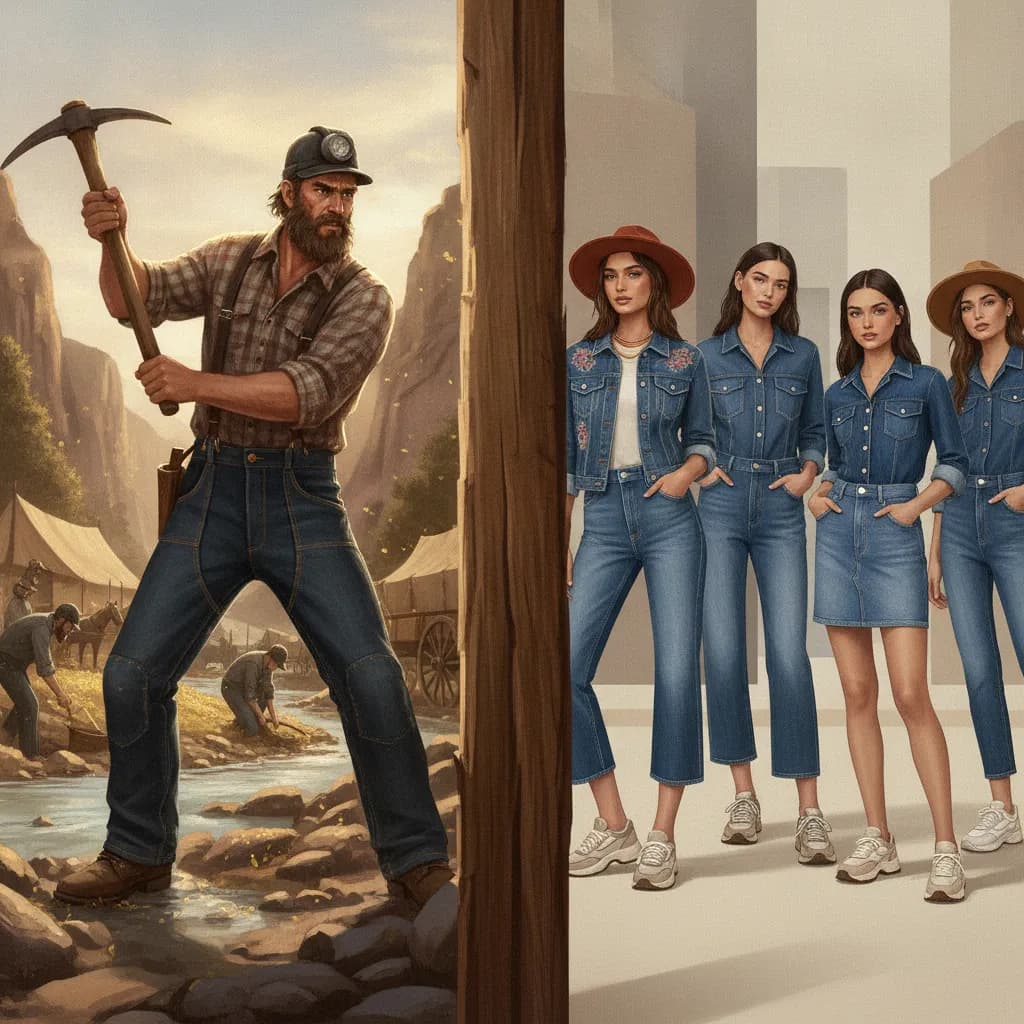
Blue jeans started life as reinforced pants for gold miners, and it took nearly a century before anyone thought to sell them as fashion rather than pure workwear.
Cheat Sheet
- Jacob Davis and Levi Strauss patented the riveted denim work pant in 1873, the invention widely credited with creating modern blue jeans.
- The fabric's name likely derives from 'serge de Nîmes,' a sturdy French twill textile from the city of Nîmes.
- Indigo dye, denim's signature color, fades unevenly with wear, which is why authentic vintage jeans develop unique whisker and honeycomb patterns.
- Originally marketed purely as durable workwear for miners and laborers, not as fashion, well into the early 20th century.
- Denim became a symbol of youth rebellion in the 1950s after films popularized it as rebellious, working-class attire among middle-class teenagers.
- The 1980s and 1990s saw a boom in designer denim, transforming a once-utilitarian fabric into a luxury fashion category.
The 60-Second Version
Denim's origin story is really about durability, not style: the fabric's signature toughness comes from a sturdy twill weave believed to trace back to a French textile called "serge de Nîmes," which is likely where the name "denim" itself comes from. Its transformation into modern jeans happened in 1873, when Jacob Davis and Levi Strauss patented the idea of reinforcing denim work pants with metal rivets at points prone to ripping, creating a garment built specifically to survive hard manual labor. For decades afterward, jeans stayed firmly in workwear territory, worn by miners and laborers rather than anyone dressing to make a fashion statement. That changed dramatically in the 1950s, when films depicting denim-clad rebellious youth turned the fabric into a symbol of teenage defiance for a middle-class audience that had nothing to do with mining or ranching. Decades later, the fashion industry completed denim's full transformation by launching a designer denim boom in the 1980s and 1990s, turning what had once been purely utilitarian workwear into a legitimate luxury fashion category commanding premium prices.
The Long Version
A Fabric Named for Its Toughness
Denim's core appeal has always been its remarkable durability, a quality rooted in a sturdy twill weave that most textile historians trace back to "serge de Nîmes," a French fabric from the city of Nîmes, which is widely believed to be the actual origin of the word "denim" itself.
The Invention That Made Jeans, Jeans
The garment most people picture today as "jeans" dates specifically to 1873, when Jacob Davis and Levi Strauss patented the idea of reinforcing denim work pants with metal rivets at stress points prone to tearing, an invention aimed purely at solving a practical durability problem for laborers rather than creating a fashion trend.
Decades of Pure Workwear
For roughly the next eighty years, denim jeans remained firmly associated with manual labor, worn primarily by miners, ranchers, and factory workers who needed clothing that could survive genuinely rough conditions, with essentially no association whatsoever to fashion or personal style during this period.
From Rebellion to Runway
That utilitarian image cracked open in the 1950s, when popular films depicted denim-wearing rebellious youth, turning jeans into a potent symbol of teenage defiance for a middle-class audience with no actual connection to manual labor. Decades later, the fashion industry completed denim's transformation entirely, with a designer denim boom throughout the 1980s and 1990s recasting what had been humble workwear into a legitimate, premium-priced luxury fashion category.
Ad slot (placeholder — set NEXT_PUBLIC_ADSENSE_SLOT_ID once an ad unit is created)
Why People Care
Denim's journey from miners' workwear to a multi-billion-dollar global fashion category is a genuinely unusual arc for any fabric, and understanding it explains why a garment invented purely for durability has managed to remain a fashion staple for over 150 years.
Glossary
- Riveted denim
- Denim reinforced with metal rivets at stress points, patented by Jacob Davis and Levi Strauss in 1873.
- Indigo dye
- The traditional blue dye used to color denim, notable for fading unevenly and distinctively with wear.
- Serge de Nîmes
- A sturdy French twill fabric from the city of Nîmes, widely believed to be the origin of the word 'denim.'
- Selvedge denim
- Denim woven on traditional shuttle looms with a self-finished edge, prized by enthusiasts for its quality and durability.
- Designer denim
- High-fashion, premium-priced jeans that emerged as a major category in the 1980s and 1990s.
Go Deeper
- Levi Strauss & Co. — Heritage and History
- Denim: Fashion's Frontier, by Emma McClendon
More to Explore
- The Little Black Dress
A single black dress was once compared to the Ford Model T for how it made a fashion staple universally accessible.
- Vintage Fashion
A single decade of clothing can carry an instantly recognizable silhouette all its own — spotting the difference between a genuine original piece and a modern "vintage-inspired" copy takes a genuinely trained eye.
- Streetwear
A fashion movement that started as a countercultural rejection of traditional luxury fashion has since become so commercially powerful that traditional luxury houses now actively seek it out for collaborations.
- Haute Couture
A term casually thrown around to describe any fancy outfit — but "haute couture" is actually a strictly regulated, legally protected French designation that only a small handful of fashion houses officially qualify for.
- Seasonal Color Analysis
The same shade of red can make one person's complexion glow and make another's look noticeably washed out — seasonal color analysis exists entirely to explain why.