Rock Climbing
Chalk, grit, and a fingertip grudge against gravity, now with Olympic medals.
By Greg Goodwin · Published November 4, 2026
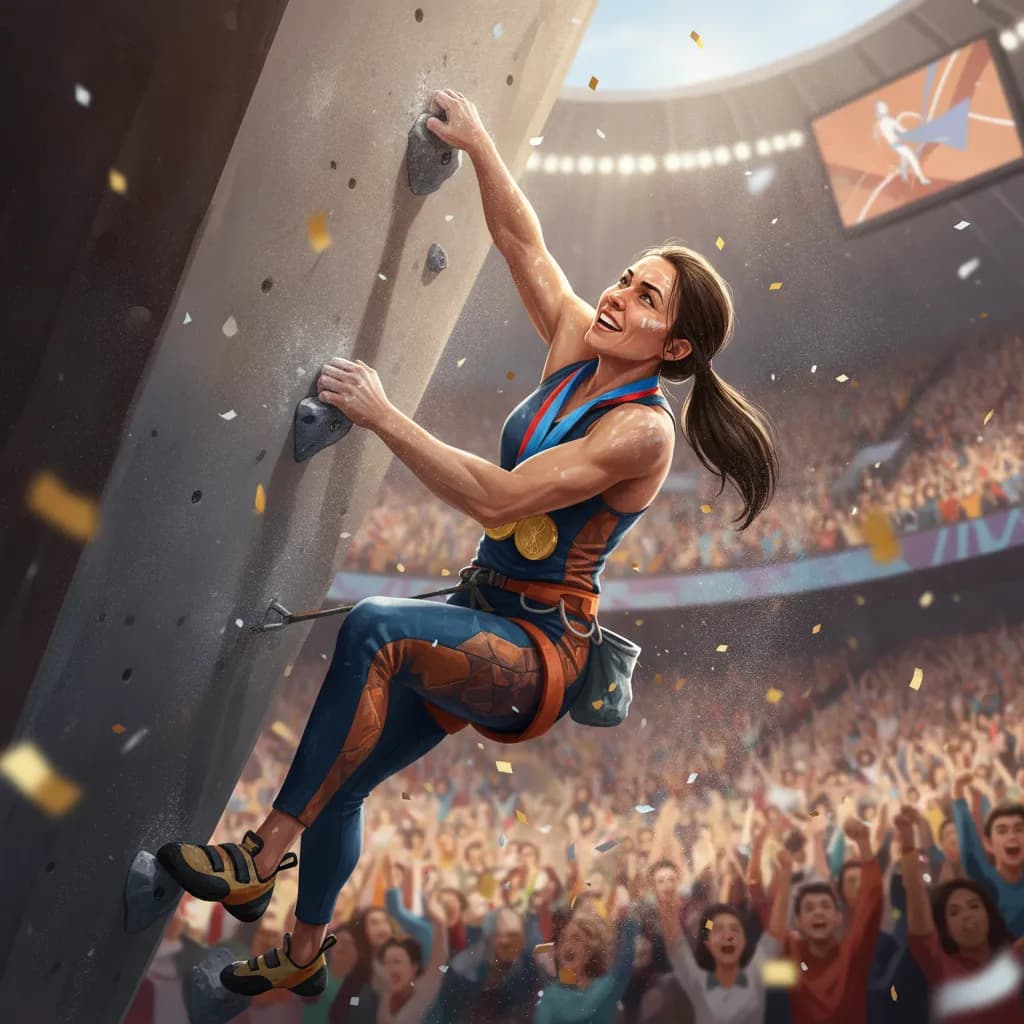
Cheat Sheet
- Olympic debut: Tokyo 2020 had one combined event per gender, mixing boulder, lead, and speed, with 40 athletes.
- Tokyo champions: Janja Garnbret (Slovenia) and Alberto Gines Lopez (Spain).
- Paris 2024: four gold medals and 68 athletes, 28 in speed and 40 in boulder-and-lead.
- Combined scoring in Paris: boulder and lead points are added, with a best possible score of 200.
- Men's speed world record: 4.64 seconds, set by Samuel Watson of the USA in Bali in May 2025.
- Hardest-grade milestone: Silence, climbed by Adam Ondra on September 3, 2017, in Norway, was proposed as the first 9c (5.15d).
The 60-Second Version
Rock climbing is the sport of moving up natural rock or artificial walls using your hands, feet, and a lot of problem-solving. It comes in several styles. Bouldering means short, hard problems close to the ground, lead climbing means clipping a rope into protection as you ascend a taller route, and speed climbing is a head-to-head race up a standardized wall that is 15 meters high. Climbs are graded for difficulty, and in the United States the Yosemite Decimal System runs from 5.0 to 5.15d. Climbing joined the Olympics at Tokyo 2020, and Paris 2024 split it into separate boulder-and-lead and speed events for each gender. Most people start in an indoor gym, where staff teach safety basics, and many later move outdoors with experienced partners or guides. It is physically demanding but friendly to beginners, because the first goal is simply to get off the floor and see how far a good foot placement can take you.
The Long Version
Three Disciplines
Competition climbing has three disciplines. In boulder and lead, the Olympics.com explainer says, athletes earn points when they validate a zone or a move, and unsuccessful attempts lead to a point deduction. The goal is to reach the highest point on the wall. In speed climbing, athletes try to reach the top of a 15-meter wall as fast as possible, in a qualification round followed by head-to-head races up a bracket. Outside competition, climbers also talk about sport climbing on routes with fixed bolts, and traditional climbing, where climbers place their own removable protection. The shared theme is balance, strength, and planning each move before gravity votes against you.
Climbing Becomes Olympic
Sport climbing debuted at Tokyo 2020 as a single combined event for each gender, in which each athlete competed in boulder, lead, and speed and needed to be an all-rounder. The first Olympic champions were Janja Garnbret of Slovenia and Alberto Gines Lopez of Spain. At Paris 2024 the sport doubled to two events per gender, boulder-and-lead combined and speed, for four gold medals in total, with the field growing from 40 athletes to 68. Competition ran from August 5 to 10, 2024, at Le Bourget. Olympics.com notes that removing speed from the combined event was welcomed by many athletes because training for all three was hard.
Speed Gets Faster
Speed climbing is the sport's most measurable event, and the records keep falling. World Climbing, the sport's international federation, reports that Samuel Watson of the USA, who set the world record at Paris 2024 while winning bronze, lowered it to 4.67 seconds in a semi-final and then to 4.64 seconds in the final at the World Cup in Bali in May 2025. Poland's Aleksandra Miroslaw, the Olympic champion, is described as the women's world record holder. At Chamonix in July 2025, the qualifying cut-off to reach the finals was a record-fast 5.09 seconds for men and 7.08 for women. Because records change quickly, check the federation's current list.
Grades and Landmark Climbs
Climbers rate routes with grading systems, and the Yosemite Decimal System, used in the United States, runs from 5.0 to 5.15d. Guinness World Records notes that grades are set by rough consensus, so a number is an opinion rather than a measurement. The route Silence, in Flatanger, Norway, was climbed by Adam Ondra on September 3, 2017, and is described as the first route given a grade of 9c, equivalent to 5.15d, though that grade is a proposal. The route is about 45 meters long, with the first half rated 8b (5.13d) before harder, boulder-style moves. Many climbers find that a grade is a rough guide, and that body size, style, and conditions matter.
Getting Started and Staying Safe
Most beginners start in a climbing gym, where introductory classes cover how to wear a harness, tie in, and belay, which means managing the rope for a partner. Bouldering needs little more than shoes and chalk, but falling safely still has to be learned. Climbing has real risks, including falls, equipment failure, and poor judgment outdoors, so it pays to learn from qualified instructors, check gear regularly, and move outside with experienced partners or guides. Local access rules and weather also matter. Start with easy routes, rest between attempts, and treat a sore forearm as information rather than a challenge.
Why People Care
Rock climbing blends fitness, puzzle-solving, and the outdoors, and it has grown from a niche pursuit into an Olympic sport with gyms in many cities. Knowing the disciplines, the grading idea, and the safety basics makes it easier to follow the Games or to take your first step onto a wall.
Glossary
- Bouldering
- Climbing short, hard problems without a rope, usually over crash pads or padded floors.
- Lead climbing
- Climbing a longer route while clipping the rope into protection points as you go up.
- Speed climbing
- A head-to-head race up a standardized wall, which is 15 meters high in Olympic competition.
- Yosemite Decimal System
- The US difficulty scale for technical climbs, running from 5.0 to 5.15d, with grades set by rough consensus.
- Onsight
- Climbing a route cleanly on the first try with no prior practice or information from watching others.
Go Deeper
More to Explore
- Surfing
The sport of standing on a moving piece of the ocean, which once nearly vanished and now has Olympic medals.
- Squash
A squash ball has to warm up before it plays properly — start a match with a cold ball and it barely bounces at all.
- Tennis
A sport whose scoring system makes zero sense to newcomers, calling zero "love" for reasons nobody fully agrees on.
- Table Tennis
Ping-pong has a basement reputation, but elite players must read spin and trajectory in a fraction of a second.
- Swimming
A sport where "freestyle" technically means you can swim however you want — everyone just happens to agree the same one stroke is fastest.