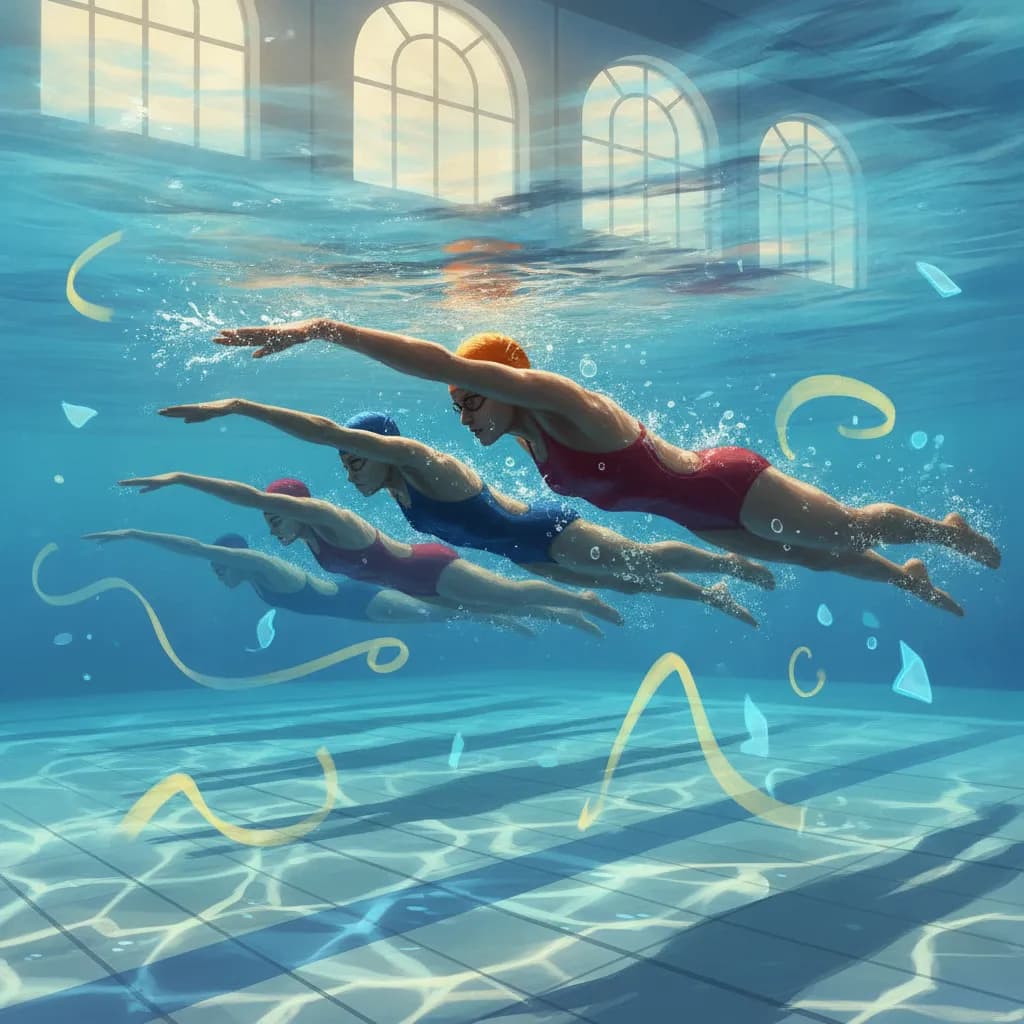
Swimming
A sport where "freestyle" technically means you can swim however you want — everyone just happens to agree the same one stroke is fastest.
Cheat Sheet
- Competitive swimming is raced across four main strokes — freestyle, backstroke, breaststroke, and butterfly — each with its own technique and rules.
- Individual medley (IM) events require a single swimmer to complete all four strokes in sequence within one race, testing versatility rather than a single specialty.
- Races are measured in a standardized pool, either 25 meters (short course) or 50 meters (long course/Olympic), with times compared globally against that standard.
- Freestyle technically just means "any stroke," but in practice nearly every swimmer uses the front crawl, the fastest known stroke, whenever a race allows free stroke choice.
- Swimming is one of the most-watched events at the Summer Olympics, with stars like Michael Phelps (23 Olympic gold medals) becoming some of the most decorated athletes in Olympic history.
- Technology like full-body swimsuits became controversial enough that they were banned from competition in 2010 after a wave of world records was set while they were in use.
The 60-Second Version
Competitive swimming is raced across four main strokes — freestyle, backstroke, breaststroke, and butterfly — each with its own distinct technique and rules. Individual medley (IM) events require a single swimmer to complete all four strokes in sequence within one race, testing versatility rather than a single specialty. Races are measured in a standardized pool, either 25 meters (short course) or 50 meters (long course, the Olympic standard), with times compared globally against that fixed benchmark. Freestyle technically just means "any stroke is allowed," but in practice nearly every swimmer uses the front crawl, the fastest known stroke, whenever a race lets them choose freely. Swimming is one of the most-watched events at the Summer Olympics, with stars like Michael Phelps, who won 23 Olympic gold medals, becoming some of the most decorated athletes in Olympic history. Technology like full-body swimsuits became controversial enough that they were banned from competition in 2010, after a wave of world records was set while they were still in use.
The Long Version
The Four Competitive Strokes
Competitive swimming is built around four distinct strokes, each with codified technique rules: freestyle (in practice, front crawl), backstroke (swum on the back with an alternating arm motion), breaststroke (a symmetrical, frog-like arm and leg motion), and butterfly (a demanding symmetrical stroke involving a simultaneous double-arm recovery and dolphin kick). Each stroke has its own specific rules governing legal technique, turns, and finishes, strictly enforced by officials at every level of competition.
Individual Medley: Testing All-Around Skill
The individual medley (IM) event requires a single swimmer to complete all four strokes in a fixed sequence, typically butterfly, backstroke, breaststroke, then freestyle, within one continuous race. Because each stroke demands different muscle groups and technical skills, IM events are widely considered among the most physically demanding races in the sport, rewarding genuinely well-rounded swimmers over pure specialists.
Pools, Standards, and Timing
Competitive swimming times are measured in standardized pools, either 25 meters (short course) or 50 meters (long course), with the Olympics and most major international competitions using the long course standard. Because pool length directly affects the number of turns in a given race distance, and turns can be executed faster than open swimming, short course and long course times aren't directly comparable, and record books track them separately.
The Suit Controversy That Changed the Sport
In the years leading up to 2010, full-body polyurethane swimsuits, engineered to increase buoyancy and reduce drag, contributed to an extraordinary wave of world records being broken across the sport. The suits became controversial enough, seen by many as offering an unfair technological advantage disconnected from athletic skill, that swimming's governing body banned full-body suits from competition starting in 2010, restoring textile-based suits with more limited coverage as the standard.
Ad slot (placeholder — set NEXT_PUBLIC_ADSENSE_SLOT_ID once an ad unit is created)
Glossary
- Freestyle
- A swimming category technically allowing any stroke, in practice almost always swum as front crawl.
- Individual medley (IM)
- A race requiring one swimmer to complete all four competitive strokes in a fixed sequence.
- Short course / Long course
- Pool length standards — 25 meters (short course) versus 50 meters (long course, used at the Olympics).
- Flip turn
- A technique where a swimmer somersaults at the wall to reverse direction without stopping, saving crucial time.
- Relay
- A team race where multiple swimmers each complete a portion of the total distance in sequence.