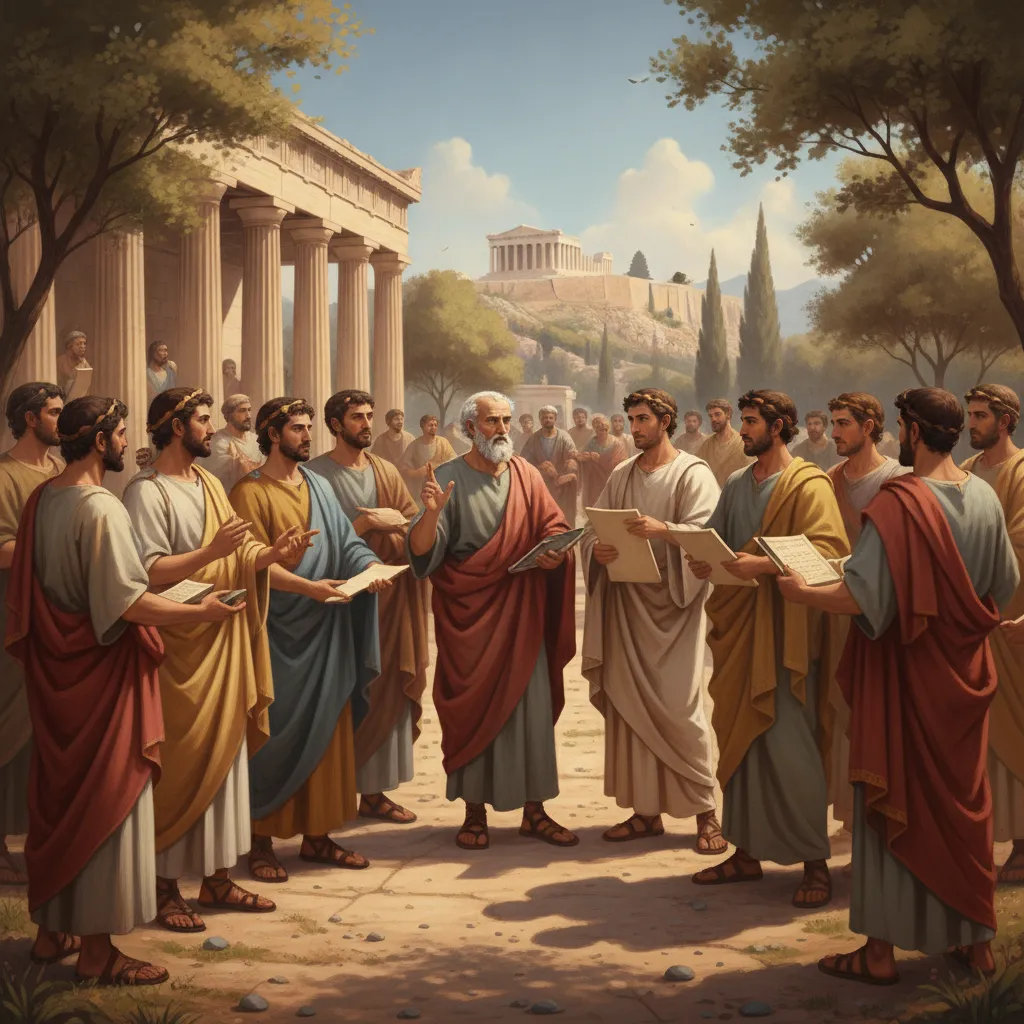
Ancient Greek Philosophy
Nearly everything known about Socrates, one of history's most influential thinkers, comes secondhand — he never wrote a single word of his own philosophy down.
Cheat Sheet
- Ancient Greek philosophy, developed primarily between the 6th and 4th centuries BCE, laid much of the intellectual foundation for later Western philosophy, science, and logic.
- Socrates, who left no writings of his own, taught primarily through persistent questioning, a method now known as the Socratic method, aimed at exposing contradictions and clarifying thinking.
- Plato, a student of Socrates, founded the Academy in Athens and is best known for his theory of Forms, which proposed that abstract, perfect versions of concepts exist beyond the physical world.
- Aristotle, a student of Plato and later tutor to Alexander the Great, made foundational contributions across logic, biology, ethics, and politics, emphasizing observation and empirical reasoning.
- Much of what is known about Socrates comes from the writings of his student Plato, since Socrates himself never wrote down his own teachings.
- Ancient Greek philosophy addressed enduring questions about ethics, knowledge, and reality that continue to directly shape philosophical, scientific, and political thought today.
The 60-Second Version
Ancient Greek philosophy, developed primarily between the 6th and 4th centuries BCE, laid much of the intellectual foundation for later Western philosophy, science, and logic. Socrates, who left no writings of his own, taught primarily through persistent questioning, a method now known as the Socratic method, aimed at exposing contradictions and clarifying thinking. Plato, a student of Socrates, founded the Academy in Athens and is best known for his theory of Forms, which proposed that abstract, perfect versions of concepts exist beyond the physical world. Aristotle, a student of Plato and later tutor to Alexander the Great, made foundational contributions across logic, biology, ethics, and politics, emphasizing observation and empirical reasoning. Much of what is known about Socrates comes from the writings of his student Plato, since Socrates himself never wrote down his own teachings. Ancient Greek philosophy addressed enduring questions about ethics, knowledge, and reality that continue to directly shape philosophical, scientific, and political thought today.
The Long Version
A Foundational Intellectual Era
Ancient Greek philosophy, developed primarily between the 6th and 4th centuries BCE, laid much of the intellectual foundation for later Western philosophy, science, and logic, establishing modes of inquiry and argument that would influence thinkers for the next two thousand years and beyond, well past the collapse of Greek civilization itself.
Socrates and the Art of Questioning
Socrates, who left no writings of his own, taught primarily through persistent questioning, a method now known as the Socratic method, aimed at exposing contradictions in a person's beliefs and gradually clarifying their thinking through structured dialogue rather than direct lecture. Much of what is known about Socrates today comes from the writings of his student Plato, since Socrates himself never wrote down his own teachings, meaning our understanding of him is inevitably filtered through his student's interpretation and literary framing.
Plato and the Theory of Forms
Plato, Socrates's most famous student, founded the Academy in Athens, considered one of the earliest institutions of higher learning in the Western world, and is best known for his theory of Forms, which proposed that abstract, perfect versions of concepts, such as beauty, justice, or a perfect circle, exist beyond the imperfect physical world we actually observe and interact with directly.
Aristotle's Emphasis on Observation
Aristotle, a student of Plato who later personally tutored Alexander the Great, made foundational contributions across an unusually wide range of fields, including logic, biology, ethics, and politics, distinguishing himself from his teacher Plato by emphasizing direct observation and empirical reasoning over abstract theorizing alone. This emphasis on systematic observation helped lay groundwork that would later influence the development of the scientific method itself, centuries after Aristotle's own lifetime.
Ad slot (placeholder — set NEXT_PUBLIC_ADSENSE_SLOT_ID once an ad unit is created)
Glossary
- Socratic method
- A technique of teaching through persistent questioning, developed by Socrates, aimed at exposing contradictions and clarifying thinking.
- Theory of Forms
- Plato's philosophical proposal that abstract, perfect versions of concepts and objects exist beyond the physical, observable world.
- The Academy
- A school founded by Plato in Athens, considered one of the earliest institutions of higher learning in the Western world.
- Empiricism
- An approach to knowledge emphasizing observation and direct experience, notably championed in ancient philosophy by Aristotle.
- Logic
- The formal study of valid reasoning and argument structure, substantially developed and systematized by Aristotle.