Compound Interest
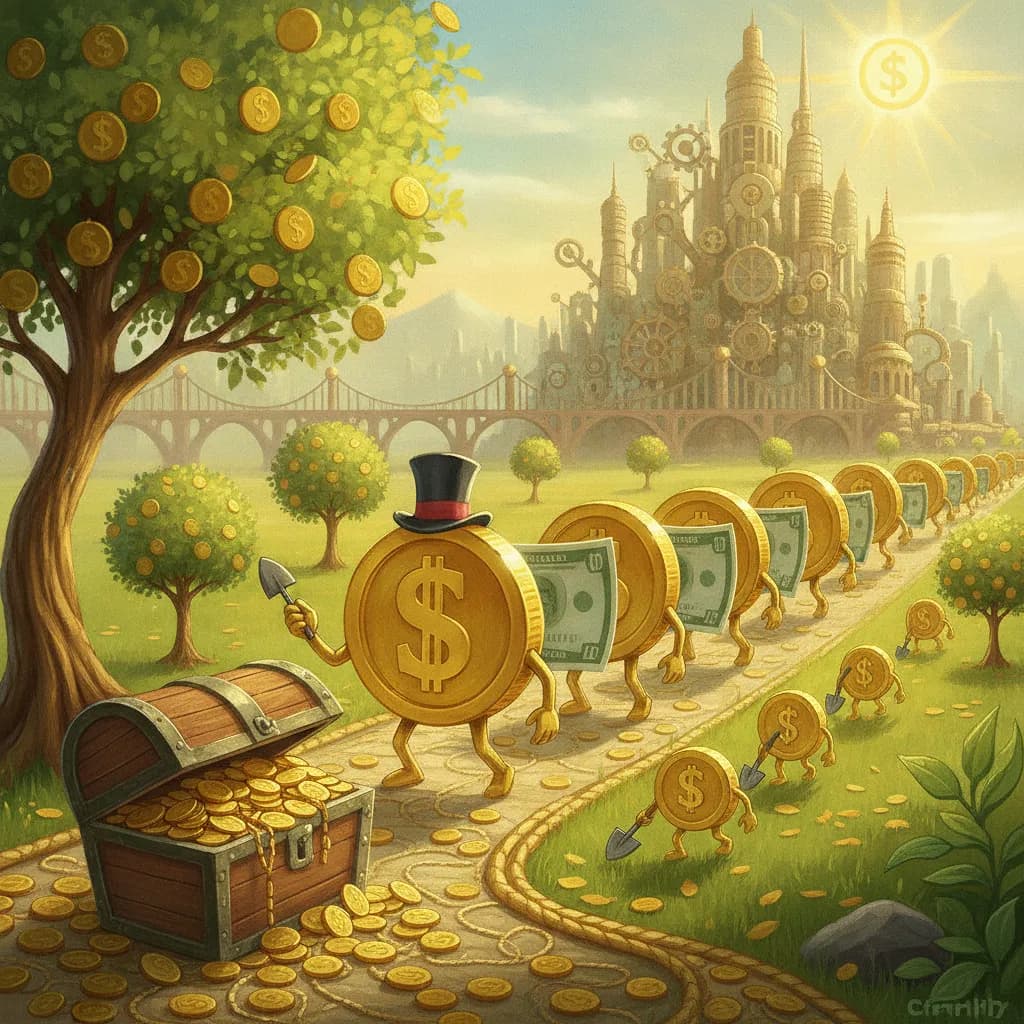
Compound interest is what happens when your money gets a job and then hires its own employees.
By Greg Goodwin · Published October 17, 2026 · Updated October 24, 2026
Cheat Sheet
- Formula: A = P(1 + r/n)^(nt), where P is the starting amount, r the annual rate, n the compounding periods per year, and t the years.
- SEC example: $100 at 5% a year becomes $105 after year one and $110.25 after year two, over $162 after 10 years, and almost $340 after 25.
- Rule of 72: divide 72 by the annual percentage return to estimate years to double; at 9% that is about 8 years. At 8% the rule says 9 years and the exact math says about 9.006.
- Simple vs compound: $10,000 at 7% for 30 years earns $21,000 in simple interest ($31,000 total) but grows to about $76,123 compounded annually.
- APR vs APY: a 6% rate compounded monthly yields an effective annual rate (APY) of about 6.168%.
- Myth: the quote calling compound interest the eighth wonder of the world is not reliably Einstein's; a Princeton reference book lists it as 'probably not by Einstein.'
The 60-Second Version
Compound interest is interest earned on interest. With simple interest, you are paid only on your original amount. With compounding, each period's interest is added to the balance, so the next period's interest is figured on a bigger number. The growth looks sluggish at first and then bends sharply upward into a curve. Three levers control it: the interest rate, how often it is added, and above all the length of time, which is why starting early matters so much. The same math works against borrowers, since unpaid debt grows on itself too. Real investments, unlike a fixed savings rate, rise and fall unpredictably, so any projection is an illustration rather than a promise. This is general education, not personalized financial or investment advice.
The Long Version
Interest on Interest
The SEC's Investor.gov explains the idea with a small example. Put $100 in an account that pays 5% a year. After the first year you have $105. After the second year you have $110.25, because you earned the usual $5 on your original $100 plus 25 cents on the $5 of interest you had already earned. That extra quarter looks trivial, but it never stops growing: with no further deposits, the account passes $162 after 10 years and reaches almost $340 after 25. Simple interest would have added just $5 every year, for $225 after 25 years.
The Formula and Its Levers
The standard formula is A = P(1 + r/n)^(nt). Take $10,000 at a 7% annual rate, compounded yearly. After 10 years it is about $19,672. After 20 years it is about $38,697. After 30 years it is about $76,123. Notice that the final ten years added about $37,400, more than the first twenty years combined, which added about $28,700. Under simple interest, the same $10,000 would reach only $31,000 after 30 years. The money doubles roughly every ten years at 7%, and each doubling is bigger in dollar terms than the one before. That is why financial educators stress time: a lower rate held for decades can beat a higher rate held briefly.
Frequency, APR, and APY
The third lever is how often interest is added. A 6% rate compounded annually yields exactly 6%. Compounded monthly, each month earns 0.5% on the growing balance, which works out to an effective annual rate of about 6.168%. Savings products usually advertise the APY, which includes compounding, while loans are typically quoted as an APR, a nominal rate that does not. More frequent compounding helps, but with diminishing returns, as the jump from annual to monthly is much bigger than from monthly to daily. In 1683, the Swiss mathematician Jacob Bernoulli studied what happens if interest is added more and more often. He showed that growth levels off between two and three times your money for a 100% rate, and Leonhard Euler later identified the limit as the number now called e, about 2.718.
The Rule of 72
You do not need a calculator for a rough estimate. Divide 72 by the annual return to see how many years it takes to double. Investor.gov's example is 9%, which gives about eight years. The rule is an approximation, and it works best at moderate rates. At 8% it gives nine years, and the exact calculation gives about 9.006 years. At 2%, the rule says 36 years, and the exact math says a $5,000 deposit would grow to about $10,200 in that time. It also works as a rough check on claims that sound too good to be true, as a promised 24% annual return would imply doubling every three years.
The Other Side of the Ledger
Compounding is neutral. It works for savers and investors, and against anyone carrying debt that charges interest on unpaid interest. Fees work the same way in reverse, since every dollar paid in costs is a dollar that stops compounding for you. The tidy curves in calculators also assume a constant return, but actual markets move up and down, and loss years compound as well. The famous line that compound interest is the eighth wonder of the world is usually pinned on Einstein, but reference works list it as probably not his, and the phrase was used about bridges long before. If you are deciding how to save or invest, a licensed professional can apply the math to your actual situation.
Why People Care
Compound interest explains why saving early beats saving more later, why credit card balances snowball, and why small differences in fees or rates become big gaps over decades. A few minutes with the formula and the Rule of 72 makes most financial products easier to judge.
Glossary
- Principal
- The original amount of money you deposit, invest, or borrow, before any interest is added.
- Simple interest
- Interest calculated only on the original principal, never on previously earned interest.
- Compounding frequency
- How often earned interest is added to the balance, such as annually, monthly, or daily.
- APY
- Annual percentage yield, the effective yearly rate once compounding within the year is counted.
- Rule of 72
- A mental shortcut that divides 72 by an annual return to estimate how many years it takes money to double.
Go Deeper
More to Explore
- Mutual Funds
Mutual funds let thousands of people chip in together and hire a professional to invest on their behalf.
- Exchange-Traded Funds (ETFs)
An ETF lets you buy hundreds of companies with one click, the same way you would buy a single share.
- Options Trading Basics
Buying an option risks only what you paid for it, while selling one can cost far more, the big asymmetry of options.
- Dividend Investing
A sky-high dividend yield can be a warning sign rather than a bargain: sometimes the share price has simply been falling.
- Bonds
When interest rates rise, the bonds you already own lose value, because bond prices and rates move in opposite directions.