Bonds
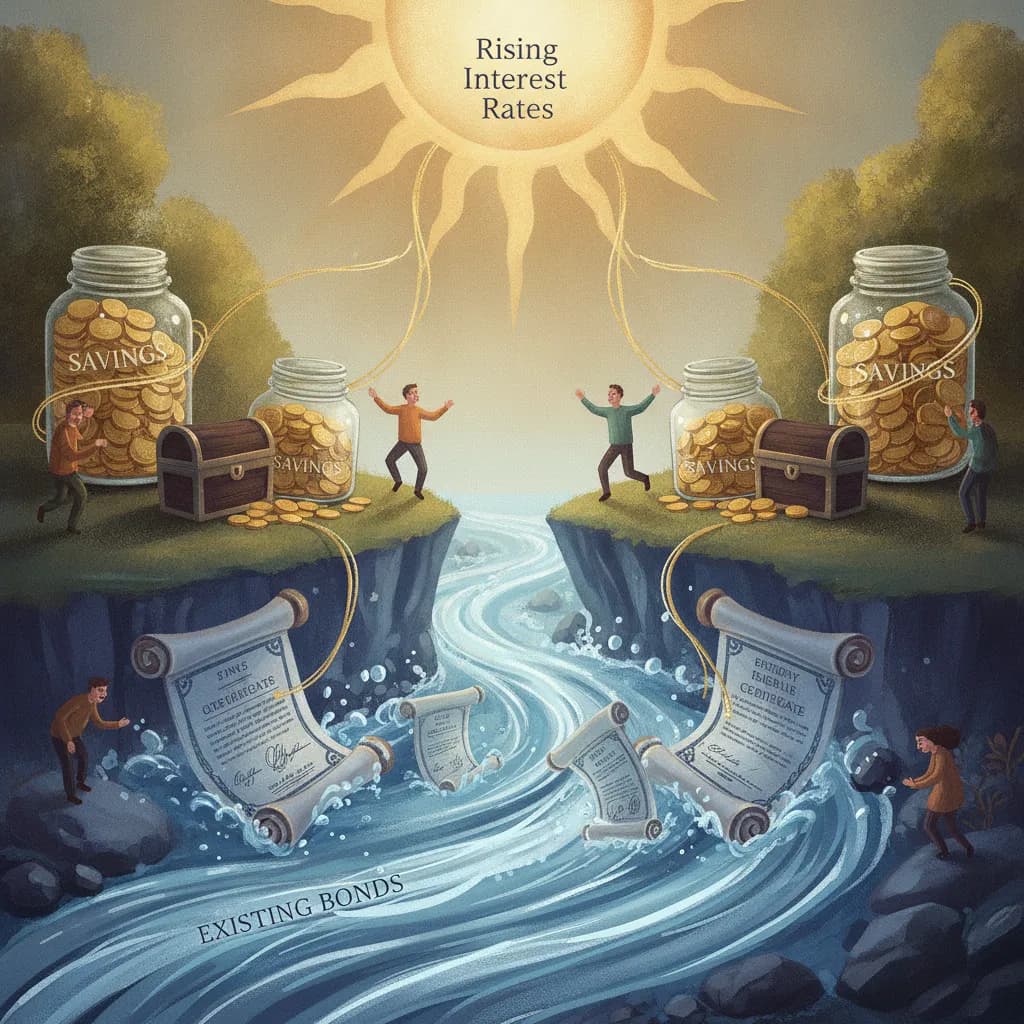
Rising interest rates are usually framed as good news for savers, yet they can simultaneously shrink the value of every existing bond an investor already owns.
Cheat Sheet
- A bond is essentially a loan an investor makes to a government or company, which promises to repay the principal plus periodic interest.
- 'Yield' and bond prices move inversely — when interest rates rise, existing lower-rate bonds become less valuable, and their price falls.
- Credit rating agencies (Moody's, S&P, Fitch) grade bonds by default risk, with 'investment grade' and riskier 'high-yield' (or 'junk') as the two broad tiers.
- U.S. Treasury bonds are widely considered among the safest investments globally, backed by the full faith and credit of the U.S. government.
- 'Duration' measures a bond's price sensitivity to interest rate changes — longer-duration bonds swing more sharply when rates move.
- Bonds are generally considered less volatile than stocks but historically deliver lower average long-term returns, a core portfolio trade-off.
The 60-Second Version
At its core, a bond is simply a loan: an investor hands money to a government or company in exchange for a promise of periodic interest payments plus the return of the original amount once the bond matures. What confuses many new investors is the relationship between interest rates and bond prices, which move in opposite directions, since a new bond issued at today's higher rate makes an older, lower-rate bond less attractive by comparison, pushing its resale price down even though nothing about the original bond itself has changed. Not all bonds carry the same risk, either, which is why independent credit rating agencies grade issuers on their likelihood of actually repaying what they owe, sorting bonds into a safer "investment grade" tier and a riskier "high-yield" or "junk" tier that compensates for that added risk with a higher promised yield. U.S. Treasury bonds sit at the safest end of this entire spectrum, backed by the full faith and credit of the federal government and widely treated as close to a risk-free benchmark against which other investments get measured. Bonds generally play a specific role in a broader investment portfolio precisely because of this risk profile, offering considerably less volatility than stocks in exchange for historically lower average long-term returns.
The Long Version
A Bond Is Just a Structured Loan
At its most basic level, a bond represents a loan made by an investor to a government or company, which in exchange promises to make periodic interest payments over a set period and then return the original loaned amount, called the principal, once the bond reaches its maturity date.
Why Rates and Prices Move in Opposite Directions
One of the most commonly misunderstood dynamics in bond investing is the inverse relationship between interest rates and bond prices, since when new bonds get issued at a higher prevailing rate, previously issued bonds paying a lower fixed rate become comparatively less attractive, pushing their resale value down even though the original bond's terms never actually changed.
Not All Bonds Carry Equal Risk
Independent credit rating agencies like Moody's, S&P, and Fitch evaluate the likelihood that a given bond issuer will actually make good on its payments, sorting bonds broadly into a safer "investment grade" tier and a considerably riskier "high-yield," or "junk," tier that compensates investors for that elevated risk with a higher promised yield.
Where Treasuries and Duration Fit In
U.S. Treasury bonds occupy the safest end of this entire spectrum, backed by the full faith and credit of the federal government and widely treated as close to a risk-free benchmark against which other investments get measured, while a bond's "duration," a measure of how sharply its price reacts to interest rate changes, helps investors gauge just how exposed a specific bond is to future rate swings. Taken together, this risk profile is exactly why bonds generally play a stabilizing role in a broader portfolio, trading away some of the higher potential returns of stocks in exchange for meaningfully lower volatility.
Ad slot (placeholder — set NEXT_PUBLIC_ADSENSE_SLOT_ID once an ad unit is created)
Why People Care
Bonds form the backbone of both government financing and countless retirement portfolios, and understanding the real mechanics behind rates, credit risk, and duration makes sense of otherwise-confusing financial news about central bank rate decisions and their ripple effects on personal investments.
Glossary
- Yield
- The effective annual return an investor earns on a bond, which moves inversely to the bond's market price.
- Credit rating
- A grade assigned by agencies like Moody's or S&P reflecting the likelihood a bond issuer will default on payments.
- Investment grade
- A credit rating tier indicating relatively low default risk, generally considered safer for conservative investors.
- High-yield bond (junk bond)
- A bond with a lower credit rating and higher default risk, offering a higher yield to compensate investors.
- Duration
- A measure of a bond's price sensitivity to interest rate changes, with longer-duration bonds fluctuating more sharply.
Go Deeper
- U.S. Securities and Exchange Commission — Investor.gov Bonds Guide
- The Bond Book, by Annette Thau
More to Explore
- Options Trading Basics
Buying an option can never cost you more than what you paid for it — but selling one carelessly can theoretically lose you far more money than you ever put in.
- Dividend Investing
A dividend yield that suddenly looks unusually generous is sometimes less a sign of a great deal and more a warning sign that a stock's price has been quietly falling.
- Index Funds
An investment strategy built on a deliberately unambitious premise: rather than trying to beat the market, simply become the market, at the lowest possible cost.
- The Stock Market
A marketplace where you can own a tiny sliver of a trillion-dollar company for less than the price of lunch.
- Real Estate Investing
A way to make money in your sleep — as long as the tenants pay rent and the roof doesn't leak.