Blood Pressure
Two numbers, one cuff, and the quietest early-warning system your body has.
By Greg Goodwin · Published October 17, 2026 · Updated October 24, 2026
Cheat Sheet
- Units: millimeters of mercury (mm Hg), written as systolic over diastolic, such as 118/76.
- AHA categories: normal is below 120 and below 80; elevated is 120-129 and below 80; stage 1 is 130-139 or 80-89; stage 2 is 140 or higher, or 90 or higher.
- Severe range: above 180 and/or above 120. With chest pain, shortness of breath, numbness, weakness, vision change or trouble speaking, the AHA says to call 911.
- First measurement: Stephen Hales, who published arterial pressure readings from a horse in 1733 (one source dates his work earlier).
- CDC scale: 48.1% of US adults (119.9 million) have high blood pressure by the 2017 ACC/AHA definition or take medication for it; about 22.5% of them have it under control.
- Awareness gap: roughly 1 in 6 US adults with high blood pressure does not know they have it.
The 60-Second Version
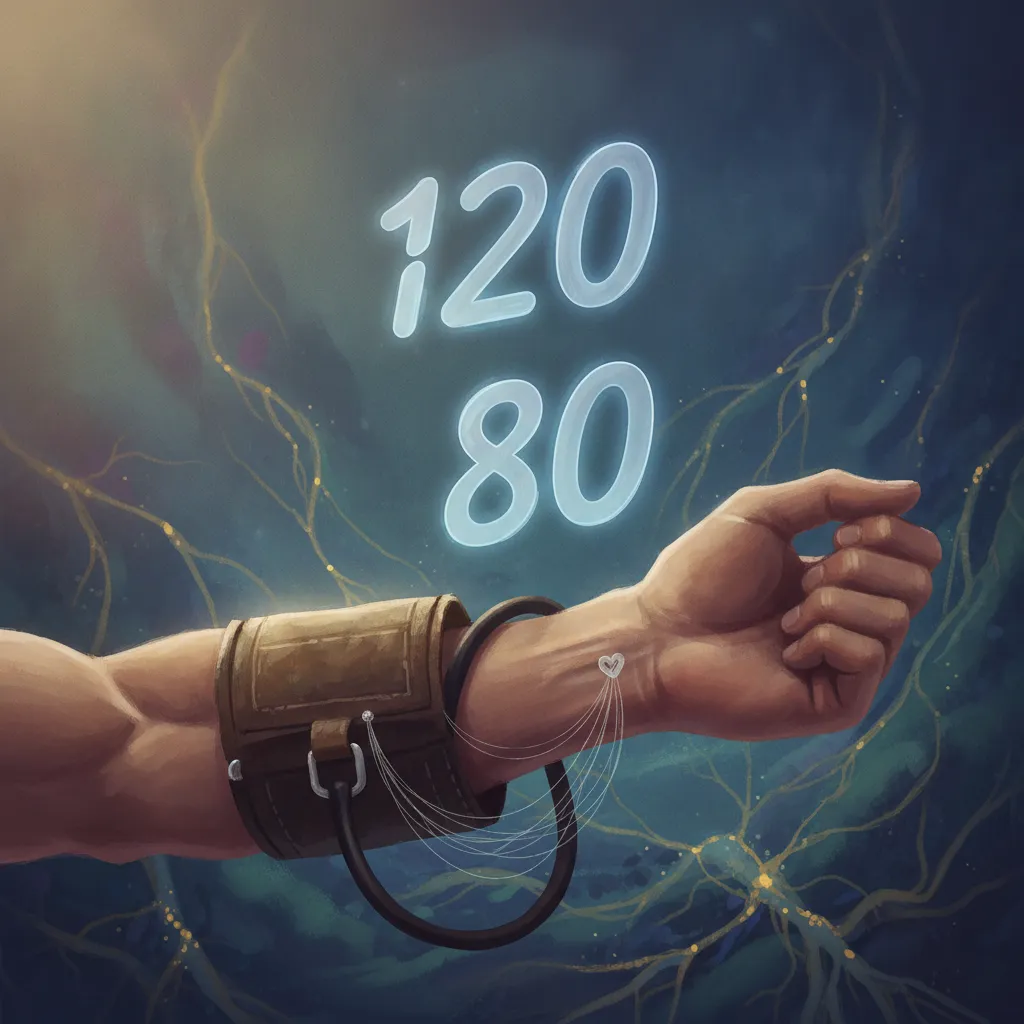
Blood pressure is the force your blood puts on the walls of your arteries as the heart pushes it around the body. It is written as two numbers in millimeters of mercury. The top one, systolic, is the pressure at each heartbeat; the bottom one, diastolic, is the pressure while the heart rests between beats. Following the 2017 American College of Cardiology and American Heart Association guideline, the AHA calls anything under 120/80 normal and treats readings from 130/80 upward as stage 1 hypertension. High blood pressure usually has no symptoms, which is why it is nicknamed a silent condition, yet over years it strains the heart, brain, kidneys and eyes and raises the odds of heart attack and stroke. The CDC reports that nearly half of American adults meet the definition. Because one reading can mislead, a clinician confirms the diagnosis and sets targets for each person. This is general information, not medical advice.
The Long Version
What the Two Numbers Mean
Every heartbeat sends a pulse of blood into the arteries, and the pressure peaks as the heart contracts. That peak is the systolic number. Between beats the heart relaxes and refills, and the pressure drops to its lowest point, the diastolic number. A reading of 120/80 is said "120 over 80." Either number can be used to flag high blood pressure, but the AHA notes that systolic pressure tells more about heart disease risk for people over 50. Systolic pressure tends to climb with age because large arteries stiffen and plaque builds up over time. Pressure also moves around during the day with activity, stress and sleep, which is one reason a single reading is only a snapshot.
A Short History of Measuring It
The first recorded measurements were crude and unforgettable. According to the American College of Cardiology's history of hypertension, the English clergyman and scientist Stephen Hales published the first arterial pressure readings in 1733 by connecting a long glass tube to an artery in a horse and watching the blood climb the tube. Some popular sources date his experiments earlier, so treat the year as approximate. The bloodless version arrived in 1896, when Scipione Riva-Rocci introduced an inflatable arm cuff with a mercury gauge, though it read only systolic pressure. In 1905 the Russian surgeon Nikolai Korotkoff described the sounds heard through a stethoscope as the cuff deflates, which made it possible to read both numbers. The mercury column explains why pressure is still quoted in mm Hg.
The Categories
The AHA's chart, based on the 2017 guideline, sorts adult readings into bands. Normal is below 120 systolic and below 80 diastolic. Elevated is 120 to 129 with diastolic still below 80. Stage 1 hypertension is 130 to 139 or 80 to 89. Stage 2 is 140 or higher, or 90 or higher. Readings above 180 and/or above 120 are severe; with symptoms such as chest pain, shortness of breath, back pain, numbness, weakness, vision changes or trouble speaking, the AHA says to call 911. The AHA stresses that only a doctor or other medical professional can confirm a diagnosis. Other guidelines and countries draw some of the lines differently, and what counts as the right target for a given person is individualized by a clinician, who weighs age, other conditions and overall risk.
A Silent Condition
High blood pressure rarely announces itself. The AHA says measuring it is the only way to know you have it, and the CDC estimates about 1 in 6 US adults with the condition is unaware of it. Years of excess pressure can damage artery walls and contribute to heart attack, heart failure, stroke, kidney disease and vision loss. The CDC reports that high blood pressure was a primary or contributing cause of 680,179 US deaths in 2024 and that associated costs were estimated at $219 billion in 2019. By the 2017 ACC/AHA definition, 48.1% of US adults, about 119.9 million people, have high blood pressure or take medication for it.
Measurement, Control and the Clinician
Control remains the weak spot. The CDC puts the share of adults with high blood pressure who have it under control at about 22.5%, roughly 1 in 4. The AHA says that at stage 1 a health professional should prescribe lifestyle changes and may consider medication depending on cardiovascular risk, while stage 2 usually calls for both. Readings that are persistently high, or low readings that come with dizziness or fainting, are worth discussing with a clinician rather than self-diagnosing. Home monitors exist, and clinicians often use repeated readings to see the pattern. This page cannot say what is right for any one person; that decision belongs to a doctor who knows the full picture.
Why People Care
High blood pressure is one of the most common and most preventable drivers of heart disease and stroke, and it often hides until damage is done. A cheap, two-minute measurement turns an invisible risk into a number you can act on with a clinician.
Glossary
- Systolic
- The top number: pressure on artery walls when the heart beats.
- Diastolic
- The bottom number: pressure on artery walls while the heart rests between beats.
- Hypertension
- The medical term for persistently high blood pressure.
- Sphygmomanometer
- The cuff-and-gauge device used to measure blood pressure.
- Korotkoff sounds
- The tapping sounds heard through a stethoscope as a cuff deflates, used to read both numbers.
Go Deeper
More to Explore
- Cholesterol
A waxy substance your body needs and your arteries would rather you not overdo.
- Pandemics
Pandemics have reshaped history, from medieval Europe to the modern world.
- Organ Transplants
The first successful organ transplant, in 1954, worked only because the donor and recipient were identical twins.
- Anesthesia
Anesthesia has worked safely for over a century, yet scientists still can't fully explain how it switches consciousness off.
- Vaccines
Vaccines helped wipe smallpox off the planet entirely, with no natural cases since the late 1970s.