Heart Disease
Heart disease is really a family of conditions, and its most common member is a plumbing problem.
By Greg Goodwin · Published November 4, 2026
Cheat Sheet
- Scale: 919,032 people in the US died from cardiovascular disease in 2023, about 1 in every 3 deaths (CDC).
- Most common type: coronary artery disease killed 371,506 people in 2022; about 1 in 20 adults age 20 and older has it.
- Heart attacks: about 805,000 a year in the US, of which 605,000 are first heart attacks and 200,000 are repeats.
- Silent cases: about 1 in 5 heart attacks are silent, meaning the damage is done but the person is not aware of it.
- Risk factors: about 47% of people in the US have at least one of high blood pressure, high blood cholesterol, or smoking.
- Cost: health care services and medications for heart disease totaled more than $168 billion between 2021 and 2022.
The 60-Second Version
Heart disease is not one illness but a group of conditions that affect the heart and the vessels that feed it. The most common type in the United States is coronary artery disease, in which plaque builds up inside the arteries, narrows them, and reduces blood flow to the heart muscle. When flow drops far enough, the result can be a heart attack. Other relatives include heart failure, where the heart cannot pump as well as the body needs, and arrhythmias, where the rhythm goes off beat. Some heart disease stays silent until a big event, which is why risk factors get so much attention: high blood pressure, high cholesterol, and smoking lead the list. The CDC calls it the leading cause of death for men, women, and people of most racial and ethnic groups in the US. This page is general information, not medical advice, and a clinician can assess any one person's risk.
The Long Version
A Family of Conditions
The term heart disease covers several types of heart conditions, which is why two people can both "have heart disease" and have quite different problems. The CDC points to three events that tend to bring it to attention: a heart attack, heart failure, and an arrhythmia, which is a disturbance of the heart's rhythm. The most common type in the United States is coronary artery disease, or CAD, which affects blood flow to the heart itself. According to the CDC, about 1 in 20 adults age 20 and older has CAD, roughly 5%, and it killed 371,506 people in 2022. Because the family is so broad, the word "heart" in front of "disease" names the organ, not the mechanism.
How Plaque Narrows the Road
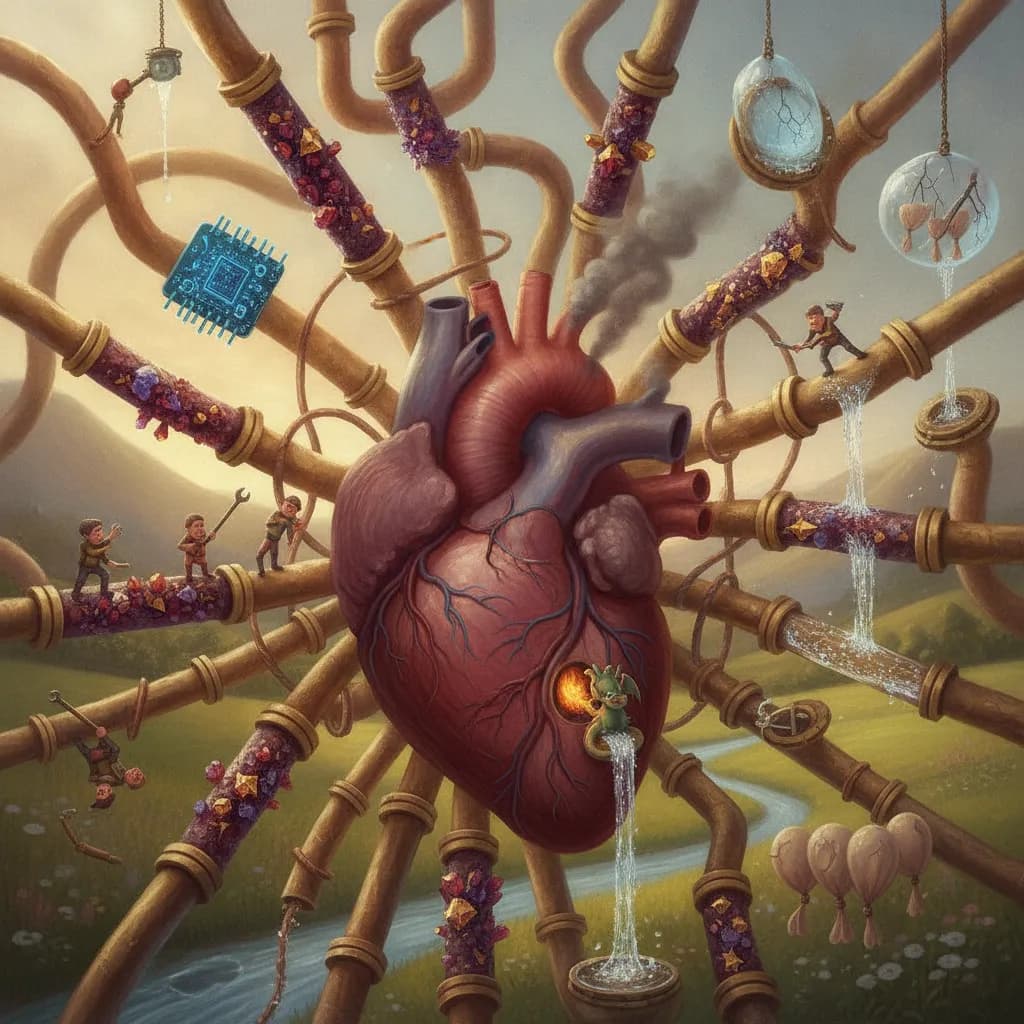
In coronary artery disease the trouble is traffic, not the engine. As plaque builds up in the arteries, the inside of the arteries begins to narrow, which lessens or blocks the flow of blood, as the CDC describes it. The heart muscle needs a steady blood supply like every other tissue, so a slimmed-down artery can leave it short. Decreased blood flow can cause a heart attack. That is why so many of the best-known risk factors involve blood vessels and blood chemistry rather than the heart muscle directly, and why heart disease can sit silent until an event finally announces it.
Signs, Loud and Quiet
Sometimes heart disease is silent and not diagnosed until a person has signs or symptoms of a heart attack, heart failure, or an arrhythmia, the CDC notes. For a heart attack the list includes chest pain or discomfort, upper back or neck pain, heartburn, nausea or vomiting, extreme fatigue, dizziness, and shortness of breath. Arrhythmias can show up as fluttering feelings in the chest, called palpitations. Heart failure can bring shortness of breath, fatigue, or swelling of the feet, ankles, legs, abdomen, or neck veins. About 1 in 5 heart attacks are silent, meaning the damage is done but the person is not aware of it. Anyone who suspects a heart attack should call emergency services rather than wait it out.
The Risk Factor Lineup
High blood pressure, high blood cholesterol, and smoking are the three key risk factors the CDC highlights, and about 47% of people in the United States have at least one of them, according to American Heart Association statistics the CDC cites. Other conditions and habits raise risk too: diabetes, overweight and obesity, an unhealthy diet, physical inactivity, and excessive alcohol use. Risk is not shared evenly across the population. Heart disease is the leading cause of death for men, women, and people of most racial and ethnic groups, but for Asian American, American Indian, Alaska Native, Hispanic, and Pacific Islander women, the CDC says it ranks second only to cancer.
Recovery and the Big Numbers
After a heart attack, heart failure, or some heart surgeries, many people are referred to cardiac rehabilitation, which the CDC describes as a supervised program of physical activity, education about healthy eating, taking medicine as prescribed, ways to quit smoking, and counseling for stress and mental health. A team may include exercise and nutrition specialists, physical therapists, and counselors. The scale of the problem explains the effort. In 2023, 919,032 people in the US died of cardiovascular disease, about 1 in every 3 deaths, and about 1 in 6 of those deaths were among adults younger than 65. Health care services and medications for heart disease cost more than $168 billion between 2021 and 2022.
Why People Care
Heart disease touches almost every family, and several of its biggest risk factors can be measured and discussed with a clinician. Knowing the difference between a heart attack, heart failure, and an arrhythmia makes health news and dinner-table conversation easier to follow. This is general information, not medical advice.
Glossary
- Coronary artery disease
- The most common type of heart disease in the US, in which the arteries that feed the heart are affected and blood flow to the heart is reduced.
- Plaque
- A buildup inside the arteries that narrows them and lessens or blocks the flow of blood.
- Arrhythmia
- A disturbance in the heart's rhythm, sometimes felt as fluttering in the chest.
- Heart failure
- A condition in which the heart cannot pump as well as the body needs, which can bring shortness of breath, fatigue, and swelling.
- Cardiac rehabilitation
- A supervised program of exercise, education, and counseling for people recovering from events such as a heart attack.
Go Deeper
More to Explore
- Parkinson's Disease
Parkinson's disease is about far more than a tremor, and it starts with a shortage of one brain chemical.
- Influenza
Influenza is the seasonal visitor that makes a common cold look polite.
- Asthma
Asthma means your airways are always a bit touchy and occasionally dramatic.
- Stroke
A brain attack: no warning bell, no waiting room, and a clock that starts the moment symptoms do.
- Diabetes
Your body's fuel system works great until the key that lets sugar into your cells goes missing or stops fitting the lock.