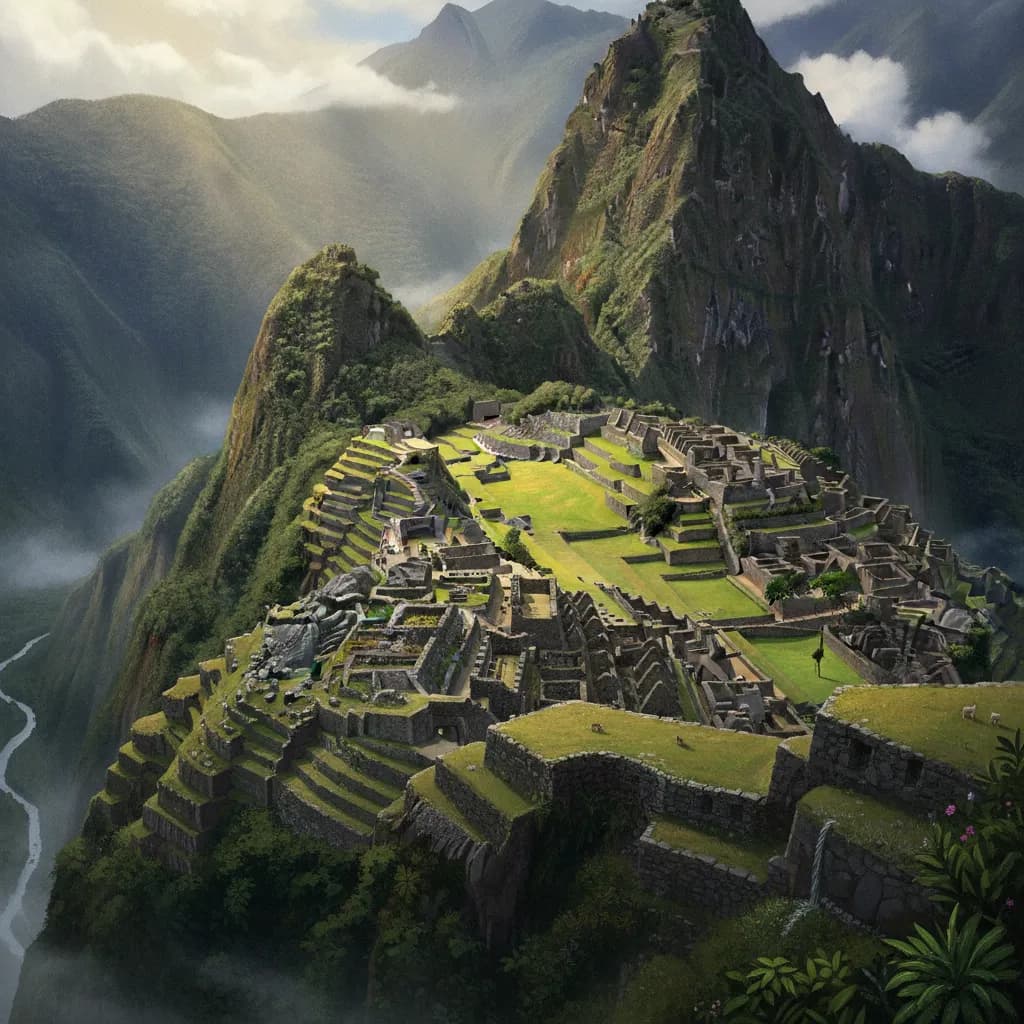
Machu Picchu
A royal Inca estate so well-hidden in the Andes that the Spanish conquistadors never even found it.
Cheat Sheet
- Machu Picchu is a 15th-century Inca citadel perched high in the Andes Mountains of Peru, built around 1450 during the reign of Emperor Pachacuti.
- It sits roughly 7,970 feet (2,430 meters) above sea level, on a ridge between two mountain peaks, deliberately positioned for both defense and ceremonial significance.
- The site was never found by the Spanish conquistadors and was essentially unknown to the outside world until American explorer Hiram Bingham brought international attention to it in 1911.
- Historians still debate its exact purpose — leading theories include a royal estate, a religious sanctuary, and an astronomical observatory, and it may well have served multiple roles at once.
- The precision Inca stonework at Machu Picchu was achieved without mortar or iron tools — stones were cut to fit together so tightly that a knife blade can't slide between them.
- It was named a UNESCO World Heritage Site in 1983 and is one of the New Seven Wonders of the World, drawing over a million visitors a year before access limits were introduced.
The 60-Second Version
Machu Picchu is a 15th-century Inca citadel perched high in the Andes Mountains of Peru, built around 1450 during the reign of Emperor Pachacuti. It sits roughly 7,970 feet above sea level, on a ridge between two mountain peaks, positioned deliberately for both defense and ceremonial significance. Remarkably, the site was never found by the Spanish conquistadors and remained essentially unknown to the outside world until American explorer Hiram Bingham brought international attention to it in 1911. Historians still debate its exact purpose, with leading theories including a royal estate, a religious sanctuary, and an astronomical observatory — it likely served multiple roles simultaneously. The precision Inca stonework found throughout the site was achieved without mortar or iron tools, with stones cut to fit together so tightly that a knife blade can't slide between them. Machu Picchu was named a UNESCO World Heritage Site in 1983 and is one of the New Seven Wonders of the World, drawing over a million visitors a year before Peru introduced stricter access limits.
The Long Version
Built by an Empire at Its Peak
Machu Picchu was constructed around 1450 under the Inca Emperor Pachacuti, whose reign marked the rapid expansion of the Inca Empire into the largest pre-Columbian civilization in the Americas. The site's location, high on a ridge between two mountain peaks in the Andes, reflects both the sophistication of Inca engineering and the strategic and ceremonial importance the empire placed on elevated, dramatic terrain.
Lost to the Outside World, Then "Discovered" in 1911
Unlike many other major Inca sites, Machu Picchu was never located by the Spanish conquistadors during their conquest of the Inca Empire in the 16th century, likely thanks to its remote, hard-to-reach position. The site remained known only to local populations until 1911, when American explorer and Yale academic Hiram Bingham was guided to it while searching for a different, unrelated lost Inca city; his subsequent expeditions and writings brought Machu Picchu widespread international recognition, even though local farming families had known of its existence all along.
What Was It Actually For?
Despite decades of archaeological study, historians and archaeologists still debate Machu Picchu's precise original purpose. The leading theory holds it was a royal estate built for Pachacuti and his court, used seasonally rather than as a permanent capital; other theories propose it functioned primarily as a religious sanctuary given the presence of ceremonial structures, or as an astronomical observation site given the alignment of certain structures with solstice sunlight. Most current scholarship suggests it likely combined several of these functions rather than serving just one single purpose.
Stonework That Still Puzzles Engineers
Among Machu Picchu's most striking features is its precision stonework, built using a dry-stone technique called ashlar masonry, in which enormous stone blocks were cut and fitted together so precisely that no mortar was needed and the joints remain famously tight even after centuries of seismic activity in the region. This was achieved without iron tools, relying instead on harder stone hammers and an exceptionally refined understanding of how to shape and fit blocks together, a technique that continues to draw study from modern structural engineers.
Ad slot (placeholder — set NEXT_PUBLIC_ADSENSE_SLOT_ID once an ad unit is created)
Glossary
- Inca Empire
- The largest pre-Columbian empire in the Americas, centered in Peru and spanning much of western South America at its height.
- Citadel
- A fortified complex, often built on high ground, combining residential, ceremonial, and defensive functions.
- Hiram Bingham
- The American explorer and academic who brought international attention to Machu Picchu in 1911.
- Ashlar masonry
- A precise stone-cutting technique, used extensively at Machu Picchu, where blocks fit together without mortar.
- Intihuatana
- A carved ritual stone at Machu Picchu believed to have served an astronomical or ceremonial function.