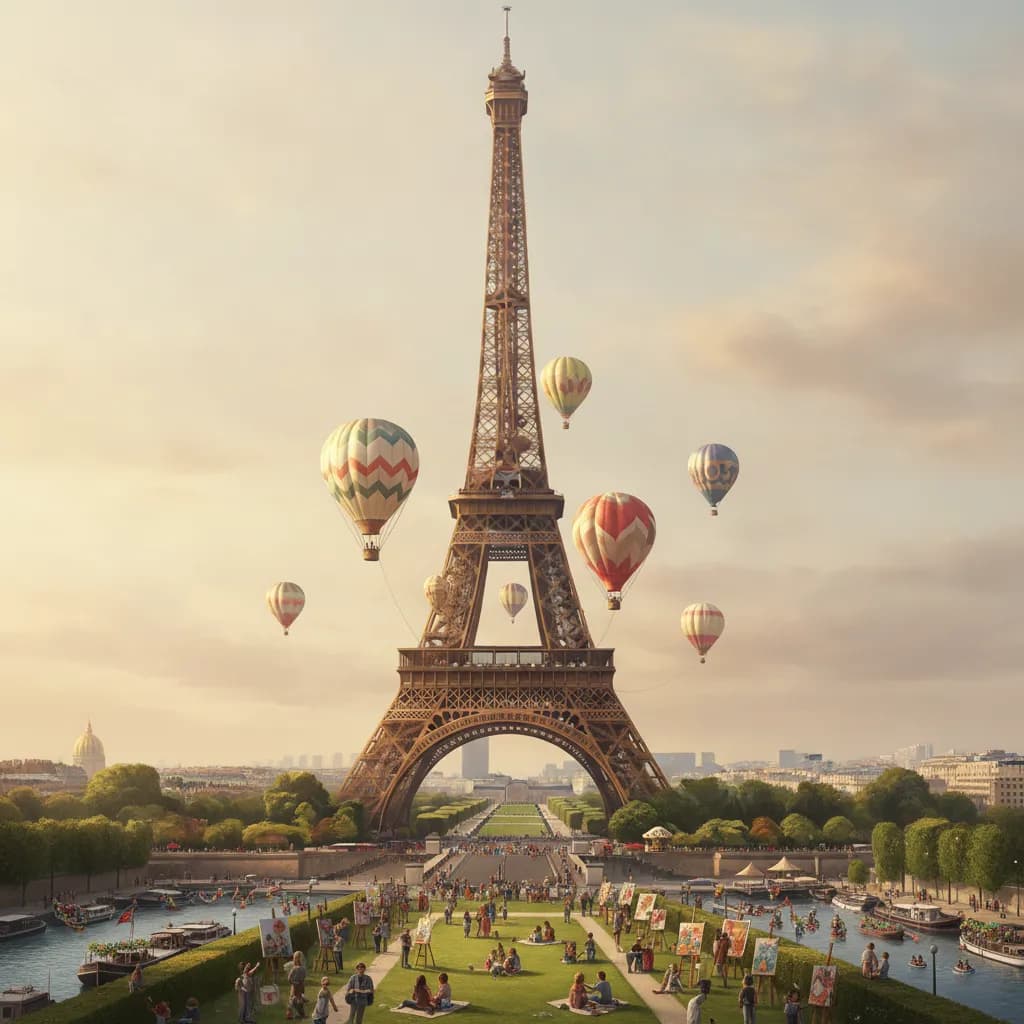
The Eiffel Tower
A "temporary" 20-year structure that Paris just... never took down, and is now unimaginable without.
Cheat Sheet
- Built for the 1889 World's Fair to mark the centennial of the French Revolution, and designed by engineer Gustave Eiffel's firm.
- It was only meant to stand for 20 years — Paris kept it because it turned out to be useful as a radio transmission tower.
- Standing about 330 meters (1,083 feet) tall, it was the tallest man-made structure in the world for over 40 years after completion.
- Many prominent Parisian artists and writers publicly hated it when it was built, calling it an eyesore that clashed with the city's architecture.
- It's repainted roughly every 7 years — about 60 tons of paint — to protect the iron structure from rust.
- It's now the most-visited paid monument in the world, drawing millions of visitors every year.
The 60-Second Version
The Eiffel Tower was built for the 1889 World's Fair, marking the 100th anniversary of the French Revolution, and designed by the engineering firm of Gustave Eiffel. At roughly 330 meters tall, it was the tallest human-made structure in the world for over four decades. It was controversial from the start — many of Paris's leading artists and writers signed public protests calling it an ugly, out-of-place intrusion on the city's skyline — and its original permit was only for 20 years before scheduled demolition. It survived because it turned out to be extremely useful as a radio and telecommunications transmission tower, giving Paris a practical reason to keep it standing well past its expiration date. Today it's repainted roughly every seven years to protect against rust, and it's the most-visited paid monument on Earth.
The Long Version
A Fast, Precise Build
Construction took just over two years, from 1887 to 1889, an impressively fast timeline achieved by prefabricating thousands of individual wrought-iron parts off-site and assembling them on location with roughly 2.5 million rivets — a level of engineering precision that was genuinely cutting-edge for its era, decades before modern construction techniques existed. Gustave Eiffel's firm had already built its reputation on large-scale iron structures and bridges, which is part of why they were trusted with a project this ambitious for a temporary World's Fair exhibit.
Paris Hated It At First
The protest against the tower, signed by a group of prominent Parisian artists and writers, called it a "useless and monstrous" eyesore that clashed violently with the elegance and proportions of the surrounding city — a striking contrast to its beloved, iconic status today. Novelist Guy de Maupassant reportedly ate lunch in the tower's restaurant regularly specifically because it was, in his words, the one place in Paris where he didn't have to look at it. The gap between that initial reception and its current status as a symbol of Paris itself is one of the more dramatic reputation reversals in architectural history.
How It Escaped Demolition
Its survival past the original 20-year demolition deadline came down to pure practicality rather than sentiment: the tower proved to be an ideal spot for radio antennas, and its usefulness for military and civilian communication gave Paris a strong, concrete reason to keep it standing well after its permit expired. Without that unplanned second life as infrastructure, one of the world's most recognized landmarks might well have been dismantled for scrap iron exactly as originally planned.
Small Stories That Stuck
During the German occupation of Paris in World War II, French resistance members reportedly cut the elevator cables so that Hitler, on his brief visit to the city, would have had to climb hundreds of stairs to reach the top — a story that's become part of the tower's folklore, whether or not every detail holds up to strict historical scrutiny. In a stranger modern quirk, the tower's nighttime light display is actually copyrighted as a distinct artistic work separate from the structure itself, meaning commercial photos of it lit up at night technically require permission — a detail that surprises most visitors and photographers alike.
Ad slot (placeholder — set NEXT_PUBLIC_ADSENSE_SLOT_ID once an ad unit is created)