Robotics
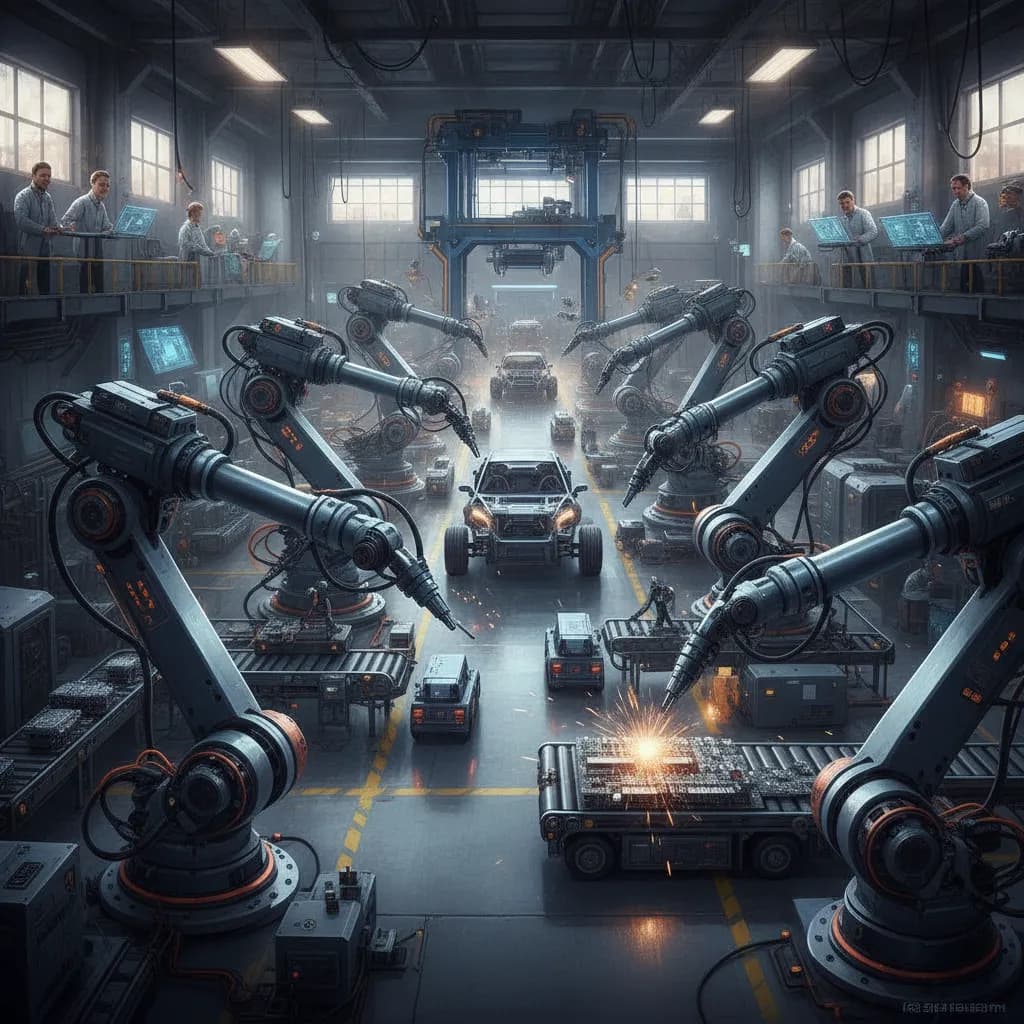
The most successful robots in the world today aren't the human-shaped ones from science fiction — they're bolted to factory floors, repeating the same precise motion millions of times.
Cheat Sheet
- Robotics is the field of designing, building, and programming machines capable of sensing their environment and performing physical tasks, often automatically or semi-autonomously.
- Industrial robots, widely used in manufacturing for tasks like welding and assembly, represent the largest and most mature segment of real-world robotics deployment today.
- Modern robotics increasingly incorporates artificial intelligence, allowing robots to adapt to varied or unpredictable environments rather than simply repeating a fixed, pre-programmed sequence of movements.
- Autonomous mobile robots, including warehouse robots and delivery robots, use sensors and mapping technology to navigate physical spaces without constant human control.
- Humanoid robots, designed with a human-like body shape, have advanced considerably in recent years but remain significantly more expensive and mechanically complex than task-specific industrial robots.
- Widespread automation of physical labor through robotics raises ongoing economic and policy questions about job displacement, even as it also improves safety and efficiency in physically demanding or hazardous work environments.
The 60-Second Version
Robotics is the field of designing, building, and programming machines capable of sensing their environment and performing physical tasks, often automatically or semi-autonomously. Industrial robots, widely used in manufacturing for tasks like welding and assembly, represent the largest and most mature segment of real-world robotics deployment today. Modern robotics increasingly incorporates artificial intelligence, allowing robots to adapt to varied or unpredictable environments rather than simply repeating a fixed, pre-programmed sequence of movements. Autonomous mobile robots, including warehouse robots and delivery robots, use sensors and mapping technology to navigate physical spaces without constant human control. Humanoid robots, designed with a human-like body shape, have advanced considerably in recent years but remain significantly more expensive and mechanically complex than task-specific industrial robots. Widespread automation of physical labor through robotics raises ongoing economic and policy questions about job displacement, even as it also improves safety and efficiency in physically demanding or hazardous work environments.
The Long Version
Industrial Robots: Robotics' Biggest Success Story
Long before robots capable of walking or conversation captured public imagination, industrial robots, fixed-arm machines performing repetitive manufacturing tasks like welding, painting, and precision assembly, became robotics' largest and most economically significant real-world application, quietly transforming manufacturing efficiency across industries for decades.
Adding AI to the Mix
Traditional industrial robots operate by precisely repeating a fixed, pre-programmed sequence of movements, well-suited to controlled, predictable factory environments. Increasingly, robotics has incorporated artificial intelligence and improved sensor technology, allowing robots to adapt their actions to varied or unpredictable real-world conditions rather than relying purely on rigid, pre-scripted motion, substantially expanding where robots can be usefully deployed.
Robots That Move Through the World on Their Own
Autonomous mobile robots represent a distinct and rapidly growing robotics category, using a combination of cameras, sensors, and mapping technology to navigate physical spaces, warehouses, hospitals, sidewalks, without requiring constant direct human control, powering applications like automated warehouse fulfillment and experimental delivery robots.
Why Humanoid Robots Remain So Difficult
Despite significant, highly publicized recent progress, humanoid robots, built with a human-like body shape including legs and articulated arms, remain considerably more mechanically complex and expensive to build and maintain than task-specific industrial or mobile robots, since replicating flexible human-like movement and balance is a substantially harder engineering problem than executing a single well-defined repetitive task.
Ad slot (placeholder — set NEXT_PUBLIC_ADSENSE_SLOT_ID once an ad unit is created)
Glossary
- Industrial robot
- A robot designed for repetitive manufacturing tasks like welding, assembly, or material handling.
- Autonomous mobile robot
- A robot capable of navigating physical spaces independently using sensors and mapping, without constant human control.
- Actuator
- A robotic component that converts energy into physical movement, functioning like an artificial muscle or motor.
- Humanoid robot
- A robot designed with a human-like body shape, including a torso, arms, and legs.
- Sensor fusion
- Combining data from multiple sensors (cameras, lidar, etc.) to give a robot a more accurate understanding of its surroundings.