Smart Home Devices
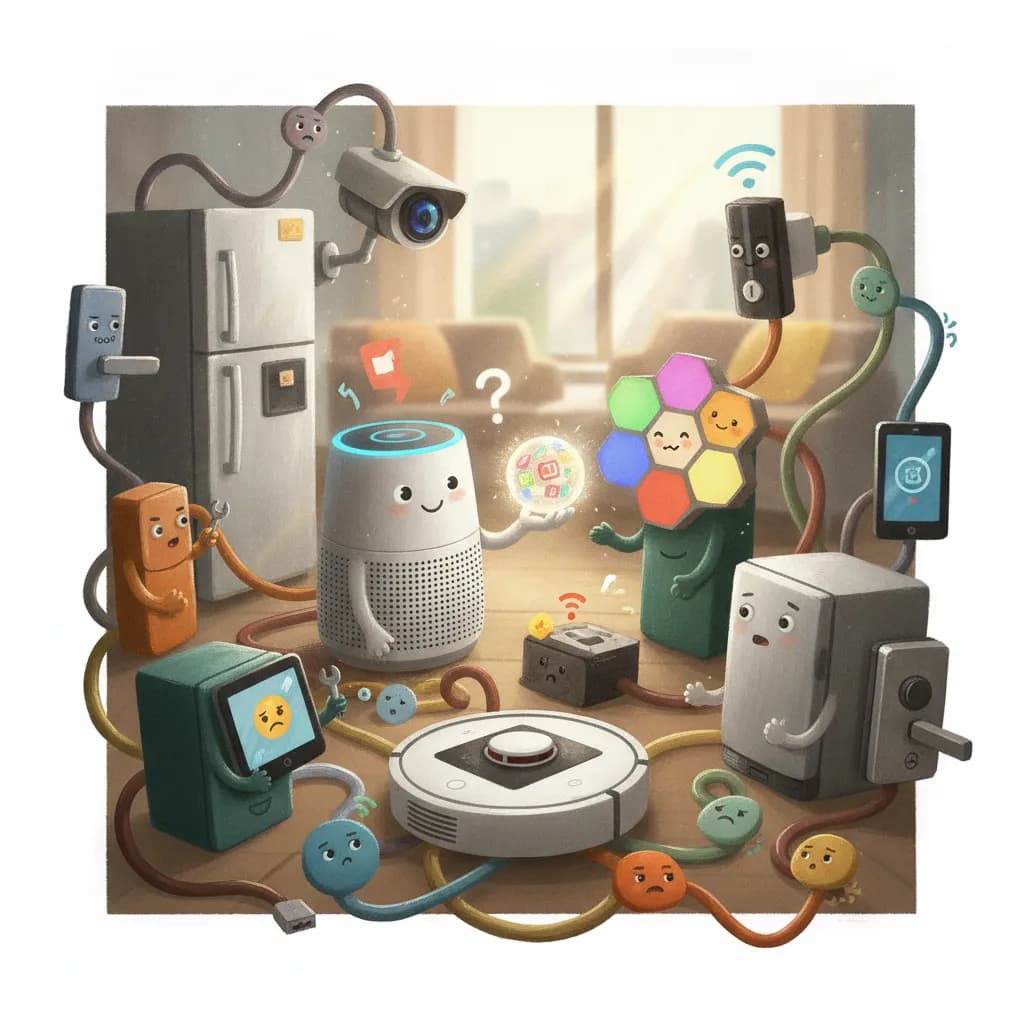
A category of devices whose biggest historical headache wasn't the technology itself, but simply getting one brand's gadgets to talk to another brand's gadgets.
Cheat Sheet
- Smart home devices are internet-connected household products — including speakers, thermostats, lights, locks, and cameras — that can be controlled remotely or automated based on set conditions.
- Voice assistants like Amazon Alexa, Google Assistant, and Apple's Siri serve as a common central control point for many smart home ecosystems, allowing spoken commands to control multiple connected devices.
- Smart home devices are frequently grouped under the broader term "Internet of Things" (IoT), referring to everyday physical objects connected to the internet and each other.
- Compatibility between different manufacturers' smart home devices has historically been a significant pain point, prompting industry efforts like the Matter standard to create shared cross-brand compatibility.
- Automation is a core appeal of smart home devices — for example, lights turning on automatically at sunset, or a thermostat adjusting based on whether anyone is actually home.
- Security researchers have repeatedly raised concerns about smart home device vulnerabilities, since compromised devices can potentially expose home networks, camera feeds, or door lock access to unauthorized parties.
The 60-Second Version
Smart home devices are internet-connected household products, including speakers, thermostats, lights, locks, and cameras, that can be controlled remotely or automated based on set conditions. Voice assistants like Amazon Alexa, Google Assistant, and Apple's Siri serve as a common central control point for many smart home ecosystems, allowing spoken commands to control multiple connected devices. Smart home devices are frequently grouped under the broader term "Internet of Things," or IoT, referring to everyday physical objects connected to the internet and each other. Compatibility between different manufacturers' smart home devices has historically been a significant pain point, prompting industry efforts like the Matter standard to create shared cross-brand compatibility. Automation is a core appeal of smart home devices — for example, lights turning on automatically at sunset, or a thermostat adjusting based on whether anyone is actually home. Security researchers have repeatedly raised concerns about smart home device vulnerabilities, since compromised devices can potentially expose home networks, camera feeds, or door lock access to unauthorized parties.
The Long Version
What Actually Counts as a Smart Home Device
Smart home devices span a wide range of household products, including voice-activated speakers, programmable thermostats, connected lighting, smart locks, and internet-connected security cameras, unified by their common ability to connect to home internet networks and be controlled or monitored remotely, typically via a smartphone app or voice command.
Voice Assistants as the Central Hub
For many households, a voice assistant like Amazon's Alexa, Google Assistant, or Apple's Siri serves as the primary control point tying multiple individual smart devices together, allowing users to issue a single spoken command that can control several connected products at once, rather than needing to open a separate app for each individual device.
The Compatibility Problem, and Matter's Attempt to Fix It
For years, one of the most persistent frustrations in the smart home space was inconsistent compatibility between devices made by different manufacturers, often forcing consumers to stick with a single brand's ecosystem to ensure everything worked together reliably. The Matter standard, backed by a coalition of major technology companies, represents a significant industry effort to establish shared compatibility across brands, though full adoption and reliability across the entire market remains a work in progress.
The Real Appeal: Automation, and Its Security Trade-off
Beyond simple remote control, much of the practical value of smart home devices comes from automation, letting devices act on their own based on pre-set conditions like time of day, whether anyone is home, or specific sensor triggers. This same always-connected nature, however, is exactly what makes smart home devices an attractive target for security researchers' and hackers' attention, since a compromised device can potentially expose far more than its own single function.
Ad slot (placeholder — set NEXT_PUBLIC_ADSENSE_SLOT_ID once an ad unit is created)
Glossary
- Internet of Things (IoT)
- The broader category of everyday physical objects connected to the internet and to each other.
- Voice assistant
- Software like Alexa, Google Assistant, or Siri that responds to spoken commands to control connected devices.
- Smart hub
- A central device or app that connects and coordinates multiple smart home devices, often across different brands.
- Matter
- An industry standard aiming to make smart home devices from different manufacturers work together more reliably.
- Automation
- Pre-set rules that trigger smart home device actions automatically based on conditions like time, location, or sensor input.