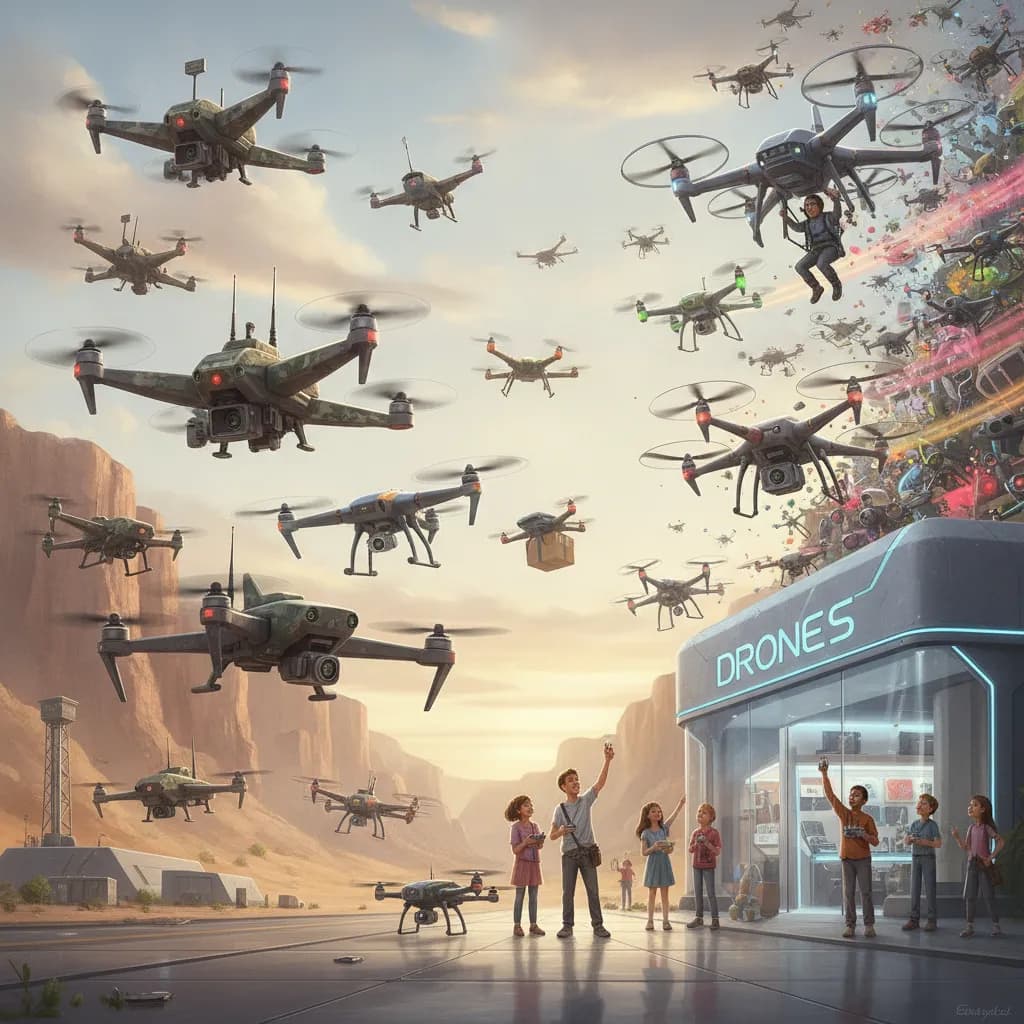
Drones
A technology that went from a specialized military tool to something available at ordinary consumer electronics stores in a remarkably short span of time.
Cheat Sheet
- A drone, formally known as an unmanned aerial vehicle, is a flying device operated remotely or autonomously without a pilot physically on board.
- Consumer drones typically use multiple rotors, most commonly four (quadcopters), providing stable flight control and relatively simple mechanical design compared to fixed-wing aircraft.
- Drones have found significant practical use across photography and videography, agriculture, infrastructure inspection, and search and rescue operations, well beyond their popular recreational use.
- Many countries require consumer drone operators to register their devices and follow specific airspace regulations, particularly restrictions around airports and other sensitive areas.
- Drone delivery services, using drones to transport small packages directly to consumers, remain in a relatively early and limited stage of real-world deployment despite considerable investment and testing by major companies.
- Advances in battery technology, camera miniaturization, and stabilization systems have significantly driven the rapid improvement in consumer drone capability and affordability over the past decade.
The 60-Second Version
A drone, formally known as an unmanned aerial vehicle, is a flying device operated remotely or autonomously without a pilot physically on board. Consumer drones typically use multiple rotors, most commonly four, called quadcopters, providing stable flight control and relatively simple mechanical design compared to fixed-wing aircraft. Drones have found significant practical use across photography and videography, agriculture, infrastructure inspection, and search and rescue operations, well beyond their popular recreational use. Many countries require consumer drone operators to register their devices and follow specific airspace regulations, particularly restrictions around airports and other sensitive areas. Drone delivery services, using drones to transport small packages directly to consumers, remain in a relatively early and limited stage of real-world deployment despite considerable investment and testing by major companies. Advances in battery technology, camera miniaturization, and stabilization systems have significantly driven the rapid improvement in consumer drone capability and affordability over the past decade.
The Long Version
The Quadcopter Design Behind Most Consumer Drones
Most consumer drones use a quadcopter design, employing four separate rotors to achieve stable, controllable flight, a mechanically simpler and generally more affordable approach than fixed-wing aircraft designs, making quadcopters the dominant design for the recreational and lower-cost commercial drone market specifically.
Well Beyond a Recreational Toy
While often associated primarily with recreational photography and hobbyist flying, drones have found significant practical application across numerous professional fields, including aerial photography and videography for film and real estate, precision agriculture for crop monitoring, infrastructure inspection of hard-to-access structures like bridges and cell towers, and search and rescue operations covering difficult terrain quickly.
Registration and Airspace Rules
Many countries require consumer drone operators to formally register their devices and follow specific airspace regulations, particularly strict restrictions around airports and other sensitive or restricted areas, reflecting growing regulatory attention as drones have become considerably more widespread and technically capable in recent years.
Delivery's Slow Real-World Rollout, and What's Actually Driving Improvement
Despite considerable investment and testing by major companies, drone delivery services, using drones to transport small packages directly to consumers, remain in a relatively early and geographically limited stage of real-world deployment, facing ongoing regulatory, safety, and logistical challenges. Meanwhile, advances in battery technology, camera miniaturization, and flight stabilization systems have significantly driven the rapid overall improvement in consumer drone capability and affordability over the past decade.
Ad slot (placeholder — set NEXT_PUBLIC_ADSENSE_SLOT_ID once an ad unit is created)
Glossary
- Unmanned aerial vehicle (UAV)
- The formal technical term for a drone, a flying device operated remotely or autonomously without an onboard pilot.
- Quadcopter
- A common consumer drone design using four rotors for stable flight control.
- Airspace regulation
- Government rules governing where and how drones can legally be flown, particularly restricting flight near airports and other sensitive areas.
- Stabilization system
- Technology that keeps a drone's camera steady during flight, a significant driver of improved consumer drone photography and video quality.
- Drone delivery
- The use of drones to transport small packages directly to consumers, still in a relatively early stage of real-world deployment.