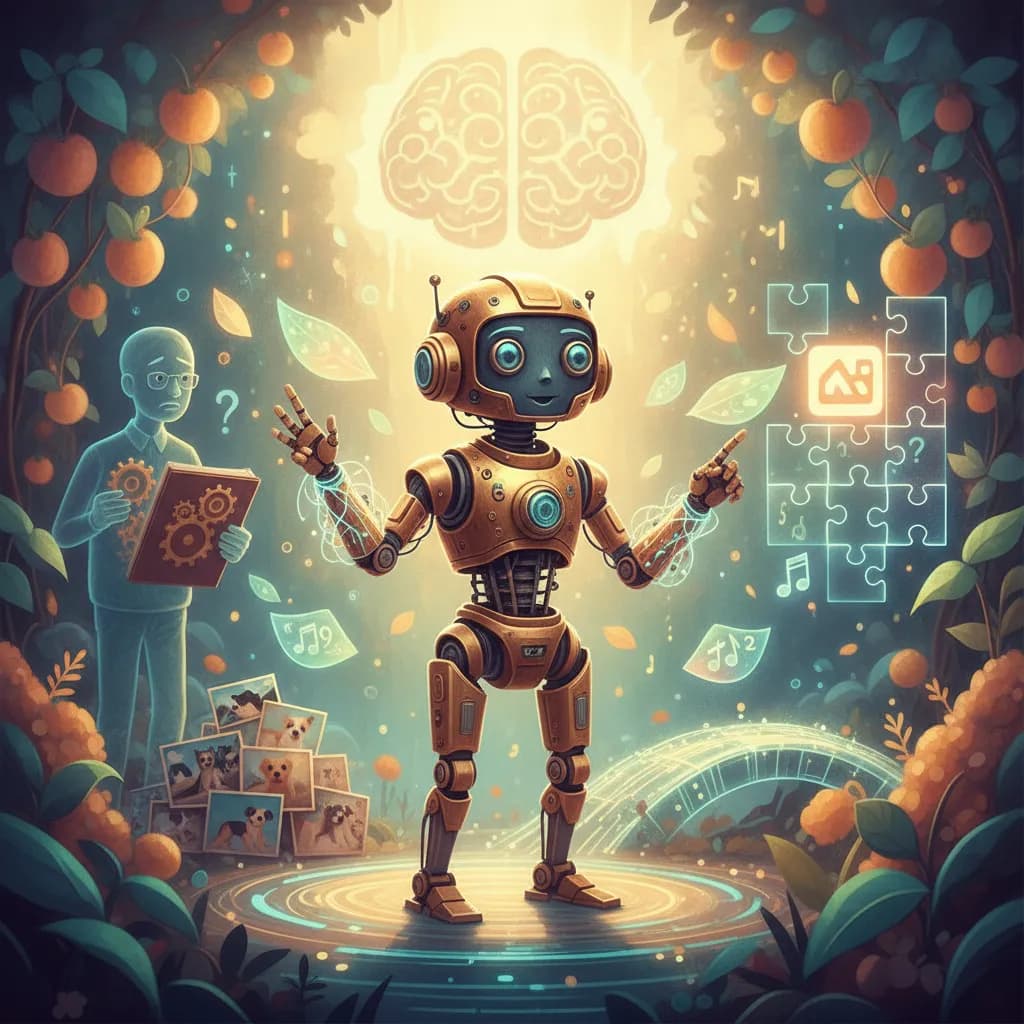
Machine Learning Basics
Software that gets better at a task not because a programmer rewrote its rules, but because it saw enough examples to figure out the pattern itself.
Cheat Sheet
- Machine learning is a way of building software that learns patterns from data rather than following explicitly hand-coded rules for every situation.
- The three broad types are supervised learning (learning from labeled examples), unsupervised learning (finding patterns in unlabeled data), and reinforcement learning (learning through trial-and-error rewards).
- A "model" is the actual mathematical structure that gets trained on data and then used to make predictions on new, unseen data.
- Training a model means adjusting its internal parameters repeatedly so its predictions get closer to the correct answers in the training data.
- Overfitting happens when a model learns the training data too specifically, including its noise and quirks, and performs poorly on new data as a result.
- Modern deep learning, which powers most recent AI breakthroughs, uses neural networks with many layers loosely inspired by how neurons connect in the brain.
The 60-Second Version
Machine learning is a way of building software that learns patterns from data rather than following explicitly hand-coded rules for every situation. The three broad types are supervised learning (learning from labeled examples), unsupervised learning (finding patterns in unlabeled data), and reinforcement learning (learning through trial-and-error rewards). A "model" is the actual mathematical structure that gets trained on data and then used to make predictions on new, unseen data, and training a model means adjusting its internal parameters repeatedly so its predictions get closer and closer to the correct answers found in the training data. Overfitting is one of the field's central challenges: it happens when a model learns the training data too specifically, including its noise and quirks, and performs poorly once it encounters genuinely new data. Modern deep learning, which powers most recent AI breakthroughs, uses neural networks with many layers loosely inspired by how neurons connect in the brain.
The Long Version
Rules vs. Learned Patterns
Traditional software is built by a programmer explicitly writing out rules for every scenario the program needs to handle. Machine learning flips this: instead of hand-coding rules, engineers feed a model large amounts of data and let it discover the underlying patterns itself, adjusting its internal parameters until its outputs match known correct answers closely enough to be useful. This distinction matters enormously for problems, like recognizing handwriting or understanding spoken language, that are far too complex and full of edge cases to realistically capture in a hand-written rulebook.
Three Main Flavors of Learning
Supervised learning trains a model on labeled examples, where the correct answer is provided alongside each input, like a dataset of photos already tagged as "cat" or "dog." Unsupervised learning works with unlabeled data, tasking the model with finding structure or groupings on its own, such as clustering customers into segments based on purchasing behavior without being told in advance what those segments should be. Reinforcement learning takes a different approach entirely, having a model learn through trial and error by taking actions in an environment and receiving rewards or penalties, a method famously used to train AI systems that master games like Go and chess.
How Training Actually Works
Training a model involves repeatedly feeding it examples, checking how far its predictions are from the correct answer, and using that error to adjust the model's internal parameters slightly in a direction that reduces future error, a process typically repeated millions of times across a large dataset. Over enough iterations, the model's parameters settle into values that let it generalize reasonably well, ideally not just memorizing the specific training examples but capturing the broader pattern behind them.
Why Deep Learning Changed Everything
Deep learning refers specifically to neural networks with many stacked layers, loosely inspired by how biological neurons connect and pass signals to each other. Each layer learns to recognize increasingly abstract features, from simple edges and shapes in an image up to complex concepts like faces or objects, without a human needing to manually specify what those intermediate features should look like. The combination of much larger datasets, far more powerful computing hardware (especially GPUs), and refined training techniques over the 2010s and 2020s is what allowed deep learning to move from an academic curiosity to the engine behind most headline-grabbing AI breakthroughs, including image recognition, translation, and large language models.
Ad slot (placeholder — set NEXT_PUBLIC_ADSENSE_SLOT_ID once an ad unit is created)
Glossary
- Model
- The trained mathematical structure that takes in new data and produces predictions or outputs.
- Training data
- The dataset used to teach a model to recognize patterns before it's deployed.
- Neural network
- A machine learning architecture made of layered, interconnected nodes loosely inspired by biological neurons.
- Overfitting
- When a model learns training data too specifically and fails to generalize to new data.
- Supervised learning
- Training a model on labeled examples, where the correct answer is provided alongside each input.
Go Deeper
- Google — Machine Learning Crash Course
- "The Hundred-Page Machine Learning Book" by Andriy Burkov