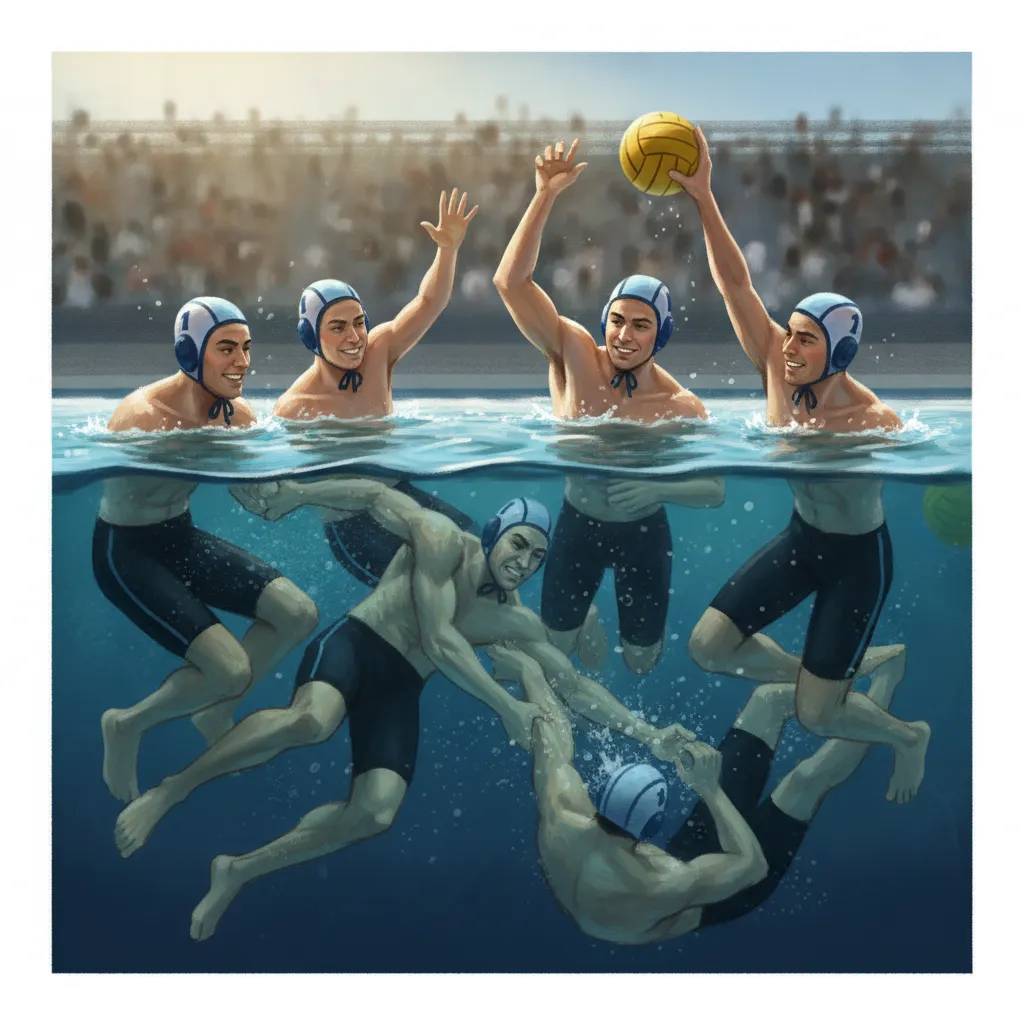
Water Polo
A sport that looks genteel from the stands and turns into an underwater wrestling match the moment the camera stops looking.
Cheat Sheet
- Two teams of seven swim and tread water while trying to throw a ball into the opponent's goal — most goals across four periods wins.
- Players (except the goalkeeper) can't touch the pool bottom or hold the ball with both hands at once — everything happens while treading water one-handed.
- A shot clock (30 seconds in most competitions) forces a team to attempt a shot or turn the ball over, similar in spirit to basketball's.
- Physical contact below the surface — grabbing, pulling, holding — happens constantly and is rarely visible to spectators or even referees.
- Exclusion fouls send a player out of the pool for 20 seconds, giving the other team a man-advantage, similar to a power play in hockey.
- It's one of the oldest team sports in the modern Olympics, part of the Games continuously since 1900.
The 60-Second Version
Water polo is played between two teams of seven, swimming and treading water while trying to throw a ball into the opponent's goal across four periods — most goals wins. Outside the goalkeeper, no player can touch the pool bottom or hold the ball with both hands at once, so every pass, catch, and shot happens one-handed while treading water using a specialized "eggbeater kick." A shot clock, commonly 30 seconds, forces a team to attempt a shot or turn the ball over, playing a similar role to basketball's shot clock. Much of the sport's real physicality — grabbing, pulling, holding — happens below the surface, out of easy view for spectators and even referees, giving water polo a reputation as one of the most demanding and hidden-contact team sports. It's also one of the longest-running Olympic team sports, part of the Games continuously since 1900.
The Long Version
A Game Played Entirely Treading Water
Outside the goalkeeper, no player is allowed to touch the bottom of the pool at any point during play, and everyone must tread water continuously for the entire game using a specialized technique called the "eggbeater kick" — an alternating circular leg motion that keeps a player stable and high enough in the water to shoot, pass, or block one-handed, since field players are never allowed to touch the ball with both hands at once. That single restriction is what makes water polo so different from land-based ball sports: every basic action, from catching a pass to taking a shot, has to be executed one-handed while simultaneously working to stay afloat against an opponent trying to push you under.
The Hidden Physicality
Water polo has a reputation among athletes as one of the most physically punishing team sports, largely because so much of the real contact — grabbing, pulling, holding an opponent underwater — happens below the surface where it's difficult for spectators, and often even referees, to actually see. That hidden physicality is a big part of why the sport demands such extraordinary conditioning: players are simultaneously swimming, treading water under resistance, and physically contesting position for the entire length of a game.
Scoring and Structure
A game is divided into four periods, with a shot clock (commonly 30 seconds) forcing a team to attempt a shot on goal or turn the ball over, functioning much like basketball's shot clock in keeping the pace of play moving. More serious fouls result in an "exclusion," removing the offending player from the pool for 20 seconds and giving the other team a numerical advantage, commonly called being "man-up" — a mechanic that plays a similar tactical role to a power play in ice hockey.
A Long Olympic History
Water polo has been part of the modern Olympics continuously since 1900, making it one of the longest-running team sports in Olympic history. Hungary has historically been the sport's most dominant men's program by a wide margin, with Serbia and Croatia also fielding consistently elite teams, while the United States women's national team has become a dominant modern force, winning multiple recent Olympic and world titles and helping drive real growth in the sport's visibility domestically.
Ad slot (placeholder — set NEXT_PUBLIC_ADSENSE_SLOT_ID once an ad unit is created)
Glossary
- Eggbeater kick
- A treading-water technique using alternating circular leg motion, letting a player stay stable and high in the water while using both hands freely.
- Exclusion foul
- A more serious foul resulting in a 20-second removal from play, similar to a penalty in hockey.
- Man-up
- A scoring opportunity created when the opposing team is down a player due to an exclusion foul.
- Counterattack
- A fast transition from defense to offense before the opposing defense can set up.
- Two-meter player
- An offensive player positioned directly in front of the opponent's goal, similar to a post player in basketball.