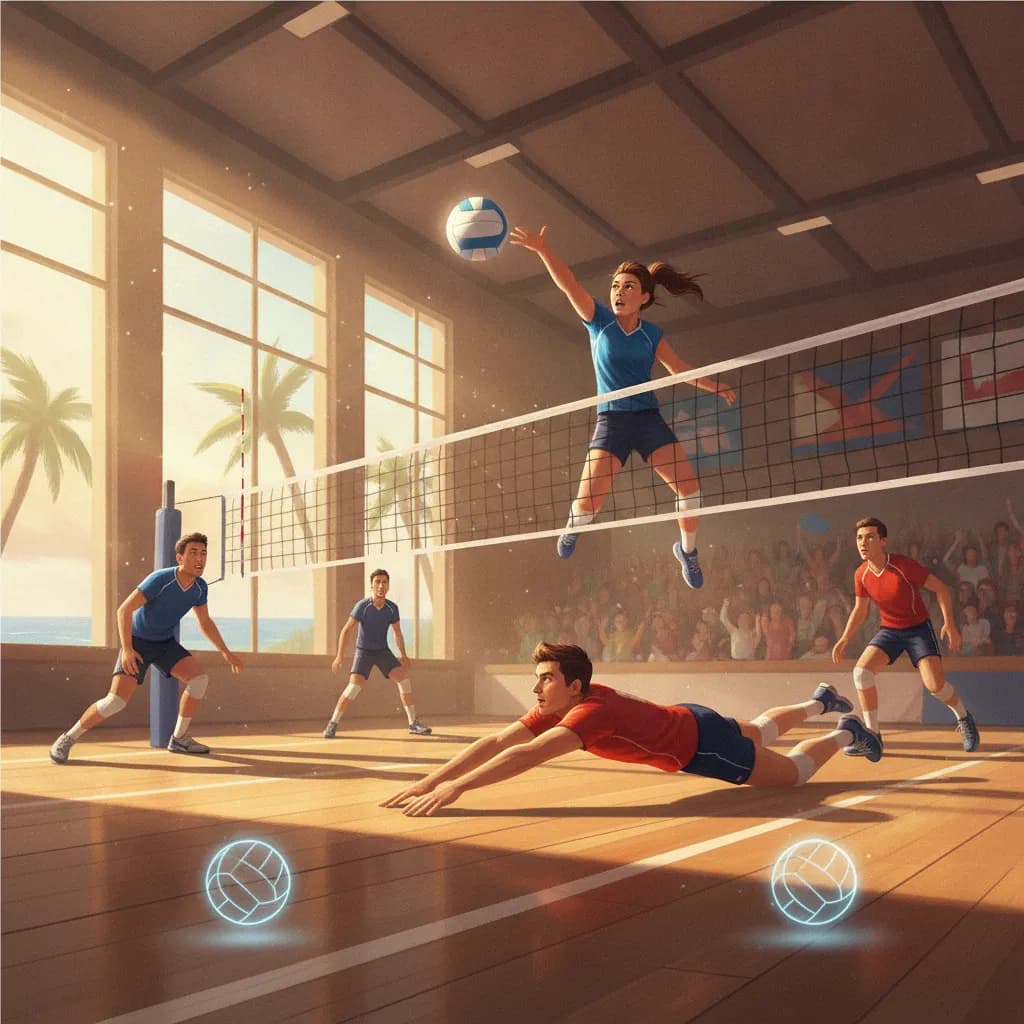
Volleyball
A sport built entirely around one rule: never let the ball touch the ground on your side — for either team.
Cheat Sheet
- Two teams of six hit a ball back and forth over a net, trying to ground it on the opponent's side or force an error — matches are won by winning sets, usually best-of-five.
- Each team gets a maximum of three touches per side (not counting a block) before the ball must go back over the net.
- A standard set is played to 25 points, win by 2 — the decisive fifth set (if needed) is usually played to 15.
- Rotation rules require players to cycle positions clockwise every time their team wins the serve back, which is why volleyball has such structured on-court movement.
- A "kill" is an attacking hit that immediately wins the point — the volleyball equivalent of a knockout blow.
- Beach volleyball (two-person teams, outdoors, played to 21) is a genuinely distinct Olympic discipline from indoor volleyball, not just a casual variant.
The 60-Second Version
Volleyball is played between two teams of six, hitting a ball back and forth over a net, trying to ground it on the opponent's side or force an error. Each team gets a maximum of three touches per side before the ball must go back over the net, which creates a standard rhythm: a defensive pass, a set that positions the ball for an attacker, and an attacking hit. A standard set is played to 25 points (win by 2), with matches typically decided best-of-five sets. Players must rotate clockwise through six court positions every time their team wins back the serve, meaning everyone cycles through both front-row attacking and back-row defensive roles over a match. Beach volleyball, played two-on-two outdoors and scored slightly differently, is a genuinely distinct Olympic discipline rather than a casual offshoot of the indoor game.
The Long Version
Rules That Shape the Game
Each team gets a maximum of three touches on their side of the net before the ball must cross back over (a block doesn't count toward that limit), which forces a standard, repeatable rhythm: a defensive dig or pass, a set that positions the ball for an attacker, and finally an attacking hit aimed at the opposing side. Players must also rotate clockwise through six court positions every time their team wins back the serve, meaning everyone cycles through both front-row attacking positions and back-row defensive positions over the course of a match rather than staying fixed in one spot like many other sports.
How a Point Is Won
A "kill" — an attacking hit that lands unreturned on the opponent's side or is touched but not controlled — immediately wins the point, and is volleyball's most decisive offensive weapon. On defense, a "dig" keeps an attacked ball from hitting the floor, while a "block" involves front-row players jumping to intercept an attack directly at the net, occasionally scoring a point outright if the ball is deflected straight down onto the attacking team's side. Because rallies are typically short and every point matters immediately (modern volleyball uses rally scoring, meaning a point is scored on every serve regardless of which team served), the sport rewards explosive, high-effort bursts over sustained endurance.
Indoor vs Beach
Beach volleyball, played two-on-two outdoors on sand and scored slightly differently (typically to 21 rather than 25), is a genuinely distinct Olympic discipline rather than a casual offshoot of the indoor game — the smaller team size means every player has to cover far more court and contribute across all three touches, producing a noticeably different skill profile and playing style than the six-person indoor game.
A Sport Bigger Than It Looks in the US
Volleyball is often underestimated in the United States relative to its actual global standing: Brazil, Italy, Poland, and a cluster of other Eastern European and Asian countries (notably Japan and China) field consistently elite national programs and treat the sport with a level of mainstream attention closer to how the US treats basketball or football. The FIVB World Championship and the sport's deep Olympic tradition reflect that genuinely global competitive depth, even though American media coverage of the sport outside the Olympics remains comparatively limited.
Ad slot (placeholder — set NEXT_PUBLIC_ADSENSE_SLOT_ID once an ad unit is created)
Glossary
- Kill
- An attacking hit that scores a point immediately, unreturned by the defense.
- Dig
- A defensive save, keeping an attacked ball from hitting the floor.
- Set
- Both a positioning pass that sets up a teammate's attack, and the name for a full unit of play within a match.
- Rotation
- The clockwise cycling of player positions each time a team regains serve.
- Libero
- A defensive specialist player who wears a different colored jersey and has restricted attacking rights.