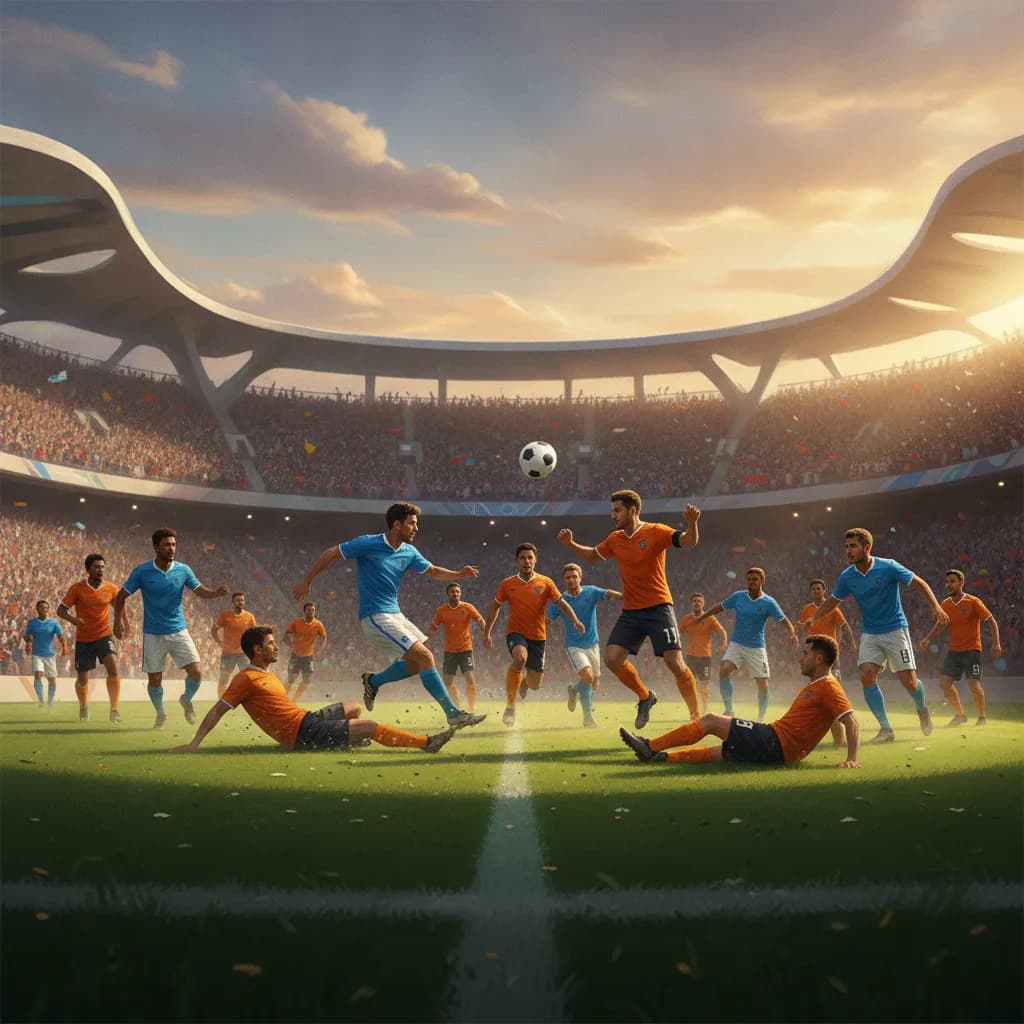
Soccer
Twenty-two people chase one ball for 90 minutes, and somehow it's still the most popular sport on Earth.
Cheat Sheet
- Offside: you can't be past the last defender when the ball is played to you — this rule causes 90% of the arguments you'll hear.
- Yellow card: a warning for rough or unsporting play. Two yellows in one game equal a red.
- Red card: instant ejection, and the team plays the rest of the match a player short.
- Penalty kick: awarded for a foul inside the box, one attacker vs. the goalkeeper from 12 yards out.
- The pitch: the field. "Box" or "penalty area" is the rectangle in front of each goal.
- Extra time / penalties: how knockout matches (like World Cup elimination rounds) get decided if tied after 90 minutes.
The 60-Second Version
Soccer (the rest of the world calls it football) is two teams of 11 trying to get a ball into the other team's goal, using anything except their hands and arms. Games run 90 minutes split into two 45-minute halves, plus a bit of "stoppage time" tacked on for delays. Whoever scores more goals wins; a tie is a tie unless it's a knockout match, in which case things escalate to extra time and then penalty kicks. That's genuinely most of what you need to follow a casual game.
The Long Version
Origins and History
Soccer's roots go back centuries — various ball-kicking games turn up in ancient China, Greece, and medieval England — but the modern game was codified in England in 1863, when a set of clubs meeting in London agreed on standardized rules, including banning hacking and carrying the ball. That split "association football" off from the handling-and-carrying game that became rugby. The name "soccer" itself is British university slang, a shortening of "assoc.," and it's mainly used today in countries like the US and Australia where "football" already refers to a different sport. From England, the game spread rapidly along trade and colonial routes in the late 1800s and early 1900s, taking root especially fast in South America, where it quickly became woven into national identity.
How a Match Works
A match runs 90 minutes, split into two 45-minute halves, with a few extra minutes of "stoppage time" added at the end of each half to make up for stoppages like injuries and substitutions. Teams typically organize into a formation — shorthand like 4-4-2 or 4-3-3 describes how many defenders, midfielders, and forwards line up in front of the goalkeeper. Center-backs and full-backs defend, midfielders link play and cover the most ground, and forwards (including wide players called wingers) lead the attack. The goalkeeper is the only player allowed to use their hands, and only inside their own penalty box. The sport's most argued-about rule is offside: an attacker is offside if they're nearer the opponent's goal line than both the ball and the second-last defender at the moment the ball is played to them. It exists to stop attackers from simply camping next to the goal waiting for a pass. Calling it accurately in real time is hard enough that assistant referees, and increasingly Video Assistant Referee (VAR) technology, are used to review close calls.
Competitions and Culture
The FIFA World Cup, held every four years, is the sport's showcase event and one of the most-watched events on the planet regardless of category. But club competitions generate arguably even more consistent followings: the UEFA Champions League pits Europe's best club teams against each other, while domestic leagues like the Premier League (England), La Liga (Spain), Serie A (Italy), and the Bundesliga (Germany) run every week for most of the year. Club soccer often features a higher standard of play than international tournaments, since top clubs can sign players from anywhere in the world rather than being limited to one country's talent pool. Beneath the big leagues, local rivalries — "derbies" between clubs from the same city or region — carry an intensity that can rival anything international.
Why It Became the World's Game
Soccer's global spread owes a lot to its sheer accessibility: all you need is a ball and open space, no expensive equipment or specialized field required, which let it take root in poor and wealthy countries alike. That low barrier to entry, combined with a simple core rule set anyone can pick up by watching a few minutes of play, made it easy to export everywhere colonial trade and migration went. Once established, national success at soccer became tightly bound up with national pride — a World Cup win is treated as a genuine source of collective identity in a way few other sports achieve, which in turn keeps interest and investment in the game self-reinforcing generation after generation.
Ad slot (placeholder — set NEXT_PUBLIC_ADSENSE_SLOT_ID once an ad unit is created)
Glossary
- Pitch
- The field of play.
- Kit
- A team's uniform.
- Nil
- Soccer-speak for zero (a "1-nil" win is 1-0).
- Derby
- A match between two rival teams, usually from the same city.
- Clean sheet
- When a team doesn't concede a goal all game.
Go Deeper
- FIFA — Laws of the Game
- BBC Sport — Football
- Soccernomics by Simon Kuper and Stefan Szymanski