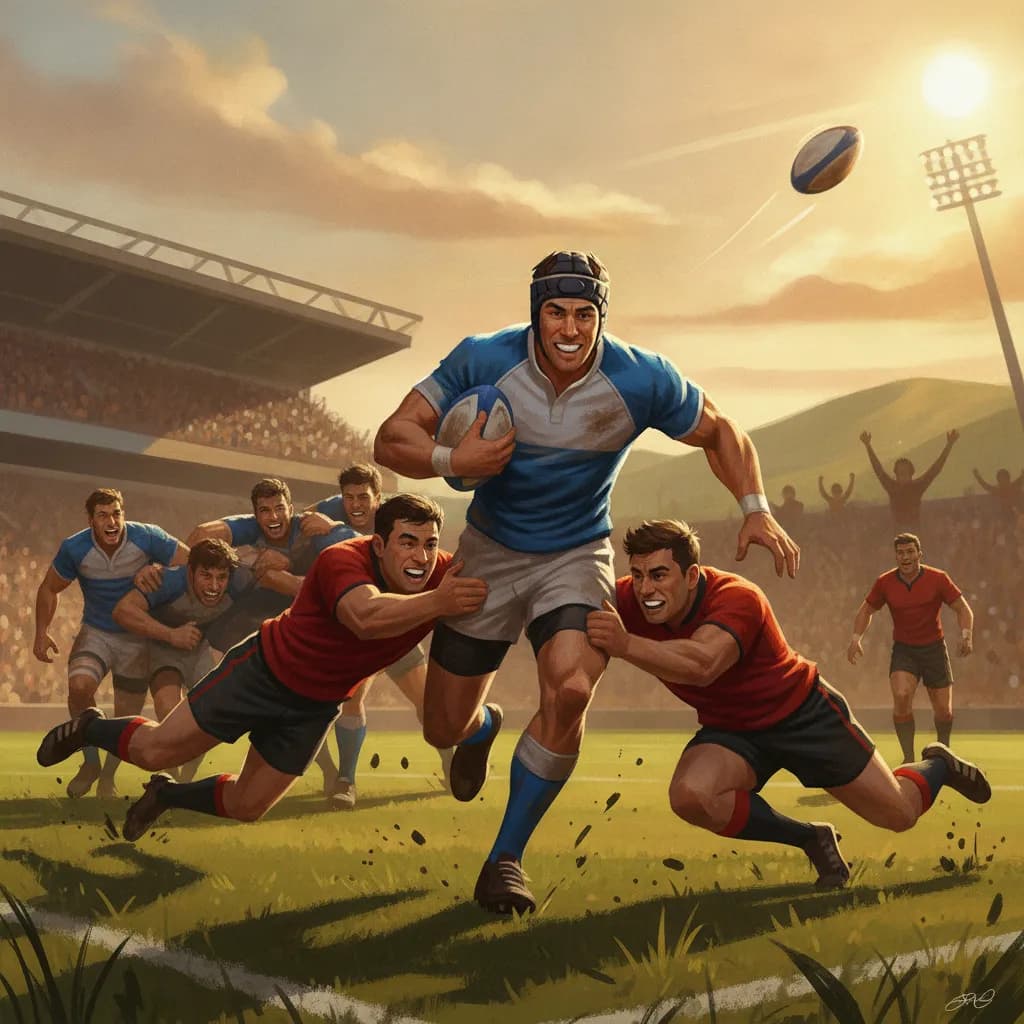
Rugby
American football's ancestor kept the tackling and dropped the forward pass entirely — and somehow that makes it faster, not slower.
Cheat Sheet
- Two teams of 15 (Rugby Union) try to score by carrying, passing, or kicking an oval ball into the opponent's end zone (a "try") or kicking it through the posts.
- You can only pass the ball backward or sideways, never forward — this single rule shapes almost everything about how the game is played.
- A try is worth 5 points, plus a conversion kick worth 2 more; penalty kicks and drop goals are worth 3.
- Tackled players must release the ball immediately, leading to contested "rucks" and "mauls" where both teams fight for possession on the ground.
- Rugby League (13 players) is a distinct, related sport with its own rules — most global attention, including the Rugby World Cup, refers to Rugby Union.
- Unlike American football, play is mostly continuous, with no huddle-and-reset between plays and relatively few stoppages.
The 60-Second Version
Rugby (specifically Rugby Union, the more widely followed of two related codes) is played between two teams of 15, trying to score by carrying, passing, or kicking an oval ball into the opponent's end zone for a try, or kicking it through raised goalposts. The sport's single defining rule is that the ball can only be passed backward or sideways, never forward — players advance the ball by running it forward themselves, or by kicking it ahead, which shapes nearly every tactical decision in the game. A try is worth 5 points, with a follow-up conversion kick worth 2 more; penalty kicks and drop goals are worth 3. Tackled players must immediately release the ball, triggering contested phases called rucks and mauls where both teams fight for possession on the ground or on their feet. Unlike American football, play is largely continuous, with few stoppages and no huddle between plays.
The Long Version
How the Game Is Played
The backward-pass-only rule is what makes rugby feel so different from American football despite the visual similarities — since you can't simply throw the ball downfield, gaining ground requires running directly at (and through) the defense, or using tactical kicks to gain territory instead. When a ball carrier is tackled, they must release the ball immediately rather than being allowed to just fall and reset like in American football; this creates a "ruck," where players from both teams bind together over the ball and try to win possession by driving over it, or a "maul," a similar contest that happens while the ball carrier is still on their feet, being held up by attackers and defenders alike.
Scoring and Restarts
Beyond tries and conversions, penalty kicks (awarded for various infractions, worth 3 points) and drop goals (a mid-play dropkick through the posts, also worth 3) give teams additional ways to score without necessarily crossing the try line. Play restarts after certain stoppages via a scrum — forwards from both teams bind together in a tight formation and push against each other while the ball is fed in underneath, contesting for possession — or a lineout, used when the ball goes out of bounds, where players are lifted by teammates to catch a ball thrown in from the sideline. Both restarts require real specialized skill and training, and are often where a team's forward pack does its most visible, physical work.
Union vs League
Rugby Union and Rugby League split from a shared origin in 1895 over a dispute about paying players, and the two have evolved into genuinely distinct sports sharing a common ancestor rather than variations on the same game. League is played 13-a-side rather than 15, has no contested rucks or mauls (possession is handed over after a set number of tackles instead), and moves at a generally faster, more repetitive pace. Union remains the more globally dominant and internationally followed code, with League concentrated more heavily in specific strongholds like northern England and Australia.
The World Cup and Global Reach
The Rugby World Cup, held every four years, is Union's premier international event, alongside major annual tournaments like the Six Nations (England, France, Ireland, Italy, Scotland, and Wales) in the north and the Rugby Championship (Argentina, Australia, New Zealand, and South Africa) in the south. New Zealand's national team, the All Blacks, holds a legendary reputation in the sport, both for their dominant playing record and for the pre-match haka, a traditional Māori challenge performed before kickoff that's become one of the most recognized rituals in international sports.
Ad slot (placeholder — set NEXT_PUBLIC_ADSENSE_SLOT_ID once an ad unit is created)
Glossary
- Try
- Grounding the ball in the opponent's end zone, the primary way to score, worth 5 points.
- Scrum
- A contested restart where forwards from both teams bind together and push for the ball.
- Ruck
- A contest for the ball on the ground after a tackle, with players from both teams bound over it.
- Conversion
- A kick attempt taken after a try, worth 2 additional points if successful.
- Lineout
- A restart after the ball goes out of bounds, where players are lifted to catch a ball thrown in from the sideline.