Lacrosse
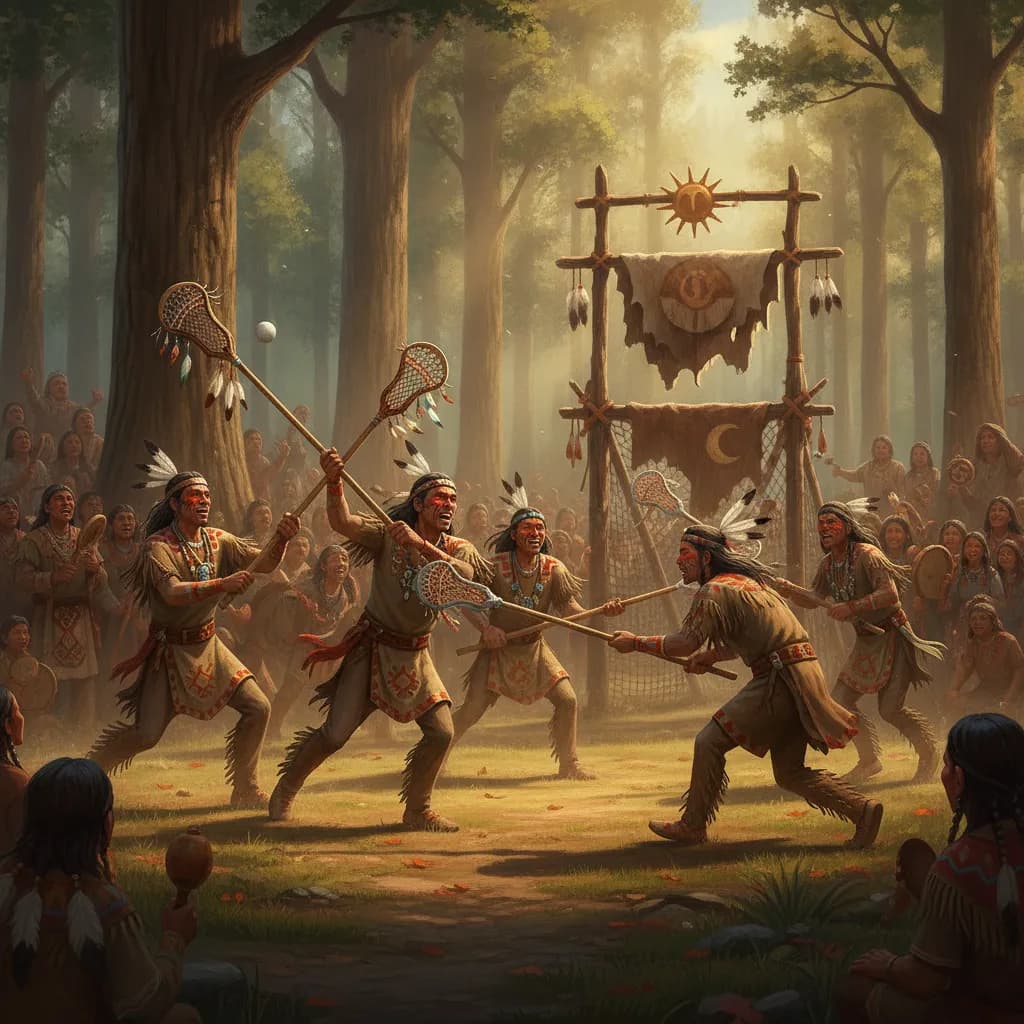
A game with real ceremonial roots stretching back centuries before "organized sport" was even a category — some Haudenosaunee communities still call it the Creator's Game.
Cheat Sheet
- Two teams use netted sticks to catch, carry, and throw a small rubber ball, trying to score in the opponent's goal — most goals wins.
- The sport originated with Indigenous peoples of North America, played for centuries before European colonizers encountered and later adapted it.
- Field lacrosse (outdoor, 10-a-side) and box lacrosse (indoor, on a hockey-rink-sized surface, 6-a-side) are genuinely distinct versions with different pacing and rules.
- A player can't touch the ball with their hands — everything happens via the netted head of the stick, called the "crosse."
- It's one of the fastest-growing sports in US high schools and colleges, especially in the Northeast and mid-Atlantic.
- The Iroquois Nationals, representing the Haudenosaunee Confederacy, compete internationally as one of the very few Indigenous nations recognized in international team sports.
The 60-Second Version
Lacrosse is played between two teams using netted sticks, called "crosses," to catch, carry, and throw a small rubber ball — no hand contact with the ball is allowed. The sport originated with Indigenous peoples of North America, particularly the Haudenosaunee (Iroquois) Confederacy, played for centuries before European colonizers encountered and eventually adapted it into today's more standardized version. Two genuinely distinct forms exist: field lacrosse, played outdoors 10-a-side, and box lacrosse, played indoors on a smaller rink-sized surface with six players per side and a noticeably faster pace. Keeping the ball secure in the stick's net while running requires a wrist motion called "cradling," and play restarts through contested "face-offs" for loose possession. It's become one of the fastest-growing sports in American high schools and colleges, especially in the Northeast and mid-Atlantic.
The Long Version
Indigenous Origins
Lacrosse originated with Indigenous peoples of North America, particularly the Haudenosaunee (Iroquois) Confederacy, who played versions of the game for centuries before European colonizers ever encountered it, often for ceremonial, spiritual, or diplomatic purposes rather than pure recreation — it's still referred to by some Haudenosaunee communities as "the Creator's Game." Early versions could involve hundreds of players across enormous stretches of land, played over multiple days, a far cry from the tightly bounded, time-limited version played today. European settlers adapted and formalized the game into the more standardized sport that eventually spread through Canadian and American schools.
Two Versions of the Same Sport
Field lacrosse, the outdoor version played 10-a-side on a large field, is the more widely known variant in the United States, particularly at the high school and college level. Box lacrosse, played indoors on a smaller rink-sized surface with six players per side, developed largely in Canada and moves at a noticeably faster, more physical pace due to the tighter space, closer in some ways to ice hockey than to field lacrosse. Professional box lacrosse (via the National Lacrosse League) and professional field lacrosse (via various American leagues) exist as genuinely separate professional ecosystems rather than one sport with a minor variant.
Basics of Play
Players use a netted stick called a "crosse" for every interaction with the ball — catching, carrying, and throwing — since direct hand contact with the ball isn't allowed. Keeping the ball secure while running or being challenged requires "cradling," a specific wrist motion that uses centrifugal force to hold the ball in the stick's net. Play restarts after a goal or certain stoppages via a face-off, where two players battle directly for possession of a ball placed on the ground between their sticks, and loose balls on the field are contested in "groundball" battles that reward aggression and quick hands.
A Sport on the Rise
Lacrosse has become one of the fastest-growing sports in American high schools and colleges over the past two decades, particularly concentrated in the Northeast and mid-Atlantic regions where it has the deepest historical roots. Internationally, the Iroquois Nationals, representing the Haudenosaunee Confederacy directly rather than a nation-state, compete in top-level international lacrosse — a rare and meaningful example of an Indigenous nation fielding its own internationally recognized team in a major sport, a status the sport's own governing bodies have specifically worked to preserve given lacrosse's Indigenous origins.
Ad slot (placeholder — set NEXT_PUBLIC_ADSENSE_SLOT_ID once an ad unit is created)
Glossary
- Crosse
- The netted stick used to catch, carry, cradle, and throw the ball — no hand contact with the ball is allowed.
- Cradling
- A wrist motion that keeps the ball secure in the stick's net while running or being challenged.
- Face-off
- A contested restart where two players battle for possession of the ball placed on the ground between their sticks.
- Box lacrosse
- An indoor version played on a smaller rink-sized surface, six players per side, generally faster-paced.
- Groundball
- A loose ball battle, scooping the ball up off the field after it's been dropped or knocked free.