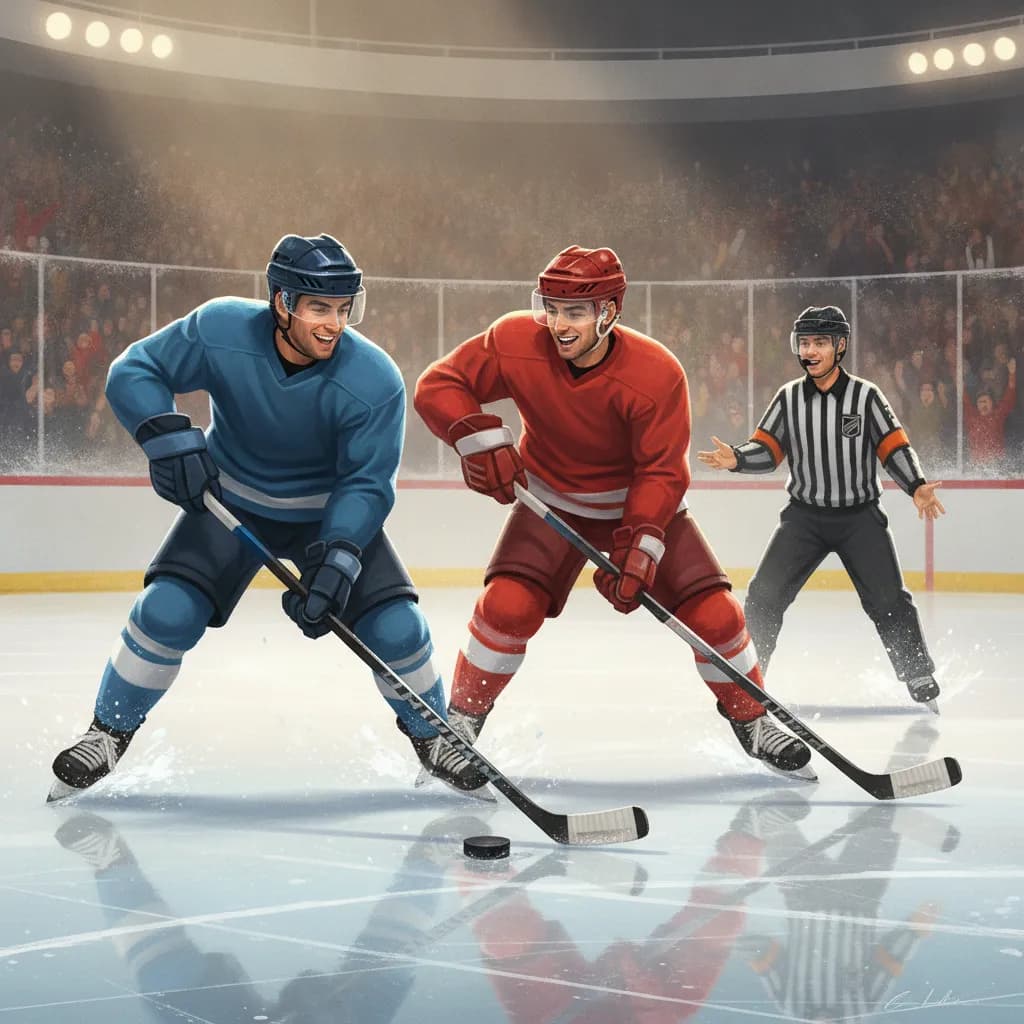
Ice Hockey
The fastest of the major team sports, with a rulebook that technically bans fighting and then shrugs and gives it a standard penalty anyway.
Cheat Sheet
- Two teams of six (including a goalie) skate on ice, trying to shoot a puck into the opponent's net — most goals after three periods wins.
- "Icing" and "offside" are the two core positional rules, both designed to stop teams from just launching the puck deep and camping near the opponent's goal.
- Penalties send a player to the penalty box for a set time, leaving their team short-handed ("on the power play" for the other side) until it expires or a goal is scored against them.
- Fighting is technically against the rules but historically tolerated with a standard penalty, a quirk unique to hockey among major team sports.
- The Stanley Cup, the NHL's championship trophy, is the oldest existing trophy competed for by professional athletes in North America, dating to 1893.
- Games can end in overtime and, if still tied, a shootout — a structural mash-up not found in most other major sports.
The 60-Second Version
Ice hockey is played between two teams of six skaters (including a goaltender), trying to shoot a puck into the opponent's net across three 20-minute periods — most goals wins. Two positional rules, "icing" and "offside," keep teams from just launching the puck deep and camping near the opponent's goal, forcing the puck to actually be carried or passed into scoring position. Penalties send a player to the box for a set time, leaving their team short-handed — a "power play" advantage for the opponent — until it expires or a goal is scored against them. Fighting occupies a strange spot in hockey's rulebook: technically illegal, but historically tolerated with a standard penalty rather than ejection, a quirk essentially unique to the sport among major professional leagues. If a game is tied after regulation, it moves to overtime and, if still unresolved, a shootout.
The Long Version
How a Game Is Played
A game is divided into three 20-minute periods, with each team fielding six skaters at a time (five positional players plus a goaltender), though rosters are much larger and players rotate on and off the ice in short shifts due to the sport's exhausting pace. Two positional rules keep the game from collapsing into simple long-range dumping: "icing" penalizes a team for shooting the puck the length of the ice past the opposing goal line without anyone touching it first, and "offside" prevents attacking players from entering the opponent's zone ahead of the puck. Both rules exist specifically to force teams to actually carry or pass the puck into scoring position rather than just launching it and camping near the net.
Penalties and the Power Play
Rule violations send the offending player to the penalty box for a set time (commonly two minutes for a minor penalty), leaving their team short-handed until the penalty expires or the opposing team scores, an advantage known as a "power play." Fighting occupies a strange position in hockey's rulebook: it's technically illegal, drawing a standard five-minute penalty, but has historically been tolerated as a self-policing mechanism within the sport, a cultural quirk essentially unique to hockey among major professional team sports, though its frequency has declined significantly in recent decades as the league has cracked down further.
Deciding a Tie
Unlike most major team sports, hockey has a genuinely layered system for breaking ties: a tied game after regulation moves to a shorter overtime period (rules vary between the NHL's regular season, its playoffs, and international competition), and if the score is still level after that, the game moves to a shootout, where players take turns attempting solo breakaways against the opposing goaltender until a winner emerges. Playoff hockey specifically uses full-length, sudden-death overtime periods instead of a shootout, which can occasionally push a single game deep into the night.
A Sport Concentrated in Cold Climates
Ice hockey's global popularity concentrates heavily in cold-climate countries where the sport can be played outdoors for much of the year: Canada, where it's treated as a genuine national institution, the northern United States, and a cluster of countries including Russia, Sweden, Finland, and the Czech Republic that consistently produce elite international talent. The NHL is the dominant professional league by talent and revenue, but Olympic hockey and the IIHF World Championship carry major national pride internationally, occasionally showcasing rosters and rivalries that differ meaningfully from NHL club competition.
Ad slot (placeholder — set NEXT_PUBLIC_ADSENSE_SLOT_ID once an ad unit is created)
Glossary
- Icing
- A violation for shooting the puck the length of the ice without it being touched, stopping a team from just clearing pressure indefinitely.
- Power play
- A scoring advantage for a team when the opponent has a player serving a penalty.
- Slap shot
- A hard shot taken by winding up and striking the puck with full force, capable of very high speeds.
- Hat trick
- Scoring three goals in a single game by one player.
- Check
- Legally using your body to separate an opponent from the puck.